


Will Rapid Load Testing damage the pile?
A rapid load test does not damage a properly constructed pile when the test is designed and executed correctly. The method applies a controlled force pulse that is deliberately longer than a dynamic impact, which reduces peak stresses in the pile to levels well within the structural capacity of most foundation types. The sections below address the most common questions engineers and project teams ask about pile safety during Rapid Load Testing.
How much force does Rapid Load Testing actually apply to a pile?
A rapid load test applies a single compressive force pulse to the pile head, typically lasting between 100 and 200 milliseconds. The peak force is calibrated to mobilize the pile’s bearing capacity, which means it is matched to the expected load level rather than applied arbitrarily. The force is measured directly during the test, giving engineers a precise record of what the pile actually experienced.
The magnitude of the applied force depends on the pile’s design load and the soil conditions. For large-diameter bored piles, peak test forces can reach several meganewtons, but the key point is that the force is spread over a controlled duration. This duration is long enough to prevent the kind of stress wave reflections that occur during a high-energy hammer blow, which means the pile behaves more like a single moving mass than a wave-propagating structure during the relevant part of the test.
Because the force is measured directly at the pile head rather than inferred from drop height or hammer energy, the test provides a transparent and verifiable record. This direct measurement is one of the practical advantages of the method, particularly for large-diameter in-situ concrete piles where indirect force estimates carry more uncertainty.
What types of pile damage could testing theoretically cause?
Pile damage during load testing is theoretically possible through three mechanisms: overstressing the pile material, generating excessive tensile stress waves, or applying a force that exceeds the structural capacity of the pile cross-section. In practice, a well-designed rapid load test avoids all three by matching the applied force to the pile’s verified structural capacity before the test begins.
The most common concern is compressive overstress at the pile head, where the applied force concentrates before distributing along the shaft. A second concern is tensile cracking, which can occur in concrete piles when a reflected stress wave returns up the pile after the load pulse ends. A third, less frequent concern is shear or bending damage if the pile head is not properly prepared and the load is applied eccentrically.
Each of these failure modes is well understood, and the test setup addresses them directly. The pile head is prepared to ensure uniform load distribution, the applied force is kept within structural limits, and the load duration is controlled to limit the amplitude of reflected tensile waves. For in-situ concrete piles with lower concrete strength than precast alternatives, these precautions are particularly relevant.
How does RLT compare to Dynamic Load Testing in terms of pile stress?
Rapid Load Testing generates significantly lower peak stresses in the pile than Dynamic Load Testing. This difference comes directly from the load duration: a dynamic impact lasts only a few milliseconds, concentrating energy into a sharp stress wave, while a rapid load test applies force over 100 milliseconds or more, spreading the energy across a longer pulse and reducing the peak compressive stress at the pile head.
In Dynamic Load Testing, the hammer must impart enough energy to mobilize the pile’s resistance, and this energy arrives as a high-amplitude stress wave that travels down the pile and reflects back. Managing these wave reflections is a core part of dynamic test analysis. If the pile material is weaker than expected, or if the hammer energy is too high, the reflected tensile wave can cause cracking in concrete piles.
Rapid Load Testing avoids much of this complexity. The longer force pulse reduces stress wave propagation effects to the point where the pile can be treated as a single moving body for most of the analysis. For large-diameter in-situ concrete piles, this is a meaningful practical advantage. A case from Barcelona involving piles of approximately 1.5 metres in diameter and working loads between 6 and 8 MN illustrates this point: Dynamic Load Testing was considered unsuitable because the required impact energy would have generated unacceptably high stresses, while Rapid Load Testing with a spring-damper system delivered the required test load without exposing the pile to damaging stress levels.
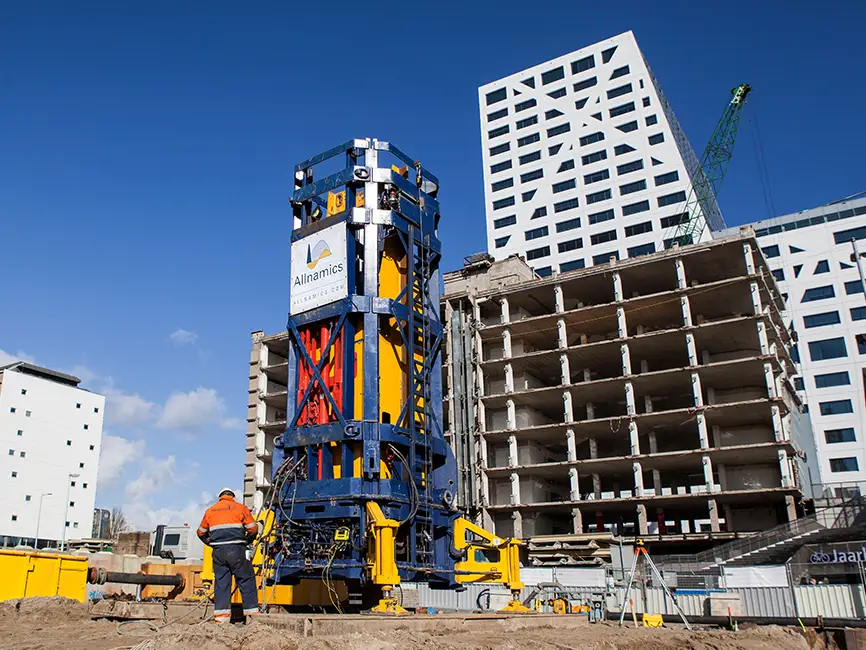
The spring-damper assembly used in some rapid load test devices, such as the StatRapid, plays an active role here. It not only extends the load duration but also reduces the peak force applied to the pile head, making the method particularly relevant for piles with lower concrete strength or uncertain structural condition.
What factors determine whether a pile is at risk during testing?
The risk to a pile during a rapid load test depends on four main factors: the structural capacity of the pile material, the quality of pile construction, the magnitude of the applied test force relative to structural limits, and the quality of the pile head preparation. A pile that is structurally sound, properly constructed, and tested within its verified capacity faces no meaningful risk of damage.
- Pile material strength: In-situ concrete piles may have lower and more variable compressive strength than precast piles. The test force must be matched to the actual concrete strength, not a nominal design value.
- Pile integrity before testing: A pile with pre-existing defects, cracks, or construction anomalies is more vulnerable. Integrity testing before the load test identifies these conditions.
- Test force calibration: The peak force applied during the test must remain within the structural capacity of the pile cross-section. This is verified during test design, not improvised on site.
- Pile head condition: An uneven or poorly prepared pile head concentrates stress and increases the risk of local damage at the point of load application.
- Soil conditions around the pile tip: Standards including ISO 22477-10 and NEN 7201:2025 specify additional conditions for rapid load tests where the soil around the pile tip may influence the test outcome. These conditions affect test validity rather than pile safety directly, but they are part of the overall risk assessment.
Cohesive soils introduce an additional consideration. Loading-rate effects mean that the soil resistance measured during a rapid load test may be higher than the resistance that would be mobilized under static loading. This does not damage the pile, but it does affect how the results are interpreted and whether a correction factor is needed to derive an equivalent static capacity.
How is pile integrity monitored during and after Rapid Load Testing?
Pile integrity is monitored through instrumentation attached to the pile during the test and through a separate integrity assessment carried out before or after loading. During the rapid load test itself, sensors measure force and velocity at the pile head throughout the load pulse. The resulting data allow engineers to identify anomalies in the pile’s response that may indicate structural issues.
Before a rapid load test, Pile Integrity Testing is commonly used to establish a baseline condition of the pile. This non-destructive method detects discontinuities, voids, or significant cross-section changes along the pile shaft. If the pre-test integrity assessment reveals a defect, the test design can be adjusted or the pile can be excluded from the test programme.
During the test, the force and displacement measurements provide a continuous record of how the pile responds to the applied load. Engineers review this data in real time and can identify unexpected behaviour, such as a sudden change in stiffness, that might indicate structural distress. After the test, the same instrumentation data is analysed in detail as part of the test report.
Post-test integrity checks can be repeated to confirm that the pile’s condition has not changed as a result of the test. In practice, when the test is designed correctly and the applied force stays within structural limits, post-test integrity results are consistent with pre-test results, confirming that the pile was not damaged during testing.
How Allnamics Supports Safe and Reliable Rapid Load Testing
We design and execute Rapid Load Testing programs that protect pile integrity from the first planning stage through to final reporting. Our approach combines decades of experience in pile testing with in-house developed equipment and analysis methods, giving your team confidence that the test delivers accurate results without exposing the pile to unnecessary risk.
When you work with us on a rapid load test program, we provide:
- Pre-test integrity assessment to establish the pile’s structural condition before any load is applied
- Test design matched to your pile type and soil conditions, including force calibration, load duration selection, and pile head preparation requirements
- On-site instrumentation and real-time data review so that any unexpected pile response is identified immediately
- Interpretation of loading-rate effects in cohesive soils, with appropriate corrections to derive equivalent static capacity
- Full reporting in line with ISO 22477-10, ASTM D7383, and NEN 7201:2025, providing a defensible record for your project documentation
- Access to the StatRapid system, our in-house developed rapid load test device that uses a spring-damper assembly to reduce peak stresses at the pile head, making it particularly suitable for large-diameter in-situ concrete piles
If you are planning a foundation testing program and want to understand whether Rapid Load Testing is the right method for your pile type and project conditions, contact our team to discuss your project in detail.