


Why is pile load testing required for offshore wind installations?
Pile load testing is required for offshore wind installations to verify that foundation piles can safely carry the structural loads imposed by turbines, towers, and environmental forces such as waves, wind, and currents. Without verified load capacity, offshore wind foundations carry unacceptable structural and financial risk. This article unpacks the specific questions project teams ask most often about pile load testing in offshore wind contexts.
What types of pile load tests are used in offshore wind projects?
Offshore wind projects use several types of pile load testing, each suited to different project phases and foundation types. The most common methods are Dynamic Load Testing (DLT, HSDT, or PDA), Static Load Testing (SLT), and Rapid Load Testing (RLT), with the choice depending on pile dimensions, site conditions, and the specific performance data required.
Dynamic Load Testing is widely used during pile installation. Different names refer to the same testing technique: High Strain Dynamic Testing (HSDT) is often used in the US, whereas Dynamic Load Testing is used in Europe. PDA, Pile Driving Analysis, is also often used, but is more related to the performance of the piling hammer and pile. In all cases, the test is based on sensors attached to the pile to measure strain and acceleration as the hammer strikes, and signal matching analysis then derives a soil model. That model is used to estimate bearing capacity, soil resistance distribution, and pile integrity. DLT is fast, cost-effective at scale, and well-suited to the large-diameter steel piles used in monopile and jacket foundations.
Static Load Testing applies a controlled, incremental load directly to the pile head and measures the displacement of the pile top under that applied load. It produces highly reliable load-settlement data and is often used as a reference test against which dynamic or rapid methods are calibrated. Offshore, SLT is logistically demanding but remains the benchmark for capacity verification.
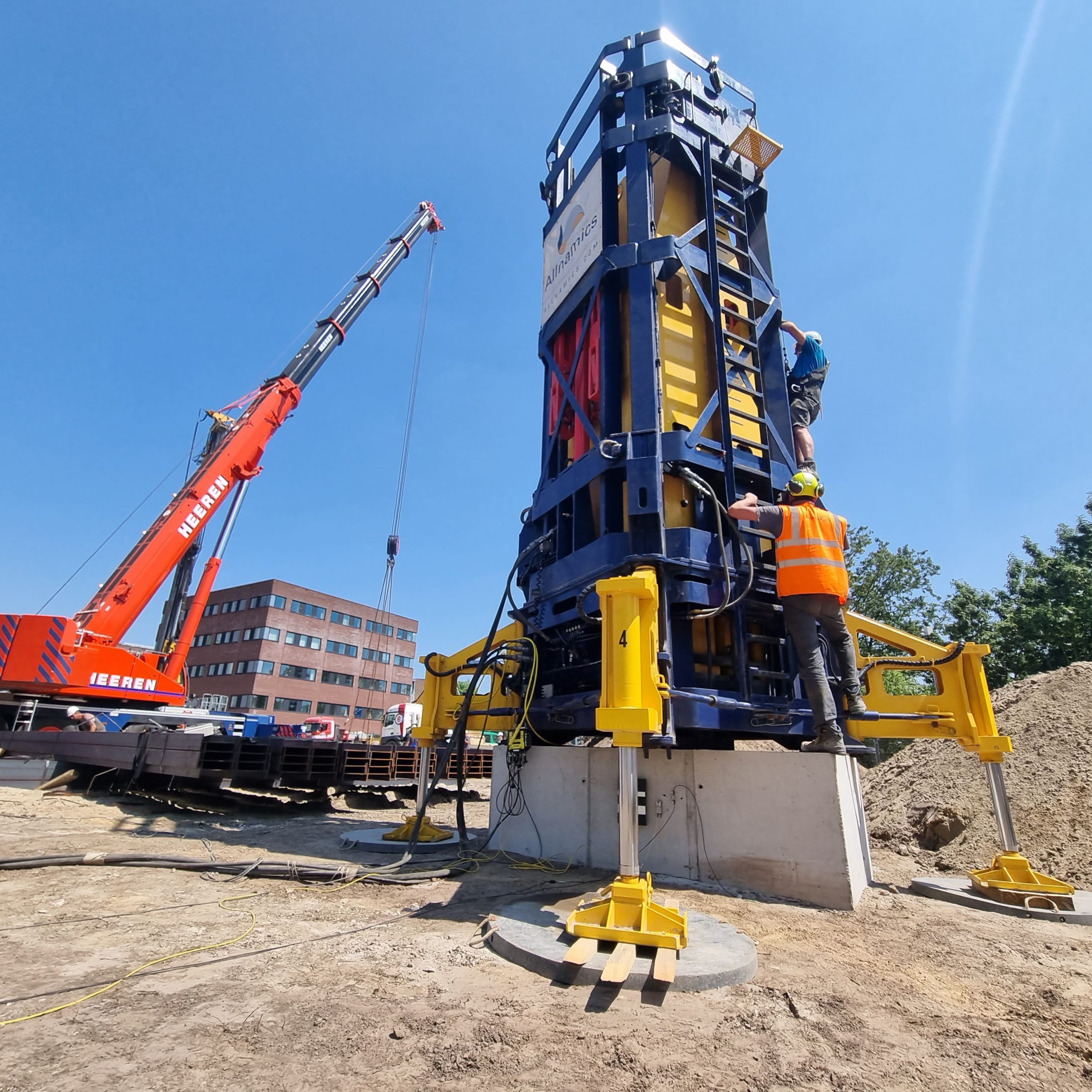
Rapid Load Testing, including Statnamic and StatRapid methods, applies a force pulse over a significantly longer duration than impact driving. As a quasi-static test method, it bridges the gap between static and dynamic approaches and is particularly useful when direct static testing is impractical offshore. All three methods can be combined within a single test program to cross-validate results and reduce uncertainty.
Why do offshore wind foundations face unique geotechnical challenges?
Offshore wind foundations face unique geotechnical challenges because they operate in highly variable seabed conditions, often in unknown or unfamiliar soils, while simultaneously carrying complex, cyclic loading from wind, waves, and tidal forces. Unlike onshore piles, offshore foundations cannot be easily inspected, modified, or retested once installed, which makes pre-installation verification far more important.
The seabed geology in offshore wind lease areas frequently varies over short distances. Sand layers, clay lenses, dense gravels, and even boulders can all appear within a single wind farm footprint. A pile design calibrated to one location may perform very differently just a few hundred meters away. Pile load testing at representative locations across the site provides design teams with the site-specific data needed to manage this variability.
What regulatory standards require pile load testing for offshore wind?
Pile load testing for offshore wind foundations is required or strongly recommended by several international standards and certification bodies. The most widely referenced frameworks include ISO 19902 for fixed steel offshore structures, DNV-ST-0126 for support structures of offshore wind turbines, and the IEC 61400-3 series covering offshore wind turbine design requirements.
DNV-ST-0126 is particularly relevant for the European and global offshore wind market. It sets out requirements for foundation design verification, including geotechnical testing programs that demonstrate pile capacity and soil-structure interaction behavior. Certification bodies such as DNV and Bureau Veritas typically require documented pile load testing results as part of the design verification package before a project can receive structural certification.
National regulatory frameworks add further requirements. In the Netherlands, Germany, the United Kingdom, and other major offshore wind markets, permitting authorities and grid operators expect geotechnical verification reports that include pile testing data. Lenders and insurers financing offshore wind projects also increasingly require independent geotechnical verification, making pile load testing a practical financing requirement as well as a regulatory one.
How does pile load testing reduce risk during offshore wind construction?
Pile load testing reduces risk during offshore wind construction by confirming that actual pile performance matches design assumptions before the full installation program proceeds. Early-stage testing identifies discrepancies between predicted and measured capacity, allowing design adjustments before they become costly construction problems.
One of the most significant risks in offshore pile installation is the difference between predicted and actual soil behavior. Geotechnical models built from site investigation data carry inherent uncertainty. If a pile is driven to a target depth but achieves lower-than-expected capacity, the project team needs to know this before installing dozens or hundreds of additional piles. A well-structured pile load testing program, carried out on early-installed piles, provides this feedback loop.
Testing during installation also enables real-time monitoring of pile integrity. Dynamic Load Testing detects damage such as cracks, section loss, or driving-induced spile damage as they occur, not after the structure is complete. This allows the installation team to adjust hammer energy, driving sequences, or even pile specifications before further damage accumulates.
From a financial risk perspective, the cost of pile load testing is small relative to the cost of foundation failure, redesign, or delayed commissioning. Offshore construction vessels, installation windows, and turbine supply chains all operate on tight schedules. Verified foundation performance protects the entire project program.
When should pile load testing be carried out on an offshore wind project?
Pile load testing should be carried out at multiple stages of an offshore wind project, starting with early design verification and continuing through installation. The timing depends on the test method, the project phase, and the specific questions the testing program is designed to answer.
- Pre-design phase: Preliminary pile testing at the site investigation stage helps calibrate soil models and refine pile design parameters before detailed engineering begins.
- Design verification phase: Load tests on trial or sacrificial piles confirm that the chosen pile type and installation method will achieve the required capacity under site-specific conditions.
- Early installation phase: Testing the first piles installed in each geotechnical zone provides real-time feedback on capacity and integrity, allowing the installation program to proceed with confidence.
- During full installation: Continuous or spot-check Dynamic Load Testing during the main installation campaign monitors consistency across the wind farm footprint and flags anomalies early.
- Post-installation verification: Final load tests confirm that the completed foundation system meets design requirements before turbine erection begins.
Projects that test only at one stage miss the opportunity to catch problems early. A phased testing program aligned with project milestones gives the most complete picture of foundation performance.
What happens if pile load testing is skipped on an offshore wind installation?
Skipping pile load testing on an offshore wind installation exposes the project to significant structural, financial, and regulatory risk. Without verified load capacity data, the design team cannot confirm that foundations will perform as intended under operational loads, and certification bodies will not issue the structural approvals needed to commission the turbines.
The designs of the foundations for offshore wind and offshore oil & gas structures have no redundancy. When a single monopile fails, there are no surrounding piles that can carry additional load from the failing pile. Load redistribution is not possible, so every single pile should perform well.
From a structural standpoint, untested foundations may have lower capacity than the design assumes. Soil conditions offshore are rarely uniform, and even high-quality site investigations carry uncertainty. If actual pile capacity falls short of design values, the turbine structure faces higher stress levels than it was designed for, which shortens fatigue life and increases the probability of foundation failure over the project’s operational lifetime.
Commercially, skipping testing rarely saves money. Discovering a foundation problem after installation is complete forces expensive remediation options: additional piles, grouted connections, or in extreme cases, complete foundation replacement. These interventions offshore are orders of magnitude more costly than a structured testing program carried out during installation.
Regulatory consequences are equally serious. Most certification frameworks treat pile load testing as a non-negotiable element of the design verification record. A project without adequate testing documentation will face delays in obtaining structural certification, which in turn delays grid connection, commissioning, and revenue generation.
How We Support Pile Load Testing for Offshore Wind Projects
Allnamics brings decades of offshore foundation experience to pile load testing programs for wind energy projects. Our teams work across the full project lifecycle, from early design verification through installation monitoring and post-installation assessment, giving your project a continuous thread of geotechnical assurance.
Here is what we provide for offshore wind pile load testing:
- Dynamic Load Testing (DLT) during installation: Real-time capacity and integrity data as each pile is driven, with immediate signal matching analysis to confirm performance against design targets.
- Rapid Load Testing and Static Load Testing: Reference tests that validate dynamic results and provide the high-confidence capacity data required for structural certification.
- Pile Driving Analysis (PDA): Continuous monitoring of driving stresses, energy transfer, and soil resistance throughout the installation campaign.
- Vibratory Driving Analysis (VDA): Continuous monitoring of driving stresses, energy transfer, hammer performance, frequencies and amplitudes, and soil resistance throughout the installation campaign for installation by means of vibratory hammers
- Drivability studies and installation prediction: Pre-installation analysis using our AllWave software to predict driving behavior, optimize hammer selection, predict possible pile runs, and reduce installation risk before the vessel mobilizes. For both impact hammers and vibratory hammers
- Independent technical review and certification support: Documentation and reporting structured to meet the requirements of DNV, Bureau Veritas, and other certification bodies.
- Offshore-capable equipment and experienced field teams: We operate onshore and offshore, with the in-house-developed equipment and sensors and logistics experience to deliver testing programs in demanding marine environments.
If your project is approaching an installation campaign or you need independent verification of foundation performance, contact us to discuss your project to discuss how we can structure a pile load testing program tailored to your specific site conditions, timeline, and certification requirements.