

What determines the penetration rate during vibratory pile driving?
The penetration rate during vibratory pile driving is controlled primarily by the balance between the energy the vibrator delivers to the pile and the resistance the surrounding soil offers at any given depth. When the vibrator generates enough dynamic force to temporarily reduce soil resistance below the combined static weight of the hammer and pile, the pile advances. Soil type, vibrator frequency, eccentric moment, displacement amplitude, and pile geometry all shape how quickly that balance tips in favor of penetration. The sections below address each of these factors in turn, along with the practical implications for drivability assessment and installation planning.
What factors control how fast a pile penetrates during vibratory driving?
Penetration rate during vibratory driving depends on the interaction between three systems: the vibrator, the pile, and the soil. The vibrator imposes continuous cyclic motion on the pile, generating displacement, velocity, and acceleration. When the resulting dynamic force is large enough to overcome soil resistance along the shaft and at the toe, the pile moves downward. The rate at which it does so reflects how effectively energy transfers through that system at each cycle.
Several factors determine the outcome simultaneously. Eccentric moment and operating frequency together define the displacement amplitude the vibrator produces. Pile geometry affects how soil resistance distributes between shaft friction and toe resistance. Soil type and layering determine how strongly and how quickly resistance builds with depth. Plug behavior in open-ended tubular piles adds another variable, since internal shaft friction and plug formation change the effective resistance the pile must overcome.
Unlike impact driving, where each hammer blow sends a discrete stress wave through the pile, vibratory driving imposes a continuous oscillation. The soil reaction in this case is a function of displacement, velocity, and acceleration simultaneously, which means simple models developed for impact driving cannot be applied directly. Realistic vibratory drivability prediction requires ground models that account for this more complex loading mechanism.
How does soil type affect vibratory pile penetration?
Soil type is one of the strongest predictors of vibratory pile penetration rate. In granular soils such as sand and gravel, cyclic motion from the vibrator disrupts the contact between soil particles, causing a temporary and often significant reduction in shear resistance along the pile shaft. This allows the pile to advance largely under the combined static weight of the hammer and pile assembly, sometimes at high penetration rates.
In cohesive soils such as clay, a greater residual strength typically remains even during vibration. Each cycle must generate enough toe displacement to push the soil past its elastic limit and produce plastic deformation. When the vibration amplitude is too small to achieve this, the soil response stays largely elastic and the pile makes little or no permanent progress downward. This is why cohesive soils are generally more difficult to penetrate with a vibratory hammer than granular soils.
It is worth noting that the resistance reduction in granular soils should not automatically be equated with liquefaction. Cyclic disturbance and a temporary drop in contact pressure and shear resistance are sufficient to explain the effect. Liquefaction can further ease penetration when it occurs, but it is not a necessary condition for vibratory driving to work effectively in sand.
Soil layering adds further complexity. As the pile advances, new soil layers come into contact with the shaft, the contact area increases, and the distribution between shaft friction and toe resistance shifts continuously. A realistic soil model for pile driving must account for this depth-dependent behavior rather than treating resistance as a fixed value.
What role do vibrator frequency and amplitude play?
Frequency and amplitude are not independent variables in vibratory driving, and neither one alone determines penetration performance. The displacement amplitude the pile experiences depends on the eccentric moment of the vibrator and its operating frequency. Two vibrators with the same nominal centrifugal force can produce very different penetration rates if their eccentric moments and frequencies differ.
A vibrator with a larger eccentric moment operating at a lower frequency will typically produce a greater displacement amplitude than one with a smaller eccentric moment running at a higher frequency, even when the peak dynamic force is comparable. In cohesive soils especially, this distinction matters: sufficient toe displacement is needed to move the soil beyond its elastic range and generate permanent penetration. A high-frequency vibrator with a small eccentric moment may fail to achieve this, while a lower-frequency unit with a larger eccentric moment succeeds.
This means that vibrator selection should not be reduced to a single centrifugal force value. The combination of eccentric moment, frequency, and the resulting amplitude must be evaluated against the soil conditions at the site. For granular soils where resistance drops sharply under cyclic loading, a wider range of vibrator configurations may work. For cohesive soils, the amplitude requirement becomes a more binding constraint on equipment selection.
Why does penetration rate slow down or stop during vibratory driving?
Penetration rate slows or stops when soil resistance at the current depth exceeds what the vibrator can overcome. This can happen for several reasons, and identifying the correct cause matters for deciding how to respond on site.
One common cause is encountering a denser or stiffer soil layer. As the pile tip enters a layer with higher resistance, the force required to maintain penetration increases. If the vibrator cannot deliver sufficient energy, the pile slows or stalls. A second cause is the gradual build-up of shaft friction as the pile goes deeper. Even if the toe resistance remains manageable, the cumulative friction along an increasingly long shaft can bring penetration to a halt.
Friction fatigue is a related but distinct phenomenon. Local shaft friction at a given soil level does not remain constant as the pile advances past it. The soil at that level undergoes repeated loading cycles, and local shear resistance can degrade toward a residual value. While friction fatigue tends to reduce shaft resistance over time, the net effect on penetration rate depends on how quickly new resistance builds at the advancing toe relative to how much is shed higher up the shaft.
Plug formation in open-ended piles can also cause a sudden increase in effective resistance. When the soil column inside the pile begins to move with the pile rather than being left behind, the pile effectively behaves as a closed-ended section, and toe resistance increases sharply. This can trigger early refusal even when the surrounding soil conditions appear favorable.
Finally, the vibrator itself may reach its operational limits. If the required force to maintain penetration exceeds what the equipment can sustain, the operator may reduce power or stop driving to avoid equipment damage, which appears as a penetration rate reduction even if the soil could theoretically be overcome with a larger or different vibrator.
How is penetration rate used to assess pile drivability?
In vibratory driving, penetration rate serves a role analogous to blow count in impact driving: it is the primary field indicator of how the pile is progressing relative to soil resistance. A high penetration rate signals that the vibrator is overcoming resistance effectively. A declining rate signals increasing resistance, and a rate approaching zero signals potential refusal.
Monitoring penetration rate continuously during installation allows the site team to detect changes in soil conditions in real time, compare actual progress against the predicted drivability profile, and make informed decisions about whether to continue, adjust vibrator settings, or switch installation methods. When field measurements are combined with a pre-installation vibratory driving prediction, deviations between predicted and actual penetration rate become diagnostic information rather than just surprises.
A well-structured drivability assessment produces a penetration rate or blow rate profile as a function of depth, not a single number. This profile shows where resistance is expected to build, where the pile may slow, and at what depth refusal becomes a realistic risk. The quality of that profile depends directly on the quality of the soil model used, including how it handles depth-dependent resistance, friction fatigue, and the specific loading mechanism of vibratory driving.
Post-installation analysis, where measured penetration data is used to back-calculate soil resistance and refine the ground model, closes the loop between prediction and reality. This updated model then improves the accuracy of future predictions in similar ground conditions.
When should vibratory driving be combined with impact driving?
Vibratory driving and impact driving are often used together on the same pile when neither method alone can complete the installation efficiently. Vibratory driving is typically faster and quieter in the upper soil layers, particularly in granular soils, making it the preferred starting method. Impact driving is then used to achieve final penetration when the vibratory hammer reaches its limits.
The most common trigger for switching is early refusal during vibratory driving: the penetration rate drops to near zero before the pile has reached its target depth. This can occur when the pile enters a dense sand layer, a cemented horizon, or a zone where plug formation has sharply increased effective toe resistance. At that point, the impact energy of a hydraulic hammer may be needed to break through the resistance and drive the pile to its final level.
A well-documented example of this combined approach involves large-diameter monopiles, where a vibratory hammer is used for initial penetration and an impact hammer completes the final meters. The transition point and the behavior of the pile during both phases provide valuable data for calibrating soil models. Signal matching during impact driving at the beginning and end of restrike, combined with the vibratory installation record, allows a comprehensive assessment of both drivability and bearing capacity.
Planning for a combined installation strategy from the outset is preferable to switching reactively on site. A drivability study that models both vibratory and impact phases, including the transition depth and the expected resistance state when impact driving begins, gives the project team a clearer picture of equipment requirements, installation duration, and refusal risk before mobilization.
How We Support Vibratory Pile Driving Prediction and Drivability Studies
At Allnamics, we provide drivability studies and vibratory driving predictions that go beyond producing a single penetration rate curve. Our approach covers the full installation process, from initial soil model development through installation monitoring and post-analysis, so that each project builds on real field data rather than assumptions alone.
Our support for vibratory pile driving projects includes:
- Vibratory and impact drivability predictions using advanced wave-based simulation, accounting for depth-dependent soil resistance, friction fatigue, and the specific loading mechanism of vibratory driving
- Vibrator selection guidance based on eccentric moment, frequency, and amplitude requirements matched to your soil conditions and pile geometry
- Combined vibratory and impact installation planning, including transition depth assessment and refusal risk quantification
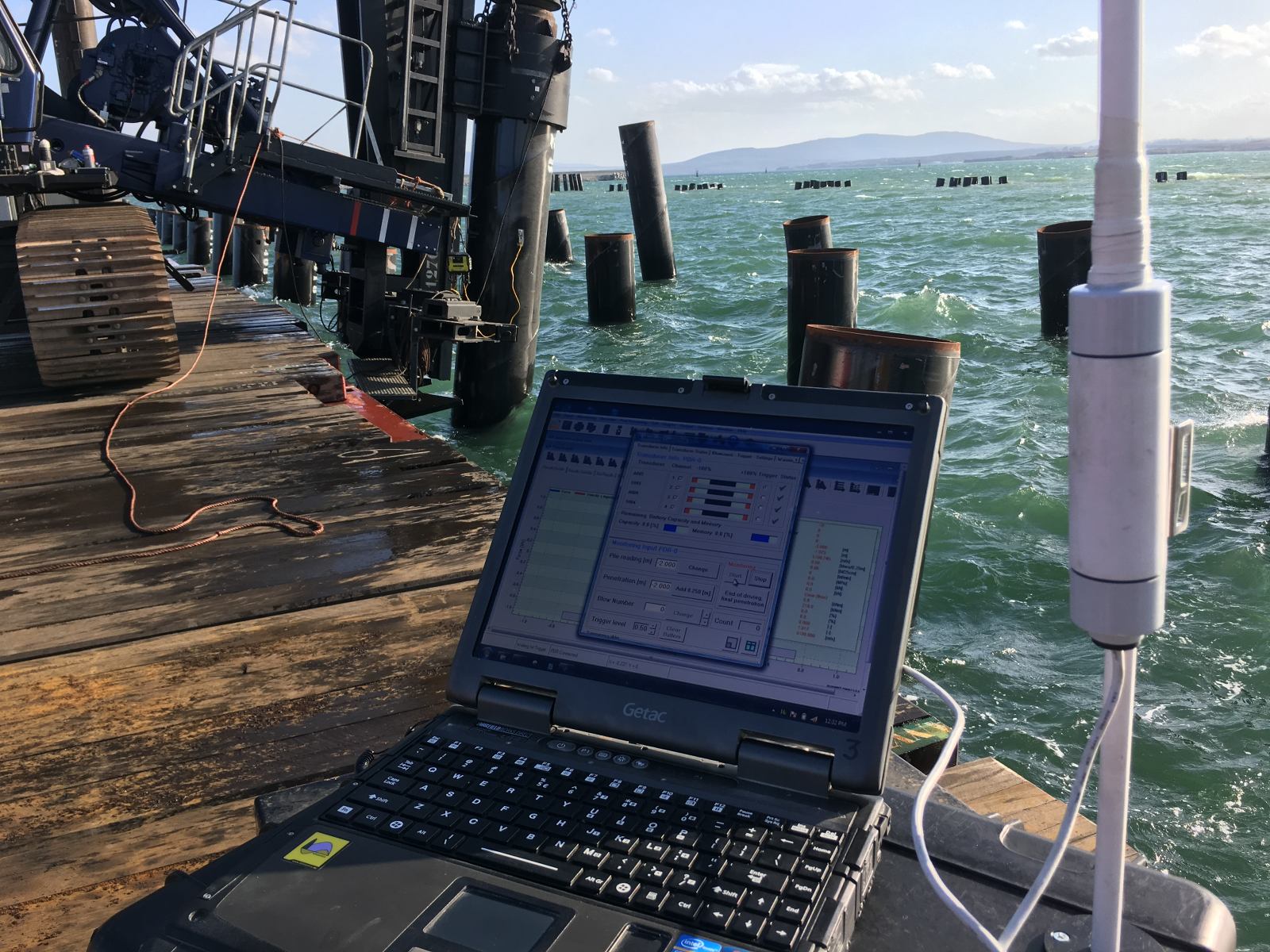
- Installation monitoring during vibratory and impact driving phases, providing real-time penetration data that can be compared directly against the predicted drivability profile
- Post-installation signal matching and back-analysis to refine soil models and improve prediction accuracy for future piles on the same project or similar ground conditions
- Access to the AllWave software package, which simulates hammer-pile-soil interaction for both impact and vibratory driving and produces blow count, penetration rate, stress, and energy transfer results as a function of depth
If your project involves complex soil conditions, large-diameter piles, offshore installation, or uncertainty about whether your vibrator can reach target penetration, we can help you quantify the risk before mobilization and monitor performance during installation. Contact us to discuss your drivability study requirements.
Related Articles
- What is the difference between Rapid Load testing and Static Load testing?
- What is the environmental impact of Rapid Load Testing?
- Is the Rapid Load testing better than Dynamic Load testing?
- How are strain sensors installed inside monopiles for monitoring?
- What are the benefits of pile load testing for offshore foundations?