

What causes early refusal during pile installation?
Early refusal during pile installation occurs when a pile stops advancing before reaching its design depth, typically because the driving resistance exceeds what the hammer can overcome. This can result from dense soil layers, obstructions, plug formation inside open-ended piles, or incorrect hammer selection. Understanding the root cause determines whether installation can continue and what remedial action is needed.
The following sections address the most common questions engineers face when a pile refuses prematurely, from identifying the cause to deciding on the right response.
What are the most common causes of premature pile refusal?
Premature pile refusal happens when the Soil Resistance to Driving (SRD) exceeds the energy the hammer can deliver to the pile tip. The most frequent causes are encountering a dense sand or gravel layer, hitting a boulder or other obstruction, plug formation in open-ended steel tubes, and selecting a hammer that is too small for the ground conditions. Each cause produces a different blow count signature and requires a different response.
Dense granular layers are the most common culprit in onshore installations. As a pile penetrates into dense sand or gravel, the toe resistance rises sharply and the blow count climbs toward refusal within a short penetration interval. Boulders and cobbles create a sudden, near-instantaneous refusal that is difficult to predict from standard soil investigation data alone.
Plug formation is particularly relevant for large-diameter open-ended steel tube piles. As the pile is driven, the soil column inside the tube can become compressed and start moving with the pile rather than being displaced. Once the internal soil plug mobilizes sufficient friction against the inner wall, the pile effectively behaves as a closed-ended section, dramatically increasing toe resistance. This is a well-recognized mechanism in offshore pile installation.
Hammer underperformance is another cause that is sometimes overlooked. If the hammer delivers less energy than assumed in the design, the pile may refuse at a depth where a correctly performing hammer would have continued. Monitoring transferred energy during installation helps separate a genuine soil-driven refusal from a hammer-driven one.
How does soil stratigraphy contribute to unexpected refusal?
Unexpected refusal is most often a consequence of soil stratigraphy that was not fully captured in the site investigation. Thin dense layers, lenses of cemented material, and lateral variability between borehole or CPT locations can all create driving conditions that differ significantly from what the design assumed. When the pile encounters a layer that was absent or underrepresented in the soil model, refusal can occur without warning.
Friction fatigue adds an important layer of complexity. As a pile penetrates deeper, the local shaft friction at any given depth does not remain constant. Research by Alm and Hamre demonstrated that as the pile tip moves past a soil horizon, the local shaft resistance at that horizon gradually decreases toward a residual value. Models that ignore friction fatigue tend to overestimate SRD at depth, particularly for long piles, which can lead to either overly conservative hammer selection or, conversely, underestimation of refusal risk in specific layers.
Chalk is a particularly challenging material in this regard. Low-to-medium density chalk shows highly variable field behavior, with some piles penetrating freely while others refuse at shallow depth. Standard SRD methods developed for sand and clay do not transfer reliably to chalk. Work by Buckley, Kontoe, Jardine, and co-authors established that chalk requires its own approach, linking cone penetration resistance to a Chalk Resistance to Driving parameter and accounting for the reduction in local stress as driving progresses.
The practical implication is that a driveability prediction is only as reliable as the soil model behind it. Where CPT data are available, connecting driveability parameters directly to measured cone resistance reduces the uncertainty introduced by intermediate interpretation steps.
What is the difference between true refusal and false refusal?
True refusal means the pile has genuinely reached a condition where further penetration is not achievable with the available hammer, because the SRD permanently exceeds deliverable energy. False refusal is a temporary condition where driving resistance spikes due to a recoverable mechanism, and penetration can resume after a waiting period or a change in driving procedure.
The most common cause of false refusal is pore pressure buildup in fine-grained or low-permeability soils. During rapid driving, excess pore pressures develop around the pile, temporarily increasing effective stress and resistance. After a rest period, pore pressures dissipate, effective stress drops, and driving can resume. This is sometimes called a “set-up” effect in reverse, where the soil temporarily stiffens during installation rather than after.
Residual stresses locked into the pile from previous blows can also produce misleading blow counts at the start of a new driving session, creating the appearance of refusal when the pile would in fact advance if driving continued. Experienced engineers recognize this pattern from the blow count trend and the behavior of the pile under the first few blows after a pause.
Distinguishing true from false refusal matters because the remedial actions are completely different. Acting on a false refusal with aggressive measures, such as switching to a larger hammer or attempting soil removal, can damage the pile or alter its bearing capacity unnecessarily.
How can dynamic load testing detect the cause of early refusal?
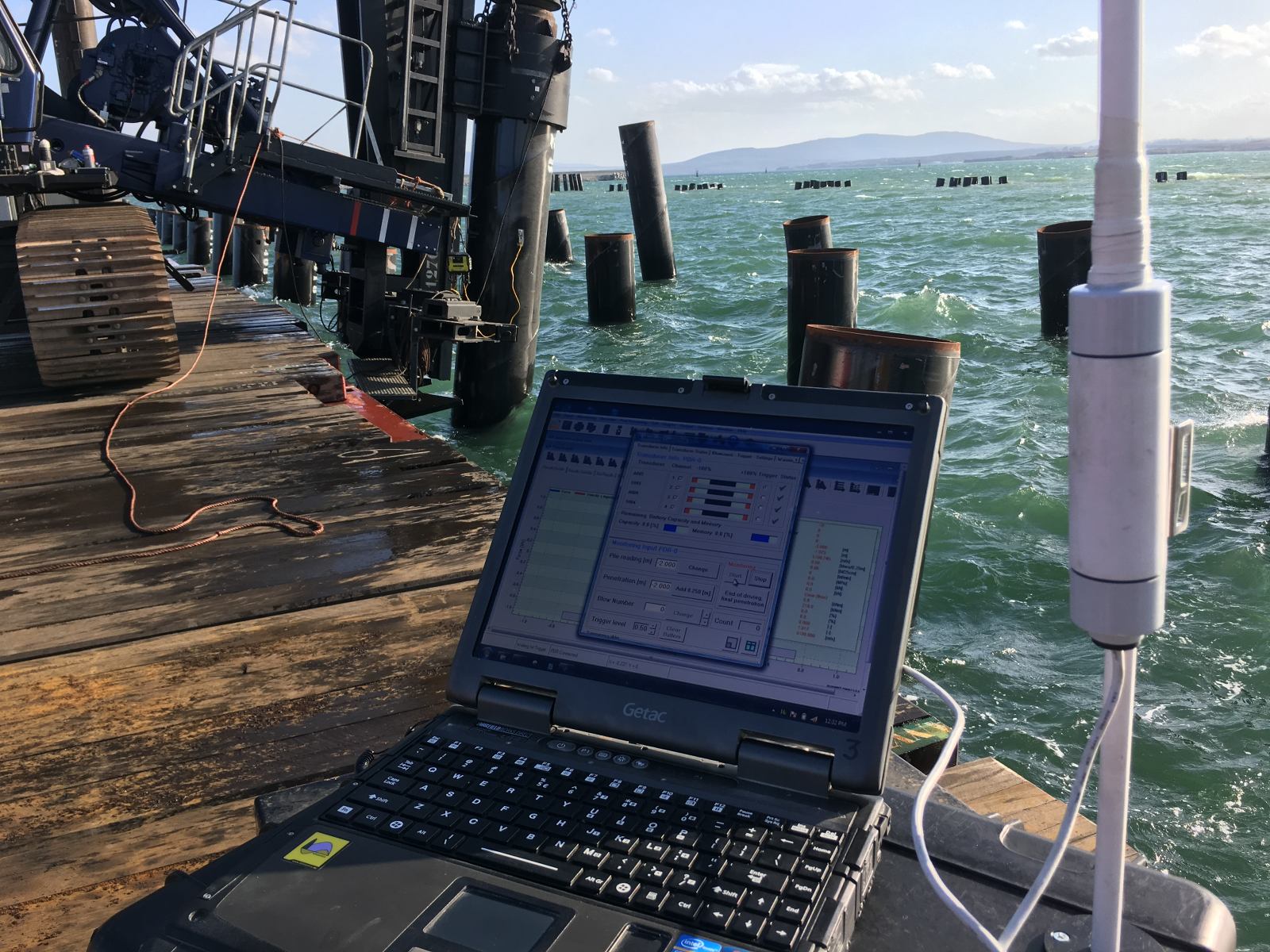
Dynamic Load Testing (DLT) during or immediately after a refusal event provides direct measurement of the forces, velocities, and energy transfer at the pile head, which allows engineers to determine whether the resistance is coming from the shaft, the toe, or from hammer underperformance. This makes it one of the most effective diagnostic tools available when a pile stops advancing before design depth.
During a refusal condition, DLT measurements capture the stress wave traveling down the pile and the reflections returning from the toe and along the shaft. A strong, early compressive reflection from the toe indicates high toe resistance, consistent with encountering a dense layer or obstruction. A distributed pattern of reflections along the shaft points to high shaft friction as the dominant mechanism. If the transferred energy is low relative to the rated hammer energy, the data suggest the hammer is not performing as expected rather than the soil being the limiting factor.
Signal matching analysis, applied to the DLT data, refines this picture further. By adjusting a soil resistance model until the calculated response matches the measured signal, engineers can derive a quantitative SRD profile at the moment of refusal. This information directly informs the decision about whether to continue driving, change the hammer, or accept the achieved penetration depth.
DLT also records compressive and tensile stresses in the pile during the refusal blows. If the pile is being driven hard against a high-resistance layer, stress levels may approach or exceed material limits, and this data provides an objective basis for deciding when to stop rather than relying on judgment alone.
What should engineers do when a pile refuses before reaching design depth?
When a pile refuses prematurely, the first step is to diagnose the cause before taking any remedial action. Acting without understanding whether the refusal is true or false, soil-driven or hammer-driven, risks damaging the pile, altering its capacity, or wasting time and cost on measures that will not work.
A structured response typically follows this sequence:
- Stop driving and assess: Record the exact depth, blow count trend, and any available monitoring data. Do not continue driving blindly against high resistance.
- Check hammer performance: Verify that the hammer is delivering the expected energy. Low transferred energy is a common and correctable cause of apparent refusal.
- Allow a rest period: If the soil is fine-grained, wait for pore pressure dissipation and attempt re-driving. A significant reduction in blow count after waiting indicates false refusal.
- Conduct dynamic load testing: Use DLT to measure actual SRD, stress levels, and energy transfer. This provides the data needed to make an informed decision.
- Evaluate remedial options: Based on the diagnosis, consider options such as using a larger or more energetic hammer, pre-drilling or soil removal, or accepting the achieved depth and reassessing the foundation design.
Remedial actions carry their own risks. Switching to a heavier hammer increases driving energy but also raises compressive and tensile stresses in the pile. For concrete piles in particular, excessive tensile stress from stress wave reflections can cause cracking. Any change in hammer or driving procedure should be evaluated against pile stress limits, not just penetration performance.
If the pile cannot reach design depth despite reasonable remedial efforts, a structural reassessment of the foundation is needed. The achieved capacity at the actual penetration depth must be evaluated, and the design team must determine whether additional piles, a modified pile arrangement, or an alternative foundation solution is required.
How Allnamics Helps with Early Pile Refusal
We support engineers and contractors at every stage of the refusal problem, from pre-installation prediction to on-site diagnosis and remedial decision-making. Our approach combines advanced numerical analysis with direct field measurement, so you get answers grounded in both the soil model and real driving data.
- Driveability predictions before installation: Using AllWave-PDP and AllWave-VDP, we simulate the full installation process, including blow count, stress levels, energy transfer, and refusal risk at each penetration depth. This lets your team identify problematic layers in advance and select the right hammer before mobilization.
- Soil modeling directly from CPT data: We link driveability parameters as directly as possible to measured CPT values, reducing uncertainty from intermediate interpretation steps and producing more reliable SRD profiles.
- Friction fatigue modeling: Our analyses account for friction degradation along the shaft, which is important for long piles and offshore installations where standard models can significantly misrepresent driving resistance at depth.
- Dynamic Load Testing during and after refusal: We perform DLT on site to measure actual forces, velocities, energy transfer, and pile stresses at the moment of refusal. Signal matching analysis then quantifies the SRD distribution and helps identify whether the cause is toe resistance, shaft friction, or hammer performance.
- Remedial action assessment: We evaluate the pile stress implications of any proposed remedial measure, including larger hammers or changed driving procedures, so you can act without risking pile damage.
- Specialist support for difficult ground conditions: We have experience with challenging materials including chalk, layered offshore stratigraphy, and variable onshore ground, where standard methods are least reliable.
If your project is facing early refusal or you want to reduce that risk before installation begins, contact our team to discuss how we can support your driveability analysis and on-site testing program.