

How can pile drivability in chalk be predicted?
Pile drivability in chalk can be predicted using one-dimensional stress wave analysis, which simulates the interaction between the hammer, pile, and soil at each stage of installation. The prediction models how chalk behaves under repeated impact, accounting for its tendency to degrade rapidly during driving. Because chalk is one of the most unpredictable formations in foundation engineering, a reliable drivability study must combine high-quality geotechnical data, calibrated soil resistance models, and sensitivity analyses that reflect the full range of possible ground conditions. The sections below address the most common questions engineers face when planning pile installation through chalk.
Why is chalk such a challenging formation for pile driving?
Chalk is challenging for pile driving because it behaves inconsistently under dynamic loading. Unlike dense sand or stiff clay, chalk can appear to offer high resistance initially, then degrade rapidly as driving progresses, causing unpredictable changes in blow count and pile penetration. This makes it difficult to distinguish between genuine refusal and temporary resistance build-up.
Chalk is a weak, porous carbonate rock with a structure that breaks down under repeated hammer blows. As the pile advances, the chalk around the shaft and at the toe is remoulded and crushed, reducing its strength significantly. This process, known as chalk degradation, means that the soil resistance to driving (SRD) can drop substantially during installation, even when the intact chalk appeared competent in the site investigation.
The challenge is compounded by the variability of chalk across a site. Density, porosity, and degree of weathering can change over short distances, meaning that conditions encountered at one pile location may not represent what the next pile will face. Chalk also has a tendency to form a plug or slurry around the pile toe, which can either reduce resistance temporarily or cause unexpected refusal at shallow depths.
For engineers planning pile installation in chalk, these characteristics mean that a standard drivability approach based on conservative SRD assumptions is rarely sufficient. The prediction must explicitly model degradation, account for uncertainty in chalk properties, and evaluate a range of resistance scenarios rather than a single nominal case.
What methods are used to predict pile drivability in chalk?
The primary method for predicting pile drivability in chalk is one-dimensional stress wave analysis, which simulates how a hammer impact travels through the pile and interacts with the surrounding soil at each penetration increment. This approach models the full installation sequence, producing blow count, pile stresses, energy transfer, and penetration resistance as functions of depth.
In practice, this means running a wave equation analysis for each penetration level from the start of driving to the target depth. The analysis couples four components: the hammer and its energy delivery system, the helmet and cushion, the pile itself, and the depth-varying soil resistance. At each step, the model calculates whether the available driving energy can overcome the soil resistance while keeping pile stresses within acceptable structural limits.
Impact driving prediction
AllWave-PDP (Pile Driving Prediction) is the tool used for impact driving scenarios. It simulates the hammer-pile-soil system and produces results including blow count versus penetration depth, maximum compression and tension stresses, energy transfer to the pile head, and refusal risk at specific depths. For chalk, this type of analysis is particularly valuable because it can reveal at which depth degradation effects are likely to cause a significant drop in resistance, and where refusal risk is highest.
Vibratory driving prediction
Where vibratory installation is being considered, AllWave-VDP (Vibratory Driving Prediction) applies the same stress wave framework to model the continuous oscillation of a vibratory hammer. Chalk can respond differently to vibratory driving than to impact driving, and the prediction must reflect this. The AllWave Software Package covers both impact and vibratory scenarios within a single modelling environment, allowing engineers to compare installation strategies before mobilising equipment.
Both methods rely on sensitivity analyses to account for uncertainty in chalk properties. Rather than producing a single predicted blow count curve, a robust drivability study presents a range of outcomes corresponding to realistic variations in SRD, damping parameters, and hammer efficiency.
How does chalk degradation affect drivability predictions?
Chalk degradation directly reduces the soil resistance to driving as installation progresses, which means the predicted blow count can decrease significantly with depth rather than increasing as it would in most other formations. If degradation is not modelled correctly, the prediction will overestimate resistance and may incorrectly flag refusal risk at depths where the pile will actually drive freely.
The degradation process works as follows: intact chalk has a measurable unconfined compressive strength, but repeated hammer blows break down the structure of the chalk around the pile. The remoulded material has a much lower strength than the intact rock, and this remoulded zone grows with each blow. The result is that shaft friction and toe resistance both decrease as driving continues, a behaviour that must be captured in the SRD model.
In practice, this is handled by applying friction fatigue factors to the shaft resistance profile. These factors reduce the unit shaft friction at shallower depths as the pile advances, reflecting the accumulated degradation from earlier driving. The choice of friction fatigue model and its parameters has a significant influence on the predicted blow count profile, which is why sensitivity analyses around these parameters are particularly important in chalk.
Degradation also affects the interpretation of field measurements during installation. A pile that drives easily through chalk is not necessarily under-designed; it may simply reflect the expected reduction in resistance due to remoulding. Understanding this distinction helps your team avoid unnecessary concern during installation and supports better decision-making if driving behaviour deviates from the prediction.
What geotechnical data is needed for a chalk drivability study?
A chalk drivability study requires geotechnical data that characterises both the intact properties of the chalk and its likely behaviour under dynamic loading. The minimum dataset includes cone penetration test (CPT) results, borehole logs, and laboratory data on chalk density, porosity, and unconfined compressive strength. Without this information, the SRD model cannot be calibrated reliably.
The following data types are most relevant for building a chalk soil model:
- CPT data: Provides continuous cone resistance and sleeve friction profiles, which form the basis for deriving unit shaft friction and toe resistance in the wave equation model
- Borehole logs and core samples: Identify chalk grade, weathering profile, and layer boundaries, which are important for understanding where degradation is most likely to occur
- Laboratory strength tests: Unconfined compressive strength and point load index tests quantify intact chalk strength and help calibrate the SRD reduction factors
- SPT data (where available): Useful as a secondary check on resistance profiles, particularly in weathered chalk zones
- Water table and pore pressure data: Chalk is often saturated, and pore pressure conditions influence both intact strength and post-driving set-up behaviour
The quality of the drivability prediction is directly limited by the quality of this input data. Where site investigation data is sparse or the chalk profile is variable, the uncertainty band around the predicted blow count will be wide. In these cases, the sensitivity analysis becomes the most informative part of the study, showing which outcomes remain consistent across the range of plausible ground conditions and which conclusions depend heavily on assumptions that cannot yet be verified.
How can dynamic load testing improve chalk drivability assessments?
Dynamic load testing (DLT) improves chalk drivability assessments by providing measured data on actual hammer-pile-soil interaction during installation, which can then be used to back-analyse the real SRD and calibrate the prediction model. This turns the drivability study from a forward prediction into a continuously updated assessment that improves as installation proceeds.
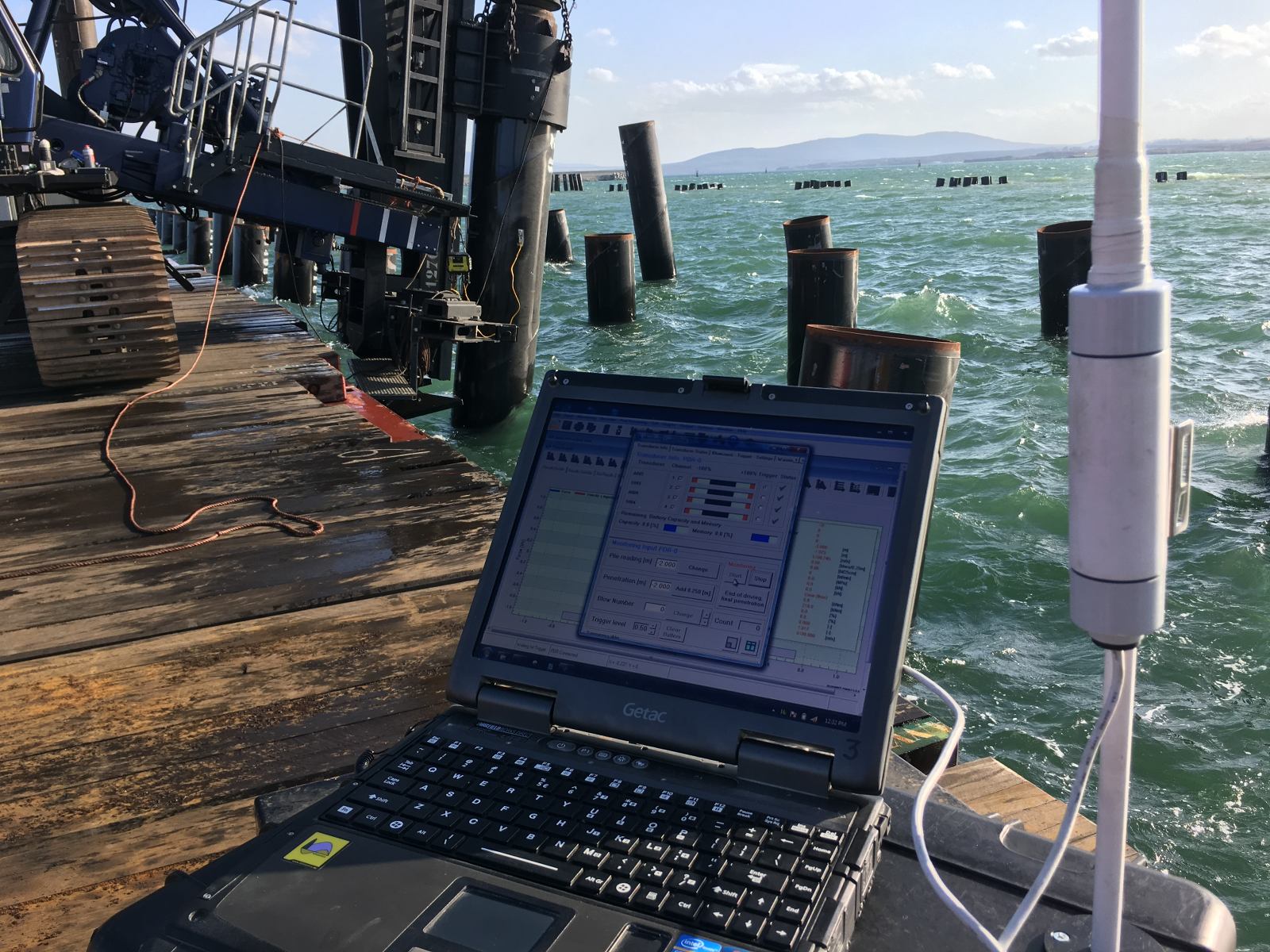
During driving, sensors attached to the pile measure force and velocity at the pile head with each hammer blow. These measurements capture how much energy is actually transferred to the pile, what the total soil resistance is at that moment, and how resistance is distributed between shaft friction and toe resistance. In chalk, where degradation can cause resistance to evolve in ways that are difficult to predict in advance, this real-time data is particularly valuable.
The measured signals are processed using signal matching, a technique in which the wave equation model is adjusted iteratively until its output matches the field measurements. The result is a back-calculated SRD profile that reflects actual chalk behaviour at that pile and penetration depth. If this back-calculated resistance differs significantly from the original prediction, the model can be updated before driving the next pile, reducing installation risk across the remainder of the programme.
Dynamic load testing also provides direct evidence of pile integrity during driving, which is relevant in chalk because the variable resistance can generate unexpected tension stresses that may damage the pile. Monitoring these stresses in real time allows your team to adjust hammer energy or driving procedure before damage occurs.
When should a chalk drivability study be commissioned?
A chalk drivability study should be commissioned during the design phase, before equipment selection and procurement. Commissioning the study early gives your team the information needed to select an appropriate hammer, evaluate alternative pile types, and identify installation risks before they become construction problems.
The earlier the study is completed, the more influence it can have on project decisions. At the design stage, the results can inform pile geometry, wall thickness, and structural stress limits. During procurement, the blow count and energy transfer predictions determine which hammer specifications are adequate for the expected chalk conditions. If the study is delayed until construction is underway, the options for responding to unexpected behaviour are more limited and more expensive.
There are also specific project milestones that trigger the need for a drivability study:
- Before tender: A preliminary study based on available site investigation data helps contractors price installation risk accurately
- After site investigation: A detailed study using the full geotechnical dataset refines the prediction and supports final equipment selection
- Before each installation campaign: If chalk conditions vary across the site, the study should be updated as new CPT or borehole data becomes available
- After the first pile is driven: Back-analysis of the first installation provides calibration data that improves predictions for subsequent piles
In chalk specifically, the cost of early refusal or pile damage during installation can be significant. Remedial measures such as switching to a larger hammer, pre-drilling, or soil removal are all more expensive than a well-timed drivability study that anticipates these risks in advance.
How Allnamics Supports Chalk Drivability Predictions
We carry out chalk drivability studies using our in-house AllWave software, combining stress wave analysis with geotechnical modelling and engineering judgement developed over decades of pile installation projects in variable and difficult ground conditions. Our approach treats drivability prediction as an iterative process, not a one-off calculation.
When your project involves pile driving in chalk, we provide:
- AllWave-PDP and AllWave-VDP analyses covering both impact and vibratory driving scenarios, with results presented as blow count, pile stresses, energy transfer, and refusal risk as functions of penetration depth
- Soil resistance to driving (SRD) modelling based on CPT, SPT, and laboratory data, with friction fatigue factors calibrated to chalk degradation behaviour
- Sensitivity analyses that quantify how the predicted blow count changes across realistic variations in chalk properties, hammer efficiency, and damping parameters
- Dynamic load testing during installation to measure actual hammer-pile-soil interaction, back-analyse real SRD, and update the prediction model in real time
- Signal matching and back-analysis after the first pile is driven, providing calibrated input for the remainder of the installation programme
- Independent technical review of existing drivability studies where a second opinion is needed before committing to an installation strategy
Our work does not stop at producing a blow count graph. We help you understand what the results mean for your specific hammer, pile, and site conditions, and we stay involved through installation to ensure the prediction is tested against reality and updated where needed.
If you are planning pile installation in chalk and want a drivability assessment that gives your team a clear, defensible basis for equipment selection and risk management, contact us to discuss your project.
Related Articles
- Why is pile driving in dense sand challenging?
- How can pile installation time be estimated with a Drivability Prediction?
- How can a Drivability Prediction reduce the risk of early refusal?
- Why is soil damping important in a Drivability Prediction?
- How is pile testing data used to optimise foundation design?