

How can pile installation time be estimated with a Drivability Prediction?
A drivability prediction estimates pile installation time by calculating the number of hammer blows needed to reach the target penetration depth at each stage of driving, then converting that blow count into time based on the hammer’s operating rate. The result gives your project team a concrete forecast of how long installation will take, which hammer is appropriate, and where delays or refusal risk may occur. The sections below unpack the key questions engineers ask when commissioning or interpreting a drivability study.
What factors determine how long pile installation takes?
Pile installation time is primarily determined by the blow count per unit of penetration: how many hammer strikes are needed to advance the pile through each soil layer. A high blow count means slow progress; a low blow count means faster driving. The total installation time combines this blow count with the hammer’s strike rate, the number of pile segments, and any interruptions for splicing, repositioning, or waiting on weather.
Several interacting factors drive the blow count at any given depth:
- Soil resistance to driving (SRD): The combined shaft friction and toe resistance the pile must overcome with each blow. Stiffer or denser layers produce higher resistance and slower penetration.
- Pile geometry and material: A longer, heavier pile with a larger cross-section transfers stress waves differently than a slender pile, affecting how efficiently each blow translates into penetration.
- Hammer type and energy: The rated energy of the hammer, its efficiency, and the cushion or helmet system all determine how much energy actually reaches the pile head per blow.
- Friction fatigue: As a pile penetrates deeper, shaft friction along already-driven sections can reduce over time due to remoulding of the surrounding soil, which can either ease or complicate driving depending on soil type.
- Layered soil profiles: Transitions between soft and hard layers, or the presence of intermediate dense layers, can create sudden changes in blow count that significantly affect the installation schedule.
For vibratory driving, the governing factors shift slightly. Penetration rate depends on the vibrator’s frequency, eccentric moment, and the soil’s response to cyclic loading rather than discrete blow counts. However, the underlying principle remains the same: soil resistance controls how quickly the pile advances.
How does a drivability prediction calculate pile installation time?
A drivability prediction calculates installation time by simulating the stress wave propagation through the hammer-pile-soil system for each blow at successive penetration depths. The simulation determines the permanent set, the net downward movement per blow, and from that derives the blow count needed to advance through each soil layer. Dividing total blows by the hammer’s operating rate produces an estimated installation duration.
The core calculation chain follows this logic:
- The hammer strikes the pile head, generating a compressive stress wave.
- The wave travels down the pile, interacting with the soil along the shaft and at the toe.
- Reflected waves return upward, and the combined response determines how much the pile moves permanently downward, the set per blow.
- The inverse of the set gives the blow count per metre of penetration at that depth.
- This process repeats at each penetration increment, building a complete blow count versus depth profile.
- Dividing blow counts by the hammer’s blows per minute converts the profile into an installation time estimate.
Tools such as AllWave-PDP perform this simulation for impact driving, while AllWave-VDP applies the same wave-equation framework to vibratory driving. Both approaches simultaneously check pile stresses, energy transfer, and hammer behaviour, so the installation time estimate is produced alongside a full assessment of pile integrity and equipment performance, not as an isolated output.
What input data is needed for a reliable drivability study?
A reliable drivability study requires accurate data in three categories: soil conditions, pile properties, and hammer system characteristics. Gaps or assumptions in any of these categories introduce uncertainty into the blow count and installation time forecast. The quality of the output is directly limited by the quality of the input.
Soil and geotechnical data
Cone penetration test (CPT) data is the most common foundation for building the soil resistance model. CPT profiles allow engineers to derive layer-by-layer shaft friction and toe resistance estimates, which are then translated into a soil resistance to driving (SRD) profile. SPT data and laboratory test results can supplement or replace CPT data where necessary. The soil model must account for dynamic effects, including rate-dependent resistance and the potential for remoulding, not just static capacity values.
Pile and hammer system data
The pile model requires geometry (length, diameter, wall thickness), material properties (elastic modulus, density, yield strength), and any cross-section changes along the pile. The hammer model requires rated energy, ram mass, stroke or drop height, efficiency, and a description of the helmet, cushion, and any follower. Inaccurate hammer efficiency assumptions are a common source of discrepancy between predicted and actual blow counts, so realistic values based on equipment specifications and field experience matter considerably.
How accurate are drivability predictions in practice?
Drivability predictions are engineering forecasts with explicit uncertainties, not deterministic guarantees. In practice, predictions based on good-quality CPT data and well-characterised hammer systems typically capture the general shape of the blow count profile, identifying hard driving zones, refusal risk, and relative installation speed, with reasonable accuracy. Exact blow counts at specific depths will vary depending on actual soil variability and hammer performance on the day.
The most important sources of uncertainty include:
- Variability in soil resistance between investigation points
- Actual hammer efficiency versus assumed efficiency
- Cushion behaviour and degradation during driving
- Friction fatigue effects that are difficult to quantify in advance
- Local impedance changes along the pile
For this reason, a single nominal run is less informative than a sensitivity analysis that tests lower-bound, best-estimate, and upper-bound soil resistance scenarios. This approach shows which conclusions remain stable across the range of plausible conditions and where the prediction carries more risk. A well-structured drivability study presents these scenarios explicitly rather than offering a single number as the answer.
Accuracy also improves over time through a learning loop: predictions made before installation are compared against monitoring data collected during driving, and the soil model is updated accordingly. This back-analysis process makes each subsequent prediction more reliable and turns installation data into a technical asset for future projects.
When should a drivability study be carried out in a project?
A drivability study should be carried out before the hammer and pile system are finalised, ideally during the design phase, when there is still time to adjust pile dimensions, select a more appropriate hammer, or revise the installation strategy. Conducting the study at this stage prevents costly mismatches between the chosen equipment and the actual soil conditions.
There are several points in a project lifecycle where a drivability study adds practical value:
- Tender and procurement stage: Helps contractors assess whether their available equipment can install the specified pile, and supports realistic scheduling and cost estimation.
- Design verification stage: Confirms that the pile design is installable without exceeding structural stress limits, and identifies any layers where refusal risk is significant.
- Pre-installation planning: Provides the project team with a blow count profile and installation time estimate to plan logistics, vessel time (for offshore projects), and contingency measures.
- After unexpected site conditions: If ground investigation reveals conditions that differ from earlier assumptions, an updated drivability study helps reassess the installation plan before driving begins.
Starting a drivability study late, after equipment has been mobilised or contracts signed, limits the options available if the results reveal a problem. Early analysis preserves flexibility and reduces the risk of expensive remediation during construction.
How does drivability prediction support pile monitoring during installation?
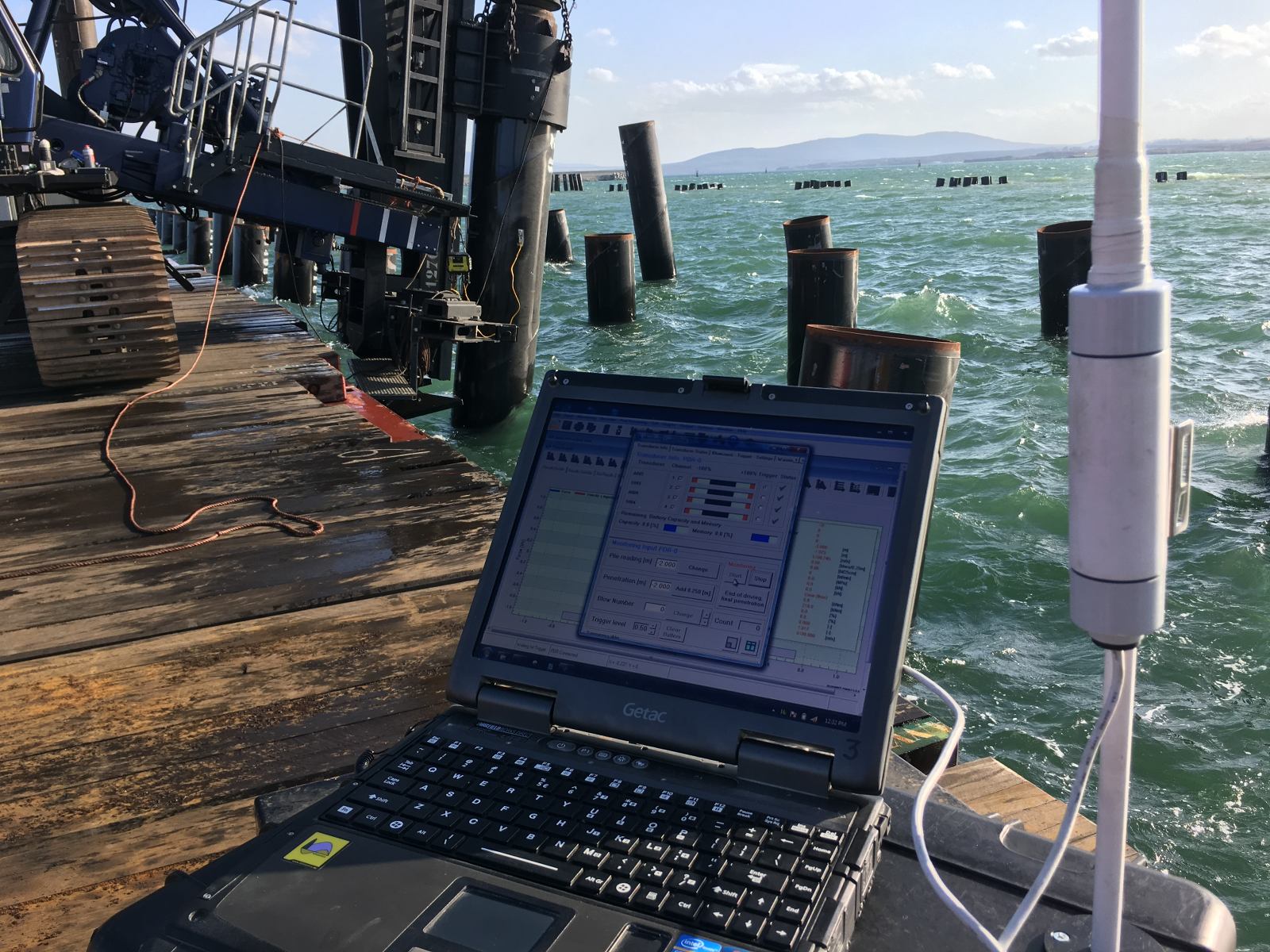
A drivability prediction supports pile monitoring by providing a reference baseline against which actual driving behaviour can be compared in real time. When measured blow counts, stresses, and energy transfer values match the prediction, the installation is proceeding as expected. When they diverge, the monitoring data signals that something in the soil model, hammer performance, or pile behaviour needs investigation.
This connection between prediction and monitoring creates a closed learning loop. The workflow runs as follows: the initial soil model produces a drivability prediction; during installation, sensors measure actual hammer performance, pile response, and penetration rate; post-analysis (signal matching) compares measured signals against the model; and the soil model is updated to reflect what the data reveals. The updated model then improves the accuracy of future predictions on the same project or similar ground conditions.
For vibratory driving, the same principle applies. Monitoring data collected during vibratory installation can be used to back-calculate a more accurate soil model, which in turn refines the prediction for the impact driving phase that often follows when vibratory methods reach their penetration limit. This combined approach, vibratory monitoring followed by impact driving analysis, gives project teams a much clearer picture of actual soil behaviour than ground investigation data alone can provide.
The practical benefit for your project team is that monitoring transforms the drivability prediction from a one-time pre-installation document into an active engineering tool. Deviations from the prediction are not just anomalies to explain; they are information that improves decision-making during installation and builds a more reliable experience database for future work.
How Allnamics Supports Your Drivability Prediction
We provide drivability studies and pile installation analysis for onshore and offshore projects, combining wave-equation modelling with decades of practical installation experience. Our approach covers the full cycle from initial prediction through installation monitoring and post-analysis, so your project benefits from a continuously refined soil model rather than a static pre-installation estimate.
Here is what we deliver as part of a drivability study:
- Blow count and installation time forecast: A depth-by-depth profile showing expected blow counts, penetration rates, and total installation duration for your chosen hammer and pile combination.
- Pile stress analysis: Simultaneous assessment of compressive and tensile stresses throughout the pile during driving, checked against structural limits.
- Hammer and equipment evaluation: Assessment of whether your selected hammer can deliver sufficient energy to reach target penetration without overstressing the pile.
- Sensitivity analysis: Lower-bound, best-estimate, and upper-bound scenarios to quantify how soil variability affects blow count, installation time, and refusal risk.
- Vibratory and impact driving simulation: Analysis using AllWave-VDP for vibratory driving and AllWave-PDP for impact driving, including combined installation sequences.
- Installation monitoring and back-analysis: Real-time monitoring during driving and post-installation signal matching to validate and update the soil model.
- Refusal risk identification: Clear identification of critical depths where hard driving or refusal may occur, with recommendations for contingency strategies.
Whether you are planning a large offshore foundation campaign or a land-based infrastructure project, a well-structured drivability study reduces scheduling risk and helps you select the right equipment before mobilisation. Contact us to discuss your project and find out how we can support your installation planning.