


What is the environmental impact of Rapid Load Testing?
Rapid Load Testing has a significantly lower environmental impact than Static Load Testing. It requires no large reaction structure, generates minimal waste, and can be completed in a fraction of the time. For project teams working under sustainability targets or in environmentally sensitive locations, this makes it a practical and responsible choice for pile capacity verification. The sections below address the most common questions about its environmental profile.
How does Rapid Load Testing compare to Static Load Testing environmentally?
Rapid Load Testing produces a smaller environmental footprint than Static Load Testing in almost every measurable dimension. Static Load Testing requires a substantial reaction system, typically anchor piles, a reaction beam, and large ballast loads, all of which demand significant material, transport, and installation effort. A rapid load test uses the inertia of a falling mass to generate the required force, eliminating the need for that permanent reaction structure entirely.
The practical consequences are considerable. Static Load Testing on high-capacity piles can require hundreds of tonnes of kentledge or multiple anchor piles, each with its own installation footprint. Transporting that mass to site generates fuel consumption and emissions before a single measurement is taken. Rapid Load Testing replaces all of that with a compact device that can be mobilized quickly and repositioned between piles with minimal effort.
Setup and testing time are also much shorter. Shorter site presence means fewer vehicle movements, less temporary infrastructure, and reduced disturbance to surrounding soil, vegetation, and groundwater. For projects near ecologically sensitive areas, this reduction in site activity is not a minor detail but a meaningful difference in overall project impact.
What makes Rapid Load Testing a low-impact testing method?
Rapid Load Testing is a low-impact method because it generates large axial forces without the heavy infrastructure that conventional static testing demands. The test applies a controlled load over a short duration, long enough to limit stress wave propagation through the pile but short enough to avoid the logistical complexity of a sustained static load. The result is a method that is mechanically efficient and physically compact.
Several specific characteristics contribute to its low-impact profile:
- No reaction structure: The inertia of the drop mass provides the reaction force, so no anchor piles, reaction beams, or ballast platforms are needed.
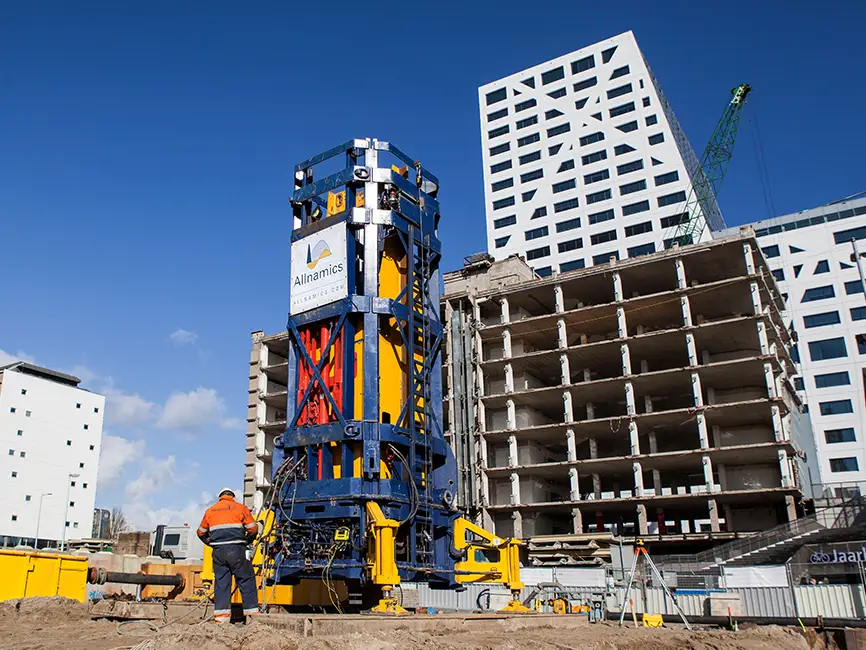
- Small equipment footprint: The testing device, such as the StatRapid system, is compact and can operate in restricted spaces where large cranes or ballast rigs cannot.
- Rapid mobilization and demobilization: Equipment arrives at and leaves the site quickly, reducing traffic, noise, and ground disturbance.
- No combustion process: The StatRapid system, introduced in 2012, generates the load using a drop mass and a modular spring assembly rather than a fuel-burning propellant, which eliminates combustion-related emissions at the point of testing.
- Multiple piles tested efficiently: When your project requires testing several piles within a short period, Rapid Load Testing allows you to move between locations quickly, reducing the cumulative site impact compared to setting up a static rig multiple times.
How does Rapid Load Testing reduce carbon emissions on construction projects?
Rapid Load Testing reduces carbon emissions primarily by eliminating the transport, installation, and removal of heavy reaction infrastructure. Every tonne of kentledge or anchor pile steel that does not need to be manufactured, transported, installed, and later removed represents a direct reduction in embodied carbon and fuel consumption associated with the testing phase of a project.
The emissions reduction operates across several stages of the project lifecycle. During mobilization, a compact rapid load test setup requires far fewer vehicle movements than a full static load test rig. During testing, the absence of a combustion-based load generation mechanism in systems like the StatRapid means no direct fuel burn at the test location. During demobilization, the same compactness that reduces arrival impact also reduces departure impact.
For large infrastructure projects where dozens of piles may need verification, these savings accumulate. Your project’s carbon accounting for the testing phase can be substantially lower when Rapid Load Testing replaces or supplements Static Load Testing, particularly where high test loads would otherwise demand very large reaction systems.
It is worth noting that the test itself still requires specialist equipment, skilled personnel, and careful interpretation. The environmental benefit comes from what is not needed, not from any reduction in technical rigor.
Can Rapid Load Testing support sustainable foundation design?
Yes, Rapid Load Testing can directly support sustainable foundation design by providing reliable pile capacity data that enables more efficient use of materials. When you can verify the actual load-bearing performance of a pile under realistic conditions, you gain the evidence needed to optimize pile dimensions, spacing, and number, rather than relying on conservative assumptions that lead to over-design.
Sustainable foundation design depends on accurate ground truth. Piles that are longer, wider, or more numerous than necessary consume more concrete and steel, generate more construction waste, and produce higher embodied carbon. Rapid Load Testing gives your design team verified capacity data that supports confident optimization decisions.
Rapid Load Testing also plays a role in the assessment of existing foundations. When a structure is being repurposed or extended, testing existing piles can confirm whether they can carry additional loads without new foundations being installed. This foundation reuse approach is one of the most direct ways to reduce the carbon and material impact of construction, and Rapid Load Testing is a practical tool for generating the data that makes reuse decisions defensible.
One important consideration: the measured response in a rapid load test must be processed to correct for pile inertia and loading-rate effects before it can be interpreted as equivalent static capacity. In cohesive soils in particular, the rate at which load is applied can influence the measured resistance. Specialist interpretation is always required to ensure the data supports sound design decisions.
Where is Rapid Load Testing most beneficial for environmental protection?
Rapid Load Testing delivers the greatest environmental benefit in locations where conventional static testing infrastructure would cause significant disturbance or where transport of heavy equipment is logistically and environmentally costly. Environmentally sensitive sites, congested urban areas, offshore or near-shore locations, and remote project sites all represent conditions where the compact, efficient nature of Rapid Load Testing has a clear advantage.
Specific contexts where the environmental benefit is most pronounced include:
- Ecologically sensitive areas: Wetlands, coastal zones, and protected habitats where ground disturbance, noise, and vehicle movements must be minimized.
- Offshore and near-shore projects: Marine environments where transporting and operating large static reaction systems is both expensive and environmentally disruptive.
- Urban redevelopment sites: Dense city environments where space is limited and minimizing site activity reduces impact on surrounding communities and infrastructure.
- Remote locations: Sites where the logistics of delivering heavy ballast or anchor pile systems would generate disproportionate transport emissions.
- Projects with multiple test piles: Where testing efficiency across many locations reduces the cumulative environmental cost of the verification program.
In each of these contexts, the ability to generate high test loads from a compact device, without a large permanent reaction structure, translates directly into reduced site impact, lower emissions, and less disturbance to the surrounding environment.
How We Support Rapid Load Testing for Sustainable Projects
At Allnamics, we provide complete Rapid Load Testing services, from planning and execution through to specialist interpretation of results. Our team works with you to determine whether Rapid Load Testing is the right approach for your soil conditions, pile type, and project objectives, and we deliver results that meet the requirements of applicable standards, including ISO 22477-10 and NEN 7201:2025.
Here is what we offer:
- Test planning and feasibility assessment: We evaluate your pile type, soil profile, required test load, and site conditions to confirm that Rapid Load Testing will deliver the information you need.
- StatRapid testing: We use our own StatRapid system, a modern Rapid Load Test installation that generates load through a drop mass and spring assembly without combustion, keeping the on-site emissions profile low.
- Specialist data interpretation: Our engineers apply the Unloading Point Method and other appropriate analysis approaches to convert raw test measurements into reliable static capacity estimates, including corrections for pile inertia and loading-rate effects.
- Foundation reuse assessments: We help you evaluate whether existing foundations can be verified and reused, supporting your decarbonization and sustainability objectives.
- Reporting aligned with project and regulatory requirements: We deliver clear, well-documented results that your design team and independent reviewers can rely on.
If you want to understand whether a rapid load test is the right fit for your project, contact our team and we will give you a direct, practical assessment.