


How do wave conditions affect offshore pile performance?
Wave conditions generate significant lateral forces on offshore piles, and over time these forces contribute to fatigue, scour, and structural degradation that can compromise foundation integrity. The severity of the impact depends on water depth, pile geometry, wave frequency, and soil conditions. This article works through the most common questions engineers and project teams ask about wave loading and offshore pile performance.
How do waves generate lateral forces on offshore piles?
Waves generate lateral forces on offshore piles through two primary mechanisms: drag and inertia. As a wave passes a pile, the moving water exerts a drag force proportional to the square of the water particle velocity, and an inertia force proportional to the rate of change of that velocity. Together, these forces create a cyclic, direction-reversing load that acts continuously along the submerged length of the pile.
The combined effect is described by the Morison equation, which engineers use to estimate total wave force on slender cylindrical structures. The relative contribution of drag versus inertia depends on the ratio of pile diameter to wavelength. For large-diameter monopiles, such as those used in offshore wind foundations, inertia forces tend to dominate. For slender jacket piles, drag plays a more significant role.
Wave height, wave period, and water depth all influence the magnitude of these forces. Longer-period waves drive deeper water particle motion, meaning the loading extends further down the pile. Storm waves with steep fronts generate particularly sharp force reversals, which matter more for fatigue than for peak load alone.
What types of wave loading cause the most damage to offshore piles?
The most damaging wave loading for offshore piles is not necessarily the largest single wave, but rather the combination of cyclic fatigue loading from repeated moderate waves and wave-induced scour that progressively removes the soil supporting the pile. Extreme storm events can cause structural overstress, but cumulative fatigue and scour-driven loss of lateral support are responsible for the majority of long-term foundation degradation.
Cyclic fatigue loading
Every wave that passes a pile applies a load cycle. Over a design life of 25 to 30 years, an offshore wind monopile may experience tens of millions of load cycles. Even at stress levels well below the material yield point, repeated cycling causes microscopic crack initiation and propagation, particularly at welds, wall thickness transitions, and connection details. The frequency of wave loading also matters: when wave frequency approaches the natural frequency of the pile-structure system, dynamic amplification increases stress levels beyond what static analysis would predict.
Wave-induced scour
Scour occurs when wave-driven currents accelerate around the base of a pile and erode the surrounding seabed. This reduces the effective embedment depth of the pile, shifting the point of fixity deeper and increasing bending moments in the upper section of the pile. In sandy seabed conditions, scour depths can reach one to two pile diameters if left unprotected. The result is a pile that behaves as though it is longer and less supported than designed, amplifying both lateral deflection and fatigue stress ranges.
How does wave-induced fatigue affect pile integrity over time?
Wave-induced fatigue affects pile integrity by initiating and propagating cracks at stress concentration points, gradually reducing the structural capacity of the pile over its service life. The process is cumulative and largely invisible without monitoring or inspection. A pile that appears structurally sound may already have fatigue damage that significantly reduces its remaining service life.
Fatigue damage accumulates according to the number and amplitude of stress cycles. Engineers use S-N curves, which relate stress range to the number of cycles a material can sustain before failure, to assess fatigue life during design. However, real-world wave spectra are irregular, meaning the pile experiences a wide distribution of stress amplitudes rather than a single repeating load. Rainflow counting methods are used to convert this irregular loading history into an equivalent fatigue damage sum.
Critical locations for fatigue crack initiation include the pile-to-transition-piece connection, circumferential welds, and any point where wall thickness or diameter changes abruptly. Corrosion accelerates fatigue by roughening the surface and creating stress concentrations where cracks can start. In the splash zone, where the pile alternates between wet and dry exposure, corrosion-fatigue interaction is particularly aggressive.
Fatigue damage is also introduced during pile installation. The repeated hammer blows of impact driving generate stress cycles in the pile material before it ever enters service. For large monopiles, the cumulative fatigue from driving can represent a meaningful fraction of the total fatigue budget, which is why pile driving predictions and installation monitoring are an important part of managing the full fatigue life of the structure.
What’s the difference between shallow-water and deep-water wave effects on piles?
In shallow water, waves interact with the seabed, which changes their shape, speed, and force characteristics compared to deep-water waves. Shallow-water waves become steeper, slower, and more asymmetric as they approach the seabed, generating higher horizontal water particle velocities near the bottom and therefore larger drag forces on piles close to the seabed. Deep-water waves maintain a more symmetrical orbital motion that decays exponentially with depth, so lateral forces are concentrated near the surface and diminish rapidly downward.
For offshore piles in shallow coastal or transitional water depths, the seabed interaction effect means that wave forces act over a greater proportion of the pile’s embedded length. This increases bending moments at depth and can mobilize more of the surrounding soil, making the pile-soil interaction more complex to model accurately.
Deep-water piles, by contrast, experience wave loading primarily in the upper portion of the water column. The pile must be designed to transfer these upper-zone lateral forces down through a longer unsupported length to the point of fixity in the seabed. This increases the importance of pile stiffness and the lateral resistance of the soil at depth.
Water depth also affects the wave period spectrum that reaches the structure. In shallow water, short-period waves are filtered and long-period swells dominate, which can be more problematic for resonance if the natural period of the foundation system falls within that range.
How is wave loading on offshore piles measured and monitored?
Wave loading on offshore piles is measured and monitored through a combination of strain gauges, accelerometers, and inclinometers installed on the pile, combined with wave measurement instruments such as wave buoys or acoustic Doppler current profilers positioned near the structure. Together, these systems capture both the applied loading environment and the structural response of the pile in real time.
Strain gauges bonded to the pile wall measure the stress variations caused by wave-induced bending. By placing gauges at multiple depths and orientations, engineers can reconstruct the bending moment distribution along the pile and identify which sections experience the highest stress ranges. Accelerometers capture dynamic motion, which is useful for detecting resonance and for calculating inertia forces. Inclinometers track pile head rotation and long-term drift, which can indicate progressive scour or soil softening.
For piles installed in deep water or below the seabed surface, waterproof sensor systems are required. Monitoring equipment must function reliably at depth, in saltwater, and under the mechanical vibrations of wave loading over extended periods. Data acquisition systems collect and transmit measurements continuously, allowing remote access to structural performance data without requiring vessel mobilization for every inspection.
During pile installation, monitoring serves a different but related purpose. Sensors measure stress waves traveling through the pile during hammer impact, providing real-time data on driving stresses, pile integrity, and soil resistance. This installation-phase monitoring is the first opportunity to verify that the pile has been installed without damage and that the foundation is performing as predicted.
When should wave conditions trigger a pile integrity assessment?
Wave conditions should trigger a pile integrity assessment when a structure has experienced an extreme storm event that exceeded design wave heights, when monitoring data shows unexpected increases in pile head deflection or stress levels, when scour protection is found to be damaged or absent, or when the structure has reached a significant fraction of its design fatigue life. Any of these conditions indicates that the actual loading history may have diverged from the assumptions used in the original design.
Post-storm assessments are particularly important when wave heights during the event approached or exceeded the design return period. Even if the structure appears undamaged visually, internal fatigue crack growth or scour-related changes in pile fixity may not be visible from the surface. A structural assessment following an extreme event provides documented evidence of the foundation’s condition and supports decisions about continued operation, inspection intervals, or remediation.
Monitoring data that shows a gradual increase in natural frequency or a change in the dynamic response pattern of the structure can also indicate that something has changed in the foundation system. Scour that reduces effective embedment, or soil softening caused by repeated cyclic loading, will alter the stiffness of the pile-soil system and shift the resonant frequency. These changes are detectable through continuous monitoring before they become critical.
For aging offshore structures, a pile load test to verify foundation capacity provides direct evidence of current bearing capacity and structural condition. Where access or water depth makes conventional testing difficult, dynamic load testing offers a practical alternative that can be performed with relatively modest vessel requirements.
How Allnamics Supports Offshore Pile Performance Under Wave Loading
We work with offshore wind developers, EPC contractors, and infrastructure operators to address the full range of wave-related challenges that affect offshore pile performance, from installation through long-term service life management.
- Pile driving predictions: Before installation begins, we simulate the driving process using our AllWave software to predict pile stresses, hammer performance, and fatigue damage accumulated during driving. This allows your team to select the right hammer, set safe driving criteria, and avoid installation damage before it happens.
- Installation monitoring: We deploy strain and acceleration sensors on offshore piles during driving, providing real-time data on stress levels, pile integrity, and soil resistance. Our waterproof sensors are certified for use at depths up to 500 metres, covering both impact and vibratory hammer installations.
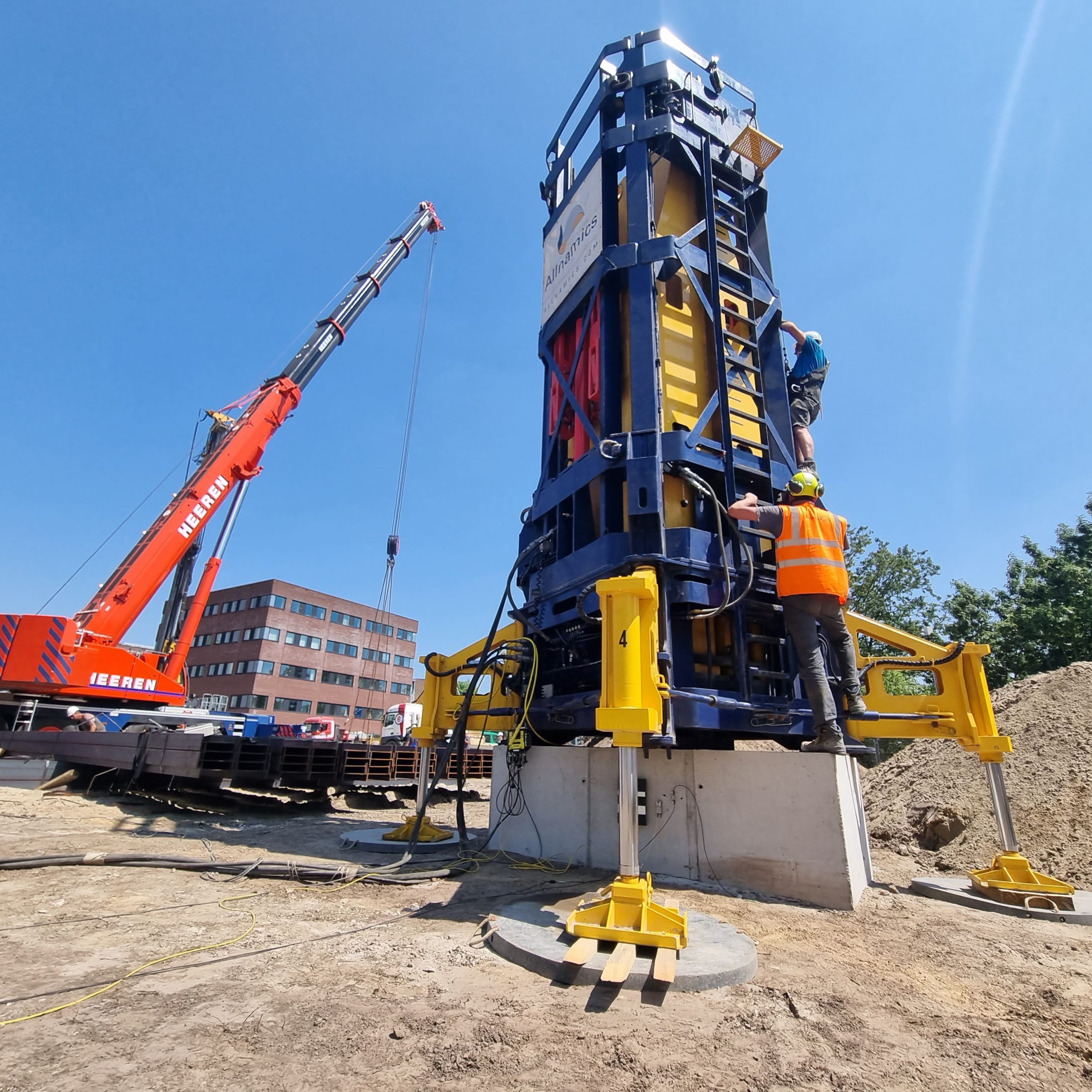
- Dynamic Load Testing (DLT): We perform DLT during and after installation to assess bearing capacity, soil resistance distribution, and pile integrity. Signal matching analysis using AllWave-DLT gives your team a calibrated model of pile-soil behaviour without the logistical complexity of a static load test offshore.
- Rapid Load Testing (RLT): Where dynamic testing alone does not capture the full soil response, our StatRapid and Statnamic systems provide a direct measurement of load and settlement under a controlled impulse, eliminating stress wave effects and improving capacity determination accuracy.
- Fatigue analysis: We assess fatigue damage from both installation driving and in-service wave loading, identifying critical locations and quantifying remaining fatigue life to support inspection planning and life extension decisions.
- Long-term structural monitoring: We design and deploy monitoring systems that track strain, deflection, vibration, and dynamic response over the operational life of the structure, giving you early warning of scour, fatigue progression, or unexpected changes in foundation behaviour.
If your project involves offshore piles subject to wave loading and you want to verify foundation performance, manage fatigue risk, or assess an existing structure, contact us to discuss your project to discuss what testing and monitoring approach fits your specific conditions.