


Can Rapid Load Testing replace Static Load Testing?
A rapid load test can replace a static load test in many practical situations, but not unconditionally. When applied to compatible pile types and soil conditions, and when results are interpreted using a validated method, a rapid load test delivers bearing capacity data that correlates well with static test results. The key qualifier is that the raw measured resistance must be corrected for loading-rate effects before it can be compared to static capacity. The sections below address the most common questions engineers and project teams ask when evaluating whether to use rapid load testing on their project.
How accurate is rapid load testing compared to static load testing?
Rapid load testing produces results that closely match static load test outcomes when the test is executed correctly and the data is interpreted with an appropriate analysis method. The accuracy depends on two conditions: the load duration must be long enough to limit stress wave effects in the pile, and the measured soil resistance must be corrected for the higher loading rate before drawing conclusions about static bearing capacity.
The physical basis for this accuracy lies in how the pile behaves during the test. Because the load duration in a rapid load test is significantly longer than in a dynamic load test, the different sections of the pile move at roughly similar velocities during the relevant part of the test. This allows the pile to be modelled as a concentrated mass rather than a wave-propagating system, which simplifies interpretation and reduces uncertainty.
Soil type plays an important role in accuracy. In granular soils, loading-rate effects are relatively limited and corrections are straightforward. In cohesive soils such as clay, the soil resistance measured during a rapid load test can be noticeably higher than the resistance mobilised during a slow static test. Research has shown that failure load in clay can increase by roughly 13.7% per logarithmic increase in loading rate, though this figure is soil-specific and cannot be applied as a universal correction factor. Proper site-specific interpretation is therefore important for reliable results.
What are the key differences between rapid load testing and static load testing?
The most important difference between rapid load testing and static load testing is the duration over which the load is applied. In a static load test, the load is applied in increments and held for extended periods, allowing the pile and surrounding soil to respond under near-static conditions. In a rapid load test, the load is applied over a much shorter period, typically generating pile velocities in the range of 0.1 to 2 metres per second.
This difference in load duration has several practical consequences:
- Inertia forces: Because the pile accelerates during a rapid load test, inertia forces must be accounted for in the analysis. Static tests involve negligible acceleration and require no such correction.
- Rate-dependent soil resistance: Soil, particularly clay, responds differently to fast loading. The resistance measured during a rapid load test includes a rate-dependent component that must be separated from the static resistance through interpretation methods such as the Unloading Point Method.
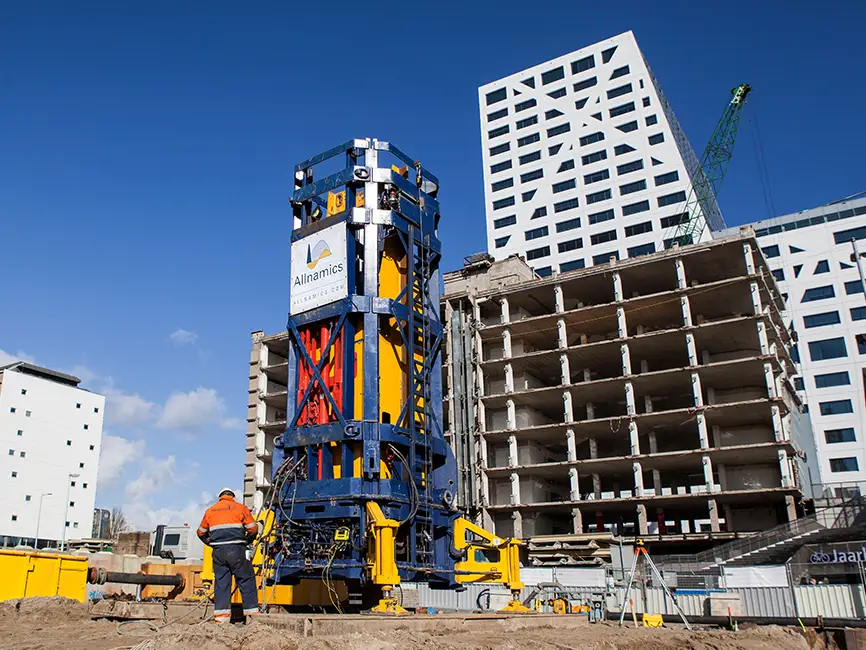
- Load application mechanism: Static tests apply load through kentledge, ground anchors, or reaction piles. Rapid load tests use a falling mass combined with a spring system, or a propellant-driven reaction mass, making the setup considerably more compact.
- Force measurement: In rapid load testing with systems such as Statnamic or StatRapid, the force is measured directly via calibrated load cells at the pile head. This is independent of pile material properties, which is an advantage over dynamic load testing where force is derived indirectly from strain measurements.
When is rapid load testing an accepted alternative to static load testing?
Rapid load testing is an accepted alternative to static load testing when the test is conducted and interpreted in accordance with a recognised standard, and when the project conditions fall within the scope of that standard. Internationally, ASTM D7383 and ISO 22477-10 provide the framework for accepted practice. Several national standards also exist, with Japan’s JGS 1815-2002 being among the earliest formal standards for the method.
In practice, rapid load testing is widely accepted as an alternative or supplementary method in the following situations:
- When a full static load test reaction system is impractical or disproportionately expensive relative to the project scale
- When programme constraints make the extended duration of a static test difficult to accommodate
- When a static test has already been performed but did not fully mobilise the available resistance, and supplementary verification is needed
- When the pile type and soil conditions are compatible with reliable rapid load test interpretation
Some projects use rapid load testing alongside a static reference test to validate the interpretation method for that specific site. Once validated, subsequent rapid load tests on the same project can be used with greater confidence as a direct alternative.
What types of piles and soil conditions suit rapid load testing?
Rapid load testing is suitable for a wide range of pile types, including driven piles, bored piles, CFA piles, and large-diameter cast-in-situ concrete piles. It is particularly well suited to large-diameter bored piles where dynamic load testing would require impact energies high enough to risk damaging the pile head. The spring system used in StatRapid, for example, extends the load duration and reduces peak stresses at the pile head, making it appropriate for piles with lower concrete strengths.
A practical example of this advantage comes from a project in Barcelona involving large in-situ concrete piles with diameters of approximately 1.5 metres and working loads between 6 and 8 MN. Dynamic load testing was considered unsuitable because the required impact energy would have generated unacceptably high stresses. Rapid load testing with StatRapid was selected as the preferred verification method.
In terms of soil conditions, rapid load testing performs most reliably in granular soils where rate effects are limited. In cohesive soils, the method remains applicable but requires careful interpretation to separate rate-dependent resistance from the static component. The required load duration is not determined solely by pile length and wave speed. Pile diameter and the shear wave velocity of the surrounding soil also influence how long the load must be applied to ensure reliable results.
What are the practical advantages of rapid load testing over static load testing?
Rapid load testing offers several practical advantages that make it attractive for many project types, particularly where logistics, cost, or programme are constraining factors.
- Compact setup: No large reaction system is required. This is a significant advantage on sites with limited space, on water, or in urban environments where installing kentledge or reaction piles would be disruptive or expensive.
- Speed: A rapid load test can typically be completed in a fraction of the time needed to set up and execute a static load test, reducing programme impact.
- Cost efficiency: The reduced mobilisation requirements and shorter test duration generally translate into lower direct costs, particularly for large-diameter piles where static test reaction systems become very substantial.
- Direct force measurement: The use of calibrated load cells at the pile head means the applied force is measured independently of pile material properties, reducing one source of uncertainty compared to dynamic load testing.
- Suitability for sensitive pile types: The controlled load application and reduced peak stresses make rapid load testing appropriate for pile types that would be at risk of damage under high-energy dynamic impacts.
What are the limitations of rapid load testing that static load testing does not have?
Rapid load testing has limitations that project teams should understand before selecting it as the primary verification method. The most significant limitation is that the measured resistance is not directly equivalent to static bearing capacity. An interpretation step is always required to separate inertia forces, rate-dependent soil resistance, and damping effects from the static component. This interpretation introduces uncertainty that does not exist in a well-executed static load test.
In cohesive soils, the rate-dependent component of resistance can be substantial, and the correction depends on soil-specific parameters that are not always well defined. Applying a generic correction factor in these conditions can lead to overestimation of static capacity. The literature is clear that no universal correction applies across all clay types, and that factors such as plasticity, overconsolidation, soil structure, and temperature all influence the rate effect.
Additional limitations include:
- Settlement data: A static load test provides a direct load-settlement curve under sustained loading. Rapid load testing provides displacement data under dynamic conditions, which requires interpretation to relate to long-term settlement behaviour.
- Regulatory acceptance: In some jurisdictions or for certain project types, static load testing remains the contractually or regulatorily required method, and rapid load testing may only be accepted as a supplementary check.
- Expertise requirement: Reliable interpretation of rapid load test data requires specialist knowledge. Errors in analysis can lead to significant misestimation of pile capacity, making the choice of experienced practitioners important.
How We Help with Rapid Load Testing
We have been involved in the development and application of rapid load testing methods for decades, and we carry that depth of experience into every project we support. Whether you need a standalone rapid load test or a combined testing programme alongside static or dynamic methods, we can help you design and execute the right approach for your pile type, soil conditions, and project requirements.
Our rapid load testing services include:
- Test design and planning: We assess your pile geometry, soil profile, and project objectives to determine whether rapid load testing is appropriate and how to configure the test for reliable results.
- On-site execution: Our teams operate StatRapid and Statnamic equipment for onshore and offshore projects, with direct force measurement via calibrated load cells.
- Data interpretation: We apply validated analysis methods, including the Unloading Point Method and signal matching, to extract static bearing capacity from the measured data.
- Independent review: If your team has already conducted a rapid load test, we can provide an independent technical review of the interpretation and conclusions.
- Integrated testing programmes: We combine rapid load testing with static load testing, dynamic load testing, or pile integrity testing where the project calls for a multi-method approach.
If you are evaluating whether a rapid load test is the right choice for your project, or if you want to discuss how to get the most reliable results from your testing programme, contact our team and we will help you find the most effective approach.