

What is the difference between a prediction and a postdiction?
A prediction is a forward-looking calculation made before pile installation begins, while a postdiction is a back-analysis performed after installation using actual field measurements to reconstruct what happened in the ground. The two serve different purposes but work best when used together as part of a structured learning loop. The sections below explain each concept in detail and show how combining them leads to better foundation engineering decisions.
How do predictions and postdictions differ in pile testing?
A prediction estimates future pile behavior based on a soil model, hammer selection, and pile geometry before any driving takes place. A postdiction works in the opposite direction: it starts from measured field data and adjusts the model until the calculated response matches what was actually observed. The core difference is the direction of reasoning: forward from assumptions versus backward from evidence.
In practice, this means the two analyses use the same wave-equation framework but with different inputs and objectives. A prediction answers the question: “Can this pile be installed to the required depth without exceeding stress limits or encountering early refusal?” A postdiction answers: “What does the measured installation behavior tell us about the actual soil resistance and hammer performance?”
Both analyses rely on stress wave theory and a coupled model of hammer, cushion, pile, and soil. What changes is whether the soil model is an input assumption or an output derived from measurements.
What is a prediction used for in foundation engineering?
In foundation engineering, a prediction, specifically a driveability prediction, is used to quantify and manage installation risk before a pile enters the ground. It simulates the full driving process across all penetration levels, producing estimates of blow count, transferred energy, hammer efficiency, and maximum compressive and tensile stresses throughout the pile.
The goal is not simply to produce a blow-count chart. A well-executed driveability prediction helps your team answer several practical questions before mobilizing equipment:
- Will the chosen hammer overcome soil resistance at all penetration depths?
- Do predicted stresses remain within the structural limits of the pile?
- Is there a risk of early refusal, and if so, at which depth?
- What remedial actions might be needed, and how do they affect cost and schedule?
For concrete piles, the prediction can also track stress development in the concrete and reinforcement, including the potential for crack formation. For offshore monopiles and driven steel piles, it informs hammer selection and helps define installation acceptance criteria.
Because a driveability prediction is a model-based estimate rather than a deterministic guarantee, a sensitivity analysis is technically more valuable than a single nominal run. Varying key parameters, such as soil layer boundaries, dynamic shaft resistance, cushion behavior, and actual hammer efficiency, shows which conclusions remain stable under realistic uncertainty and which require additional data before installation begins.
Tools such as AllWave-PDP and AllWave-VDP support both impact and vibratory driving predictions within a single integrated framework, covering the full range of outputs needed for a robust pre-installation assessment.
What is a postdiction and when is it performed?
A postdiction is a back-analysis carried out after pile installation, using measurements collected during or immediately after driving to reconstruct the actual soil behavior and hammer performance. It is performed once field data, such as blow counts, dynamic strain and acceleration measurements, or vibratory monitoring records, are available for comparison with the original prediction.
Postdictions are typically triggered by one of three situations:
- The installation deviated from the prediction: blow counts were higher or lower than expected, early refusal occurred, or penetration rates differed significantly from the forecast.
- Dynamic Load Testing was performed: strain and acceleration data recorded near the pile head provide the input needed for signal matching, which is the primary postdiction method for impact-driven piles.
- A systematic learning objective exists: the project team wants to update the soil model for use on subsequent piles or future projects in the same area.
For vibratory driving, postdiction follows the same logic: actual installation data from monitoring are used for post-processing and further development of the ground model. A well-documented case is the 2022 NAM L13-F1-1 installation, where a 4.5 m diameter monopile was first driven with a vibratory hammer to approximately 25 m before early refusal occurred, then completed with an impact hammer to around 31.5 m. The installation itself became a calibration experiment, allowing comparison between the original CPT-based soil model, a model derived from vibratory signal matching, and capacity predictions from Beginning of Restrike and End of Restrike measurements.
Why can’t a postdiction replace a prediction?
A postdiction cannot replace a prediction because it requires the pile to already be in the ground. By the time a postdiction is possible, the installation decisions, hammer selection, pile geometry, stress limits, and acceptance criteria, have already been made. If those decisions were wrong, the consequences are already unfolding.
Early refusal, for example, can force costly remedial actions: switching to a larger hammer, extending driving time, removing soil or plug material, or adopting an entirely different installation strategy. Some of these measures can damage the pile or reduce its long-term bearing capacity. A prediction exists precisely to identify these risks before they become field problems.
There is also a structural difference in what each analysis can address. A prediction covers the full installation process from the first blow to final penetration, including stress peaks at intermediate depths that may never be captured by post-installation measurements. A postdiction reconstructs what happened at the moments when measurements were taken. It cannot recover information about what occurred between measurement points.
The two analyses are complementary, not interchangeable. A postdiction improves the quality of future predictions; it does not substitute for the risk management function that a prediction provides before installation.
How does signal matching turn field measurements into a postdiction?
Signal matching converts field measurements into a postdiction by using measured force and velocity signals at the pile head as boundary conditions in a wave-equation model, then iteratively adjusting soil parameters until the calculated pile response matches the measured response. The result is a soil model that reflects actual ground behavior rather than pre-installation assumptions.
The process works as follows during Dynamic Load Testing:
- Strain and acceleration sensors near the pile head record data during each hammer blow.
- Force and velocity are derived from these measurements.
- The measured force signal is applied as the input to the wave-equation model.
- The model calculates the pile’s response based on an assumed soil resistance distribution.
- The calculated velocity is compared with the measured velocity.
- Soil parameters, including shaft and toe resistance, damping, and quake values, are adjusted iteratively until a good match is achieved.
Because pile properties such as cross-section, material stiffness, and impedance are known with reasonable accuracy, differences between the calculated and measured responses are primarily attributed to the soil model. After a successful match, the static and dynamic contributions of shaft and toe resistance can be separated, and the sum of the static contributions gives the calculated static pile bearing capacity.
Signal matching is not a unique inverse solution. Different combinations of soil parameters can produce similar-looking signals, which means engineering judgment, sensitivity analysis, and independent validation remain important. The result is a postdiction, a reconstructed picture of what the ground was doing, not a direct measurement of soil resistance.
When should predictions and postdictions be used together?
Predictions and postdictions should be used together whenever installation quality, soil model accuracy, or bearing capacity verification matters, which, in practice, means on most driven pile projects of any significance. The most effective approach treats them as two phases of a single learning loop rather than separate analyses.
The workflow runs in a defined sequence:
- Ground investigation produces an initial soil model.
- The soil model feeds a driveability prediction.
- Installation monitoring captures actual blow counts, hammer performance, and dynamic measurements.
- Signal matching and back-analysis produce an updated soil model.
- The updated model is compared with the original prediction.
- Findings enter an experience database that improves the next prediction.
This cycle means that a deviation between prediction and reality is not just an error to be explained. It is information that makes future models more accurate. A good driveability model must be both predictive and updatable.
For projects with multiple piles in similar ground conditions, this approach is particularly valuable. The postdiction from the first pile becomes calibration data for the predictions governing the remaining piles. For offshore wind foundations, where hammer mobilization costs are high and schedule risk is significant, the ability to update the soil model mid-campaign can prevent costly surprises on later installations.
The underlying principle, as described in the AllWave-PDP methodology, is that driveability engineering is not a single calculation but an iterative process in which prediction, monitoring, back-analysis, and accumulated experience reinforce each other. Knowing when inputs and results are reliable, when assumptions need to be questioned, and when additional data are needed is as important as the wave-equation calculations themselves.
How Allnamics Supports Driveability Predictions and Postdictions
We combine wave-equation modeling, field monitoring, and signal matching into an integrated workflow that connects pre-installation predictions with post-installation back-analysis. This means your team gets not just a forecast before driving begins, but a verified and updated soil model after installation that feeds directly into future project decisions.
Our support covers the full prediction-to-postdiction cycle:
- Driveability predictions using AllWave-PDP (impact driving) and AllWave-VDP (vibratory driving), including sensitivity analyses across key soil and hammer parameters
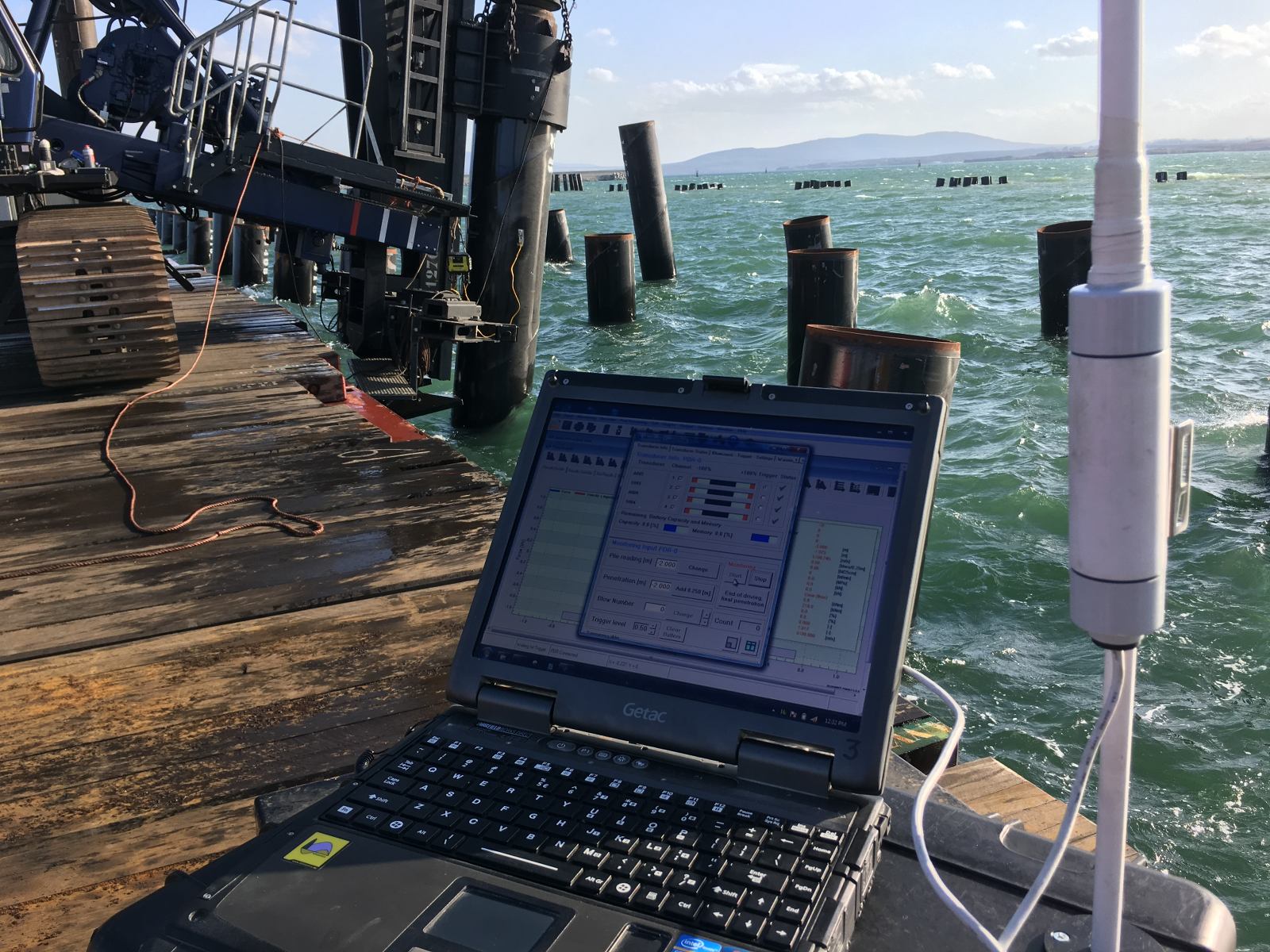
- Installation monitoring with real-time data collection during impact and vibratory driving, capturing blow counts, transferred energy, and dynamic pile response
- Signal matching and back-analysis using AllWave-DLT to reconstruct actual soil resistance from field measurements and derive static bearing capacity
- Soil model updates based on postdiction results, with structured comparison against the original prediction
- Experience database integration so that findings from one project improve the accuracy of predictions on the next
- Independent technical review for projects where a second opinion on prediction assumptions or postdiction results adds value
Whether you are planning a first-of-kind offshore installation, managing a multi-pile onshore campaign, or investigating a deviation from expected behavior, we can help you close the loop between what was predicted and what actually happened. Contact us to discuss your project and find out how we can support your driveability and back-analysis work.
Related Articles
- What is the relationship between vibratory hammer frequency and eccentric moment?
- How to calculate large amounts of calculations with AllWave-PDP?
- What are the different soil fatigue models in AllWave-PDP?
- How does stand-alone data logging work during monopile installation?
- How do you determine pile failure from test results?