

Why is vibratory pile driving more effective in granular soils?
Vibratory pile driving is more effective in granular soils because the cyclic vibration disrupts the interlocking structure of sand and gravel particles, temporarily reducing friction along the pile shaft and allowing the pile to advance with far less resistance. This mechanism depends directly on the physical behavior of granular material under dynamic loading. The sections below unpack how that process works, where it breaks down, and how you can verify pile performance after installation.
How does vibratory pile driving actually work in granular soils?
A vibratory hammer generates continuous cyclic motion rather than discrete impact blows. It transmits displacement, velocity, and acceleration into the pile simultaneously, and this sustained oscillation is what makes granular soils respond so favorably. In loose to medium-dense sands and gravels, the vibration causes particles to rearrange, temporarily reducing the contact forces between grains and the pile surface.
Unlike impact driving, where each hammer blow sends a discrete stress wave down the pile, vibratory driving maintains a near-continuous loading cycle. The ground reaction in this case cannot be described by the same relationships used for impact driving. Research by Bielefeld, Moscoso, and Verbeek defines the soil reaction during vibratory driving as a function of displacement, velocity, and acceleration combined, with spring stiffness, damping, and added mass all contributing to the response. This is why simple linear soil models developed for impact driving are not directly transferable to vibratory simulations.
Three hammer parameters control how effectively this process works in practice: eccentric moment, operating frequency, and the resulting displacement amplitude. Two hammers with similar centrifugal force can produce very different penetration rates if their eccentric moments and frequencies differ. A hammer with a larger eccentric moment and lower frequency generates a greater displacement amplitude, which drives more soil displacement per cycle and typically delivers a higher penetration rate in granular conditions.
What happens to granular soil during vibratory pile installation?
During vibratory pile installation in granular soils, repeated cyclic loading causes the soil particles surrounding the pile to lose their interlocked arrangement. This temporary liquefaction-like state along the shaft dramatically reduces skin friction, allowing the pile to penetrate under its own weight combined with the dynamic force of the hammer.
The effect is most pronounced along the pile shaft. As the pile advances, the contact area between shaft and soil increases with depth, and the distribution of resistance between shaft friction and toe resistance shifts continuously. This is why a good vibratory driving prediction cannot rely on a single calculation at one depth. It requires a series of analyses at successive penetration levels to capture how the resistance profile evolves as the pile moves deeper through the soil layers.
For open-ended tubular piles, an additional factor comes into play: plugging. During vibratory installation, the pile may behave as unplugged, with soil entering the tube and internal shaft friction contributing to resistance. However, under static loading after installation, the same pile may exhibit plugged behavior, altering how toe resistance and shaft resistance are distributed. This distinction matters when you later assess the pile’s load-bearing capacity.
Why does vibratory driving struggle in cohesive soils?
Vibratory driving is far less effective in cohesive soils such as clay because the mechanism that makes it work in granular material simply does not apply. Clay particles do not rearrange under cyclic vibration the way sand grains do. Instead, cohesive soils absorb and dampen the vibratory energy without the temporary reduction in friction that granular soils experience.
In cohesive conditions, sufficient toe displacement is needed to push the soil beyond its elastic range and achieve meaningful penetration. Research from 2022 on factors affecting vibratory pile driving confirms that hammer selection becomes especially important here: a configuration with a larger eccentric moment and lower frequency, producing greater displacement amplitude, performs better in cohesive soils than a hammer with the same centrifugal force but smaller displacement amplitude. Even so, the fundamental limitation remains. The soil remolding and particle rearrangement that make vibratory driving efficient in sand simply do not occur in clay to the same degree.
This is also why vibratory driving in mixed soil profiles requires careful analysis. A pile passing through alternating sand and clay layers will encounter very different resistance conditions at different depths, and the hammer settings that work well in the granular layers may be insufficient in the cohesive ones.
What’s the difference between vibratory and impact pile driving?
The core difference is the loading mechanism. Impact pile driving delivers discrete, high-energy blows that generate stress waves traveling down the pile. Vibratory pile driving applies continuous cyclic motion, imposing oscillating displacement, velocity, and acceleration on the pile without discrete impact events.
This distinction has direct consequences for how you model and predict pile behavior:
- Stress wave propagation: Impact driving produces clearly defined compression and tension waves that travel the length of the pile and reflect from the toe. Vibratory driving does not generate the same discrete wave pattern, which means signal matching and dynamic load testing methods developed for impact driving require adaptation before they can be applied to vibratory installations.
- Soil resistance model: Impact driving soil models, including the widely used Smith model, couple static and dynamic resistance in a way that does not accurately represent vibratory loading physics. Vibratory simulations require a soil reaction model that accounts for the combined effect of displacement, velocity, and acceleration simultaneously.
- Penetration mechanism: Impact driving achieves penetration through the energy of each blow and the resulting permanent set per strike. Vibratory driving achieves penetration by reducing friction continuously, allowing the pile to advance progressively through the vibrating soil.
- Pile stress profile: Impact driving can generate significant tension and compression stresses that risk pile damage, particularly in hard driving conditions. Vibratory driving generally produces lower peak stresses, though the cumulative effect of cyclic loading still requires monitoring.
In practice, the two methods are often used together. A vibratory hammer may install a pile to a certain depth efficiently, and an impact hammer then drives it to final set, as illustrated in documented offshore monopile installations where early refusal during vibratory driving was overcome by switching to impact driving.
When should vibratory pile driving be avoided in granular soils?
Even in granular soils, vibratory pile driving is not always the right choice. You should avoid it or approach it with caution in several specific conditions.
Dense granular soils present a significant challenge. In high-density sands, the interlocking between particles is strong enough that vibratory energy alone may not overcome shaft friction and toe resistance. The result is early refusal, where the pile stops advancing before reaching the target depth. This is a known risk in offshore applications where dense sand layers are encountered.
Closed-ended piles are considerably harder to install with a vibratory hammer than open-ended tubular piles. Without the ability to displace soil into the pile interior, the full resistance at the toe must be overcome by the hammer’s dynamic force, which raises the threshold for successful installation significantly.
Other conditions where vibratory driving warrants careful evaluation include:
- Granular soils with cemented layers or interbedded hard strata that interrupt the vibration-induced friction reduction
- Sites where nearby structures are sensitive to ground vibrations, since vibratory driving transmits energy into the surrounding soil and can affect adjacent foundations
- Projects where the required final penetration depth demands a level of toe resistance that exceeds what the vibratory hammer can overcome
- Situations where the pile geometry or wall thickness makes the pile susceptible to buckling under the sustained cyclic loading
A thorough drivability prediction before mobilization is the most reliable way to identify these risks early and select the right installation approach.
How is pile performance verified after vibratory installation?
After vibratory installation, pile performance verification typically combines dynamic load testing, signal matching, and static load testing. Because vibratory driving does not produce the discrete stress wave records that impact driving does, the verification approach requires careful adaptation to the installation method used.
One effective approach is to perform Beginning of Restrike and End of Restrike tests using an impact hammer after vibratory installation is complete. This generates measurable stress wave data that can be analyzed through signal matching to assess soil resistance and pile capacity. A documented case involving a 4.5-meter-diameter monopile showed how vibratory signal matching, combined with restrike testing, allowed comparison between the original CPT-based soil model and the actual installation response, effectively turning the installation itself into a calibration exercise.
The broader verification workflow follows a closed learning loop:
- Develop an initial soil model from ground investigation data such as CPT or SPT results
- Run a driveability prediction before installation
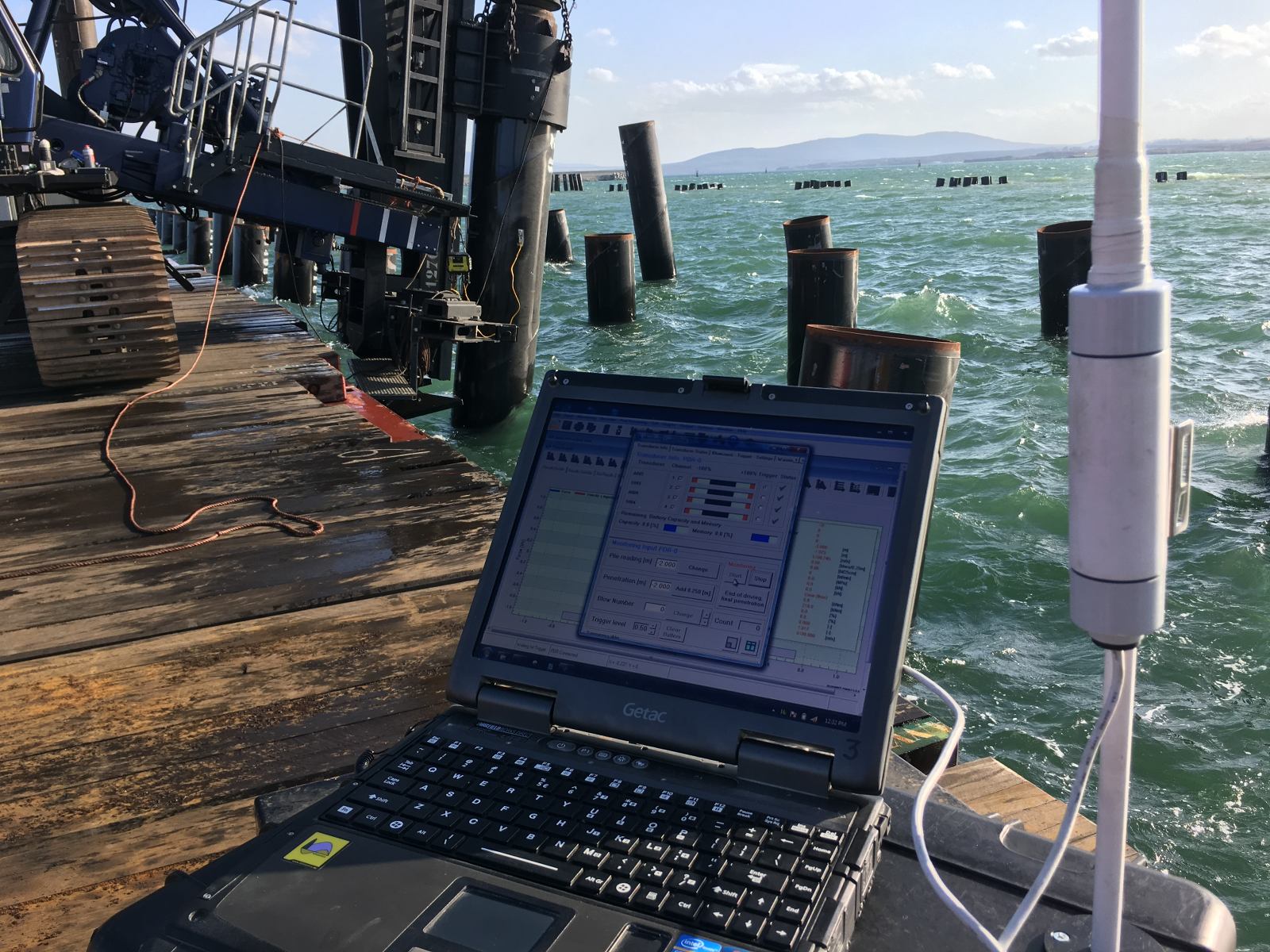
- Monitor the installation in real time
- Perform signal matching and back-analysis after installation
- Update the soil model based on measured data
- Compare the updated model with the original prediction to improve future analyses
This approach treats each installation as a source of technical data, not just a construction activity. Deviations between prediction and reality become information that improves the accuracy of future predictions on the same project or in similar soil conditions.
How We Support Vibratory Pile Driving Analysis and Verification
At Allnamics, we combine advanced simulation tools, field monitoring expertise, and decades of foundation engineering experience to support every stage of vibratory pile installation, from pre-project planning through post-installation verification.
Our support covers:
- Vibratory and impact driveability predictions using our in-house AllWave software package, which includes AllWave-VDP for vibratory driving simulation and AllWave-PDP for impact driving, both built on one-dimensional stress wave analysis using the Method of Characteristics
- Soil modeling from CPT, SPT, and laboratory data, translated into dynamic soil parameters that reflect the actual loading mechanism of vibratory or impact driving rather than static conditions alone
- Hammer selection advice based on eccentric moment, frequency, and displacement amplitude, not just centrifugal force, so your team selects a configuration that matches the soil profile and pile geometry
- Installation monitoring and signal matching during and after driving, including Beginning of Restrike and End of Restrike analysis to verify pile capacity after vibratory installation
- Dynamic load testing and pile integrity testing to confirm that the installed pile meets design requirements and has not sustained damage during installation
- Post-analysis and model updating that feeds measured installation data back into the soil model, improving prediction accuracy for subsequent piles on the same project
Whether you are planning an offshore monopile installation, a nearshore infrastructure project, or an onshore foundation program in variable granular soils, our team can help you reduce installation risk and verify performance with confidence. Contact us to discuss your project requirements.