

Why is pile driving in dense sand challenging?
Pile driving in dense sand is challenging because the high friction along the pile shaft and strong resistance at the pile tip combine to create very high soil resistance to driving. Dense sand grains interlock tightly, and as the pile penetrates deeper, this resistance can increase to the point where further installation becomes impractical or impossible. The sections below address the most common questions about what makes dense sand so difficult to work with and how to manage the risks effectively.
What makes dense sand so resistant to pile penetration?
Dense sand resists pile penetration because its tightly packed grain structure generates high shaft friction and strong tip resistance simultaneously. As the pile advances, the surrounding sand mobilizes significant lateral stress against the pile surface, and the dense particle arrangement at the pile tip requires substantial force to displace. Both effects compound as penetration depth increases.
In loose or medium-density sand, grains can rearrange relatively easily under load. In dense sand, the interlocking structure means that displacing material at the tip requires overcoming dilatancy, the tendency of dense granular material to expand in volume before it can shear. This expansion increases effective stress locally, which in turn raises both tip resistance and shaft friction.
A further complication is friction fatigue, or friction degradation. As the pile advances, soil at shallower depths along the shaft experiences repeated loading cycles. The local shaft resistance at any given depth does not remain constant; it tends to decrease as the pile tip moves further past that level. However, in very dense sand, even the degraded residual shaft resistance can remain high enough to create serious installation challenges. Models that ignore friction fatigue tend to overestimate the shaft resistance near the pile tip and underestimate total driving resistance for long piles.
What is pile refusal and when does it occur in dense sand?
Pile refusal occurs when the blow count, the number of hammer blows required per unit of penetration, rises to a level where further driving is no longer practically achievable. In dense sand, refusal typically occurs when the combined shaft friction and tip resistance exceed the energy the hammer can deliver per blow, making additional penetration negligible or zero.
Industry practice generally defines refusal as a blow count above a threshold such as 250 blows per 0.25 metres, though the exact criterion depends on the project specification and pile type. When this threshold is reached, continuing to drive risks damaging the pile rather than advancing it.
In dense sand, refusal can occur at shallower depths than anticipated if the soil profile is more variable than the ground investigation suggested. Thin dense layers, cemented horizons, or localized zones of very high relative density can all trigger early refusal. This is why a reliable drivability prediction, one that accounts for realistic soil resistance profiles rather than average values, is so important before mobilizing equipment on site.
How does soil plugging affect pile driving in sand?
Soil plugging occurs when the column of soil inside an open-ended tubular pile moves with the pile rather than being left behind as the pile advances. When a plug forms, the pile effectively behaves like a closed-ended pile, which significantly increases tip resistance and makes driving much harder in dense sand conditions.
Whether a pile plugs during driving depends on several interacting factors: pile diameter, wall thickness, penetration rate, and the relative density and grain size of the sand. In dense sand, plugging is more likely because the internal shaft friction between the soil column and the inner pile wall is high enough to carry the weight of the soil plug and resist its downward movement.
The relationship between dynamic and static plugging adds another layer of complexity. An open-ended pile may remain unplugged during impact driving, where inertia effects allow the soil column to lag behind, but behave as a plugged pile under static load testing. This distinction matters for both installation planning and capacity interpretation. Plugging also affects how Dynamic Load Testing results should be interpreted, since the resistance distribution during driving may not reflect the resistance distribution under service loads.
What are the main risks of driving piles through dense sand layers?
The main risks of driving piles through dense sand are pile refusal before reaching target depth, structural damage to the pile from excessive compressive or tensile stresses, and equipment damage from prolonged high-energy driving. Each of these risks can lead to significant project delays and cost overruns if not anticipated in advance.
Structural risks deserve particular attention. High soil resistance in dense sand requires the hammer to deliver more energy per blow. This increases compressive stresses travelling down the pile, but it also increases the tensile stresses that arise when stress waves reflect back from the pile tip. In concrete piles, tensile stress reflections can cause cracking even when the pile is advancing. In steel piles, fatigue damage accumulates across the full installation sequence.
Beyond pile integrity, there are operational risks. Driving through dense sand layers at high blow counts generates significant vibrations that can affect adjacent structures or utilities. Prolonged driving also increases wear on hammer components and can exceed the operational limits of the equipment. A hammer that is too light will struggle to overcome resistance; a hammer that is too heavy may advance the pile but generate stresses that exceed the pile’s structural capacity. Selecting the right hammer requires balancing penetration performance against pile stress limits, a trade-off that cannot be resolved without a proper drivability analysis.
How can drivability studies help predict performance in dense sand?
A drivability study predicts how a pile will behave throughout the entire installation process by simulating the interaction between the hammer, the pile, and the soil resistance profile. In dense sand, this type of analysis helps identify the depth at which refusal may occur, the stress levels the pile will experience, and whether the selected hammer can realistically achieve the target penetration.
The core output of a drivability study is a blow count versus penetration curve, but a complete analysis covers much more than that single result. A well-executed study addresses:
- Drivability: whether the blow count stays within a practically achievable range throughout installation
- Pile integrity: whether compressive and tensile stresses remain within acceptable limits at every depth
- Hammer operation: whether the hammer can function within its rated limits given the soil resistance encountered
- Refusal risk: at which depth the soil resistance may exceed the hammer’s capacity
- Fatigue loading: the cumulative stress cycles generated during the full installation sequence
- Installation time: the estimated number of blows and time required to reach target penetration
Soil modelling quality is the single most important factor in a reliable drivability prediction. In dense sand, the soil resistance to driving (SRD) profile must account for friction fatigue along the shaft, the distinction between plugged and unplugged tip resistance, and the variability that CPT data reveals across the site. Using raw CPT data without applying a friction fatigue model tends to overestimate shaft resistance near the pile tip and produce unreliable blow count predictions, particularly for long piles. AllWave-PDP supports CPT-based soil modelling and generates the full range of drivability outputs needed to assess installation risk in dense sand conditions.
What pile testing methods are used after driving in dense sand?
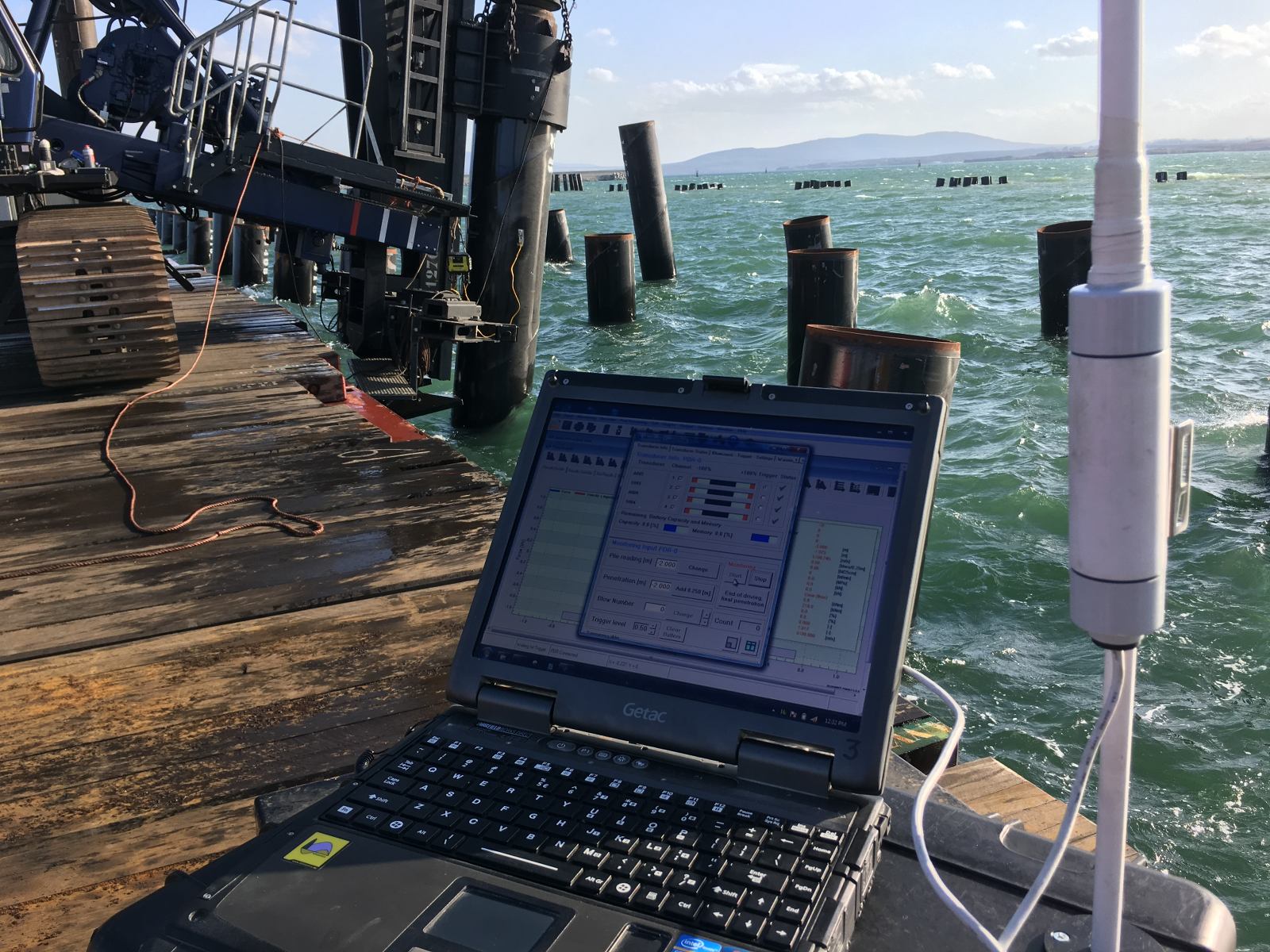
After driving piles in dense sand, the most commonly used testing methods are Dynamic Load Testing (DLT) and Static Load Testing (SLT). Dynamic Load Testing is performed during or immediately after driving and provides information on energy transfer, soil resistance distribution, and pile integrity. Static Load Testing applies a controlled load directly to the pile head to measure actual load-settlement behaviour.
Dynamic Load Testing uses sensors attached to the pile to record force and velocity during hammer impact. Signal matching analysis, comparing measured signals against a pile-soil model, allows engineers to estimate shaft and tip resistance separately. In dense sand, this distinction matters because the relative contribution of shaft friction and tip resistance affects both capacity interpretation and the assessment of plugging behaviour.
Rapid Load Testing (RLT) offers a middle ground between dynamic and static methods. It applies a load pulse longer than a typical hammer blow but shorter than a static test, which reduces inertia effects and allows more direct capacity interpretation. For piles in dense sand where set-up effects are limited, RLT can provide a useful capacity estimate at lower cost than a full static test.
Pile Integrity Testing (PIT) is used to check the structural condition of the pile after driving. In dense sand, where high blow counts and stress wave reflections increase the risk of pile damage, integrity testing provides confidence that the installed pile meets structural requirements before the project moves forward.
How Allnamics Supports Pile Driving in Dense Sand
We work with foundation contractors, EPC contractors, and engineering consultancies on projects where dense sand creates real installation risk. Our approach combines advanced soil modelling, drivability simulation, and field testing to give your team a clear picture of what to expect before and during installation.
Here is what we offer for projects involving pile driving in dense sand:
- Drivability studies using AllWave-PDP: We simulate the full installation process, including blow count versus penetration, compressive and tensile stresses, hammer performance, and refusal risk, using CPT-based soil models that account for friction fatigue and plugging behaviour
- Vibratory driving prediction using AllWave-VDP: For projects where vibratory installation is considered, we model the interaction between the vibratory hammer, pile, and soil to assess penetration rate and the risk of early refusal in dense granular conditions
- Soil modelling for pile driving: We build site-specific SRD profiles from CPT, SPT, and laboratory data, applying friction fatigue models and accounting for open-ended versus closed-ended pile behaviour
- Dynamic Load Testing during and after installation: We measure energy transfer, soil resistance, and pile integrity in real time, with signal matching analysis to separate shaft and tip contributions
- Static Load Testing and Rapid Load Testing: We verify actual pile capacity under controlled loading conditions when project requirements demand direct measurement
- Pile Integrity Testing: We assess structural condition after high-stress driving in dense sand to confirm the pile meets design requirements
- Independent technical review: We review drivability studies, hammer selection decisions, and testing programmes prepared by others, providing an independent check before installation begins
If your project involves pile installation in dense sand and you want to reduce the risk of refusal, pile damage, or unexpected delays, contact us to discuss how we can support your drivability analysis and testing programme.
Related Articles
- What is the relationship between vibratory hammer frequency and eccentric moment?
- What is the difference between Pile Driving Prediction (PDA) and a Vibratory Driving Prediction (VDP)?
- What is the future of real-time pile monitoring on sites?
- How does AllWave software analyse pile driving signals?
- How does signal matching improve dynamic pile test results?