

How does soil fatigue differ between impact and vibratory driving?
Soil fatigue during pile installation refers to the progressive reduction in soil resistance that occurs as a pile is driven deeper and the surrounding soil experiences repeated loading cycles. Impact driving generates this effect through discrete, high-energy stress waves, while vibratory driving produces continuous cyclic disturbance that disrupts soil structure in a fundamentally different way. The two mechanisms differ in how quickly fatigue develops, which soil types are most affected, and what the consequences are for long-term bearing capacity. The sections below address the most common questions engineers ask when evaluating these differences.
What actually causes soil fatigue during pile installation?
Soil fatigue during pile installation is caused by repeated loading cycles that progressively degrade the contact forces and shear resistance between soil particles and the pile shaft. As the pile advances, the soil at any given depth experiences multiple stress events. Each cycle can reduce local shaft friction from its peak value toward a lower residual resistance, a phenomenon known as friction fatigue or friction degradation.
The mechanism works as follows: when a pile tip passes a particular soil layer, the local shaft friction at that depth is initially relatively high. As the pile continues to penetrate and the tip moves further below that layer, the same soil volume undergoes additional loading cycles without the benefit of the tip’s advancing displacement. Over time, the contact pressure between the pile shaft and the surrounding soil decreases, and the local shaft friction drops toward a residual value. This effect becomes especially significant for long piles, where upper soil layers may experience dozens or hundreds of stress cycles before installation is complete.
Friction fatigue is not simply a surface phenomenon. It reflects changes in soil structure, particle arrangement, and effective stress at the pile-soil interface. Models that ignore this effect tend to significantly overestimate the Soil Resistance to Driving (SRD) for long piles, particularly in offshore conditions where penetration depths can exceed 75 metres.
How does impact driving generate soil fatigue differently than vibratory driving?
Impact driving generates soil fatigue through discrete, high-energy stress waves that travel down the pile with each hammer blow. Vibratory driving, by contrast, produces continuous cyclic displacement at lower energy per cycle but at much higher frequency. These two mechanisms cause fatigue through different physical processes and at different rates.
In impact driving, each blow sends a compressive stress wave through the pile that mobilises shaft friction and toe resistance simultaneously. The soil response is rapid and intense, with high peak stresses followed by a period of rest before the next blow. Friction fatigue accumulates blow by blow, and the total number of blows required to reach target penetration directly determines how much cumulative degradation occurs. Tools like AllWave-PDP simulate this process using one-dimensional stress-wave analysis, calculating blow count, pile stresses, and SRD profiles as a function of depth.
Vibratory driving works through a different mechanism. The oscillating hammer generates continuous cyclic displacements that disturb the soil structure around the pile without the discrete rest periods between impact blows. In granular soils, these cyclic movements temporarily reduce contact pressure and shear resistance, allowing the pile to advance under the combined static weight of the hammer and pile system. The disturbance is more diffuse and continuous, affecting a larger volume of soil around the pile shaft over time.
A key distinction is the role of displacement amplitude. In vibratory driving, the displacement amplitude must be large enough to push the soil beyond its elastic range and generate permanent penetration. If the amplitude is too small relative to the soil stiffness, the soil response remains largely elastic and penetration stalls. This is why hammer selection for vibratory driving must consider eccentric moment and operating frequency alongside nominal centrifugal force.
Which soil types are most vulnerable to fatigue from vibratory driving?
Granular soils, particularly loose to medium-dense sands, are most vulnerable to fatigue effects from vibratory driving. In these materials, cyclic disturbance can cause a strong and rapid reduction in shear resistance, allowing the pile to advance significantly under the static weight of the hammer system alone. Cohesive soils behave quite differently and are generally more resistant to this type of fatigue.
In granular materials, the cyclic movements disrupt particle contacts and temporarily reduce effective stress at the pile-soil interface. This resistance reduction can be very pronounced and develops quickly. It is important to note that this effect should not automatically be equated with liquefaction. Vibratory driving can be effective in unsaturated granular soils as well, and the resistance reduction is more broadly attributed to cyclic disturbance and temporary loss of contact pressure rather than pore pressure build-up alone.
In cohesive soils, a greater residual strength typically remains throughout the driving process. For the pile to advance, each cycle must generate sufficient displacement to produce plastic deformation in the surrounding clay. When the displacement amplitude is too small, the soil response stays within the elastic range and produces little or no permanent penetration. This means vibratory driving in cohesive soils is more sensitive to hammer configuration, specifically the eccentric moment and frequency, than in granular materials.
Chalk and other weak rocks present a separate challenge. These materials can experience rapid strength degradation under cyclic loading, but the mechanisms differ from those in sand or clay and require specific soil modelling approaches to predict reliably.
Does soil fatigue affect pile bearing capacity after installation?
Yes, soil fatigue during installation can affect the pile’s bearing capacity after driving, but the relationship is not straightforward. The resistance measured during driving reflects a combination of static and dynamic components, and the static bearing capacity that develops after installation depends on how the soil recovers once cyclic loading stops.
During impact driving, the total resistance encountered by the pile includes both static soil resistance and dynamic resistance generated by rapid pile movement. Dynamic resistance does not contribute to long-term bearing capacity. A high total resistance during driving therefore does not automatically indicate a correspondingly high static pile capacity. This distinction between dynamic and static resistance components is fundamental to interpreting driving records correctly.
After installation, soils often recover some of the strength lost during driving through a process called set-up or soil reconsolidation. In clays, pore pressures generated during driving dissipate over time, and effective stresses recover. In sands, particle rearrangement and stress redistribution can also lead to capacity gains after driving stops. The degree of set-up depends on soil type, pile geometry, and time elapsed since installation.
For vibratory-driven piles, the relationship between installation resistance and final bearing capacity is particularly complex. Because vibratory driving does not generate the same stress-wave signature as impact driving, the correlation between driving behaviour and static capacity requires careful interpretation. Research comparing impact-driven and vibro-driven piles in similar soil conditions shows that the two installation methods can produce different axial capacity outcomes even for geometrically identical piles.
When should vibratory driving be avoided due to fatigue risk?
Vibratory driving should be approached with caution when the soil conditions are likely to produce excessive fatigue-related resistance reduction that cannot be recovered, when the target bearing capacity depends on friction that vibratory installation may permanently degrade, or when the pile geometry makes it difficult to achieve sufficient displacement amplitude for controlled penetration.
Specific situations where vibratory driving carries elevated fatigue risk include:
- Dense granular profiles with interbedded cohesive layers: Resistance can drop sharply in sand layers while cohesive layers resist penetration, creating unpredictable driving behaviour and potential for an uncontrolled run.
- Long piles in offshore sand: Extended penetration means upper shaft friction undergoes many more disturbance cycles, increasing cumulative fatigue and making final capacity harder to predict.
- Closed-ended piles: These are considerably harder to install with a vibratory hammer than open-ended tubular piles, and the risk of inadequate penetration or pile damage increases.
- Sites where set-up is limited: If the soil has low reconsolidation potential, the strength lost during vibratory installation may not recover sufficiently to meet design capacity requirements.
- Chalk and low-to-medium density weak rock: These materials can degrade rapidly under cyclic loading, and vibratory driving may cause irreversible strength loss that compromises long-term performance.
In these situations, impact driving may be the more reliable installation method, or a combination of vibratory pre-driving followed by impact driving may be used to balance installation efficiency with capacity assurance.
How is soil fatigue assessed before and during pile driving?
Soil fatigue is assessed before driving through driveability prediction studies that model friction degradation as a function of pile penetration and soil type. During driving, it is monitored through real-time measurements of blow count, pile stresses, and energy transfer, which are compared against pre-drive predictions to detect unexpected resistance changes.
Pre-installation assessment
Before installation begins, a driveability prediction study uses CPT data, SPT results, and laboratory soil parameters to build a soil model that accounts for friction fatigue. The SRD profile is calculated not as a fixed value but as a depth-dependent function that reflects how shaft friction degrades as the pile tip advances past each soil layer. Models that incorporate friction fatigue produce more realistic SRD profiles for long piles than those that assume constant local friction values.
For impact driving, this analysis produces blow count versus penetration curves, maximum compression and tension stresses, energy transfer estimates, and refusal risk assessments. For vibratory driving, the analysis evaluates penetration rate, required eccentric moment and frequency, and the likelihood of achieving target penetration in the prevailing soil conditions. Both analyses should also consider pile geometry, including whether the pile is open-ended or closed-ended, and the potential for plugging.
Monitoring during installation
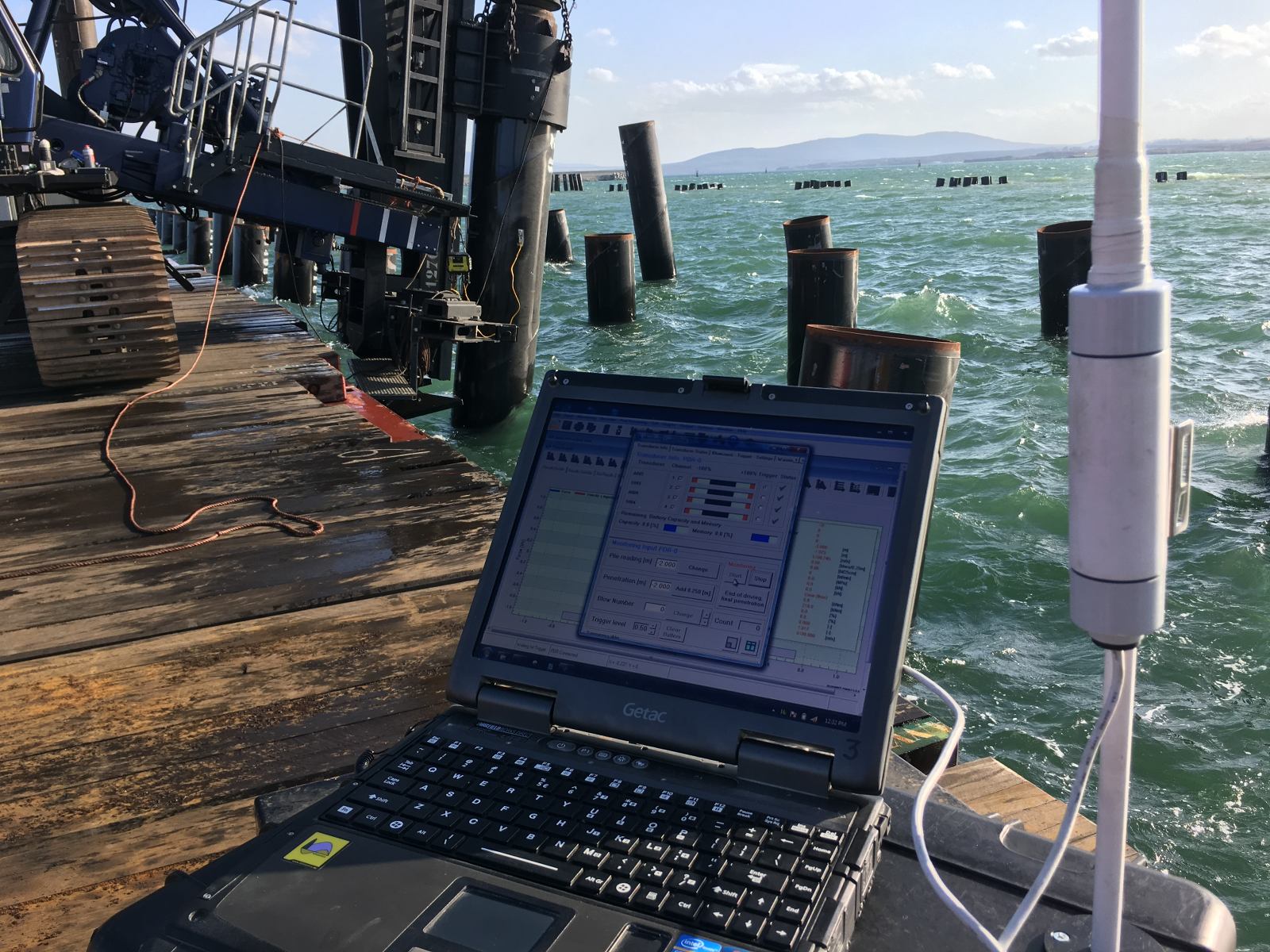
During pile driving, real-time monitoring provides the data needed to validate pre-drive predictions and detect developing problems. For impact-driven piles, Dynamic Load Testing (DLT) measures force and velocity at the pile head during each blow, allowing calculation of energy transfer, soil resistance distribution, and pile integrity. When measured blow counts diverge significantly from predicted values, this can indicate that friction fatigue is developing faster or slower than modelled, prompting reassessment of the installation plan.
For vibratory-driven piles, monitoring focuses on penetration rate, hammer performance, and displacement amplitude. Sudden changes in penetration rate can signal unexpected soil behaviour, including resistance reduction in granular layers or resistance build-up in cohesive zones. Post-installation testing, including static load testing or rapid load testing, provides the most direct verification of whether the installed pile meets its bearing capacity requirements.
How We Help with Soil Fatigue Assessment and Driveability Prediction
We bring together decades of experience in pile installation analysis, soil modelling, and foundation verification to help your team make well-informed decisions before and during pile driving. Our approach combines advanced software tools with field expertise to give you a complete picture of soil fatigue risk and its implications for your project.
- Driveability prediction studies: We use AllWave-PDP for impact driving and AllWave-VDP for vibratory driving to simulate the full installation process, including friction fatigue effects, SRD profiles derived from CPT data, and pile stress analysis across the entire penetration range.
- Soil modelling from CPT and laboratory data: Our soil models incorporate friction degradation as a depth-dependent function, giving you realistic SRD profiles rather than simplified constant-friction assumptions that can lead to refusal or over-driving.
- Hammer and equipment selection support: We evaluate eccentric moment, operating frequency, and displacement amplitude for vibratory hammers, and energy transfer and cushion performance for impact hammers, so your equipment choices are grounded in site-specific analysis.
- Dynamic Load Testing and installation monitoring: During pile driving, we provide real-time DLT monitoring and back-analysis to compare measured performance against predictions, identify unexpected soil behaviour, and support timely decisions on the site.
- Post-installation capacity verification: We offer static load testing, rapid load testing, and signal matching analysis to verify that installed piles meet their design requirements, accounting for set-up and any fatigue-related capacity changes.
- Independent technical review: For complex projects or disputed results, we provide independent assessments of driveability studies, soil models, and testing data to give you confidence in the conclusions.
If your project involves challenging soil conditions, long piles, or uncertainty about the right installation method, contact us to discuss how we can support your driveability and soil fatigue assessment needs.