


Is there a Rapid Load Testing code for the USA?
There is no dedicated US code specifically for Rapid Load Testing. However, ASTM D7383-19 provides the primary recognized standard for axial rapid load testing of deep foundations in the United States, and it is widely referenced on US projects where this method is specified. Engineers working in the USA also draw on international references such as ISO 22477-10 to supplement ASTM guidance. The sections below address the most common questions US engineers ask when evaluating whether a rapid load test is the right choice for their project.
What standards currently govern pile load testing in the USA?
Pile load testing in the USA is governed primarily by ASTM International standards. ASTM D1143 covers static axial compressive load testing, ASTM D4945 covers high-strain dynamic testing, and ASTM D7383-19 covers axial rapid load testing. These standards define equipment requirements, test procedures, measurement instrumentation, and reporting expectations, but they do not prescribe design acceptance criteria; those remain the responsibility of the engineer of record and the applicable project or jurisdictional requirements.
Beyond ASTM, state departments of transportation and federal agencies such as FHWA publish their own guidance documents that reference or supplement these standards. In practice, the governing standard on any given project is determined by the contract specification, the owner’s requirements, and the applicable building code, not by a single national mandate. This means that the engineer specifying the test method carries significant responsibility for selecting the appropriate standard and ensuring the test program delivers the information the design requires.
Is Rapid Load Testing officially recognized in the USA?
Yes, Rapid Load Testing is officially recognized in the USA through ASTM D7383-19, titled Standard Test Methods for Axial Rapid Load (Compressive Force Pulse) Testing of Deep Foundations. This standard distinguishes two procedures: Procedure A, which uses gas pressure to accelerate a reaction mass, and Procedure B, which uses a drop mass combined with a damping or spring system. Both procedures require specialist knowledge for execution and interpretation.
Recognition in a standard does not automatically mean widespread adoption. Rapid Load Testing remains less common in the USA than static or dynamic load testing, partly because familiarity with the method varies across the industry and partly because project specifications do not yet routinely include it as a default option. That said, acceptance is growing, particularly on projects where high test loads are needed and a conventional static reaction system would be costly or impractical to construct.
ASTM D7383 makes clear that converting the measured rapid load response to a static-equivalent capacity is not a straightforward calculation. The standard treats both execution and interpretation as specialist activities, which reflects the broader technical reality: the reliability of a rapid load test depends on correct load duration, accurate instrumentation, proper inertia correction, and an appropriate model for rate-dependent soil behavior.
How does RLT compare to Static Load Testing and Dynamic Load Testing under US practice?
Under US practice, these three methods occupy distinct positions in terms of test duration, load application mechanism, and the complexity of result interpretation. Rapid Load Testing sits between static and dynamic testing: it applies a force pulse that is long enough to limit stress wave effects in the pile, but short enough that inertia and rate-dependent soil effects must still be accounted for.
Static Load Testing
Static Load Testing under ASTM D1143 applies load slowly and incrementally, allowing the soil to respond under near-static conditions. It is widely accepted as the most direct method for measuring pile capacity, and its results require the least interpretive correction. The limitation is practical: building a reaction system capable of applying several meganewtons of load is expensive, time-consuming, and sometimes spatially impossible on congested sites or over water.
Dynamic Load Testing
Dynamic Load Testing under ASTM D4945 uses a drop hammer to apply a short, high-energy impact. The load duration is very brief, which means stress wave analysis is central to interpreting the result. Signal matching using programs such as CAPWAP is required to separate soil resistance from inertia and damping effects. Dynamic testing is fast and cost-effective for large numbers of piles, but the short pulse duration introduces more interpretive complexity, particularly for cast-in-place concrete piles where the hammer must strike the pile head directly.
Where Rapid Load Testing fits
Rapid Load Testing applies a longer force pulse than dynamic testing, which reduces stress wave complications in the pile and allows a relatively straightforward inertia correction using the Unloading Point Method or more advanced non-linear damping approaches. For cast-in-place piles, this longer pulse and the use of a spring system can reduce peak stresses compared to a direct hammer impact. The trade-off is that rate-dependent soil behavior, particularly in cohesive soils, must be assessed and corrected for. The method is most reliable when the soil conditions, pile type, and load duration all fall within the validated range of the interpretation method being used.
What international RLT codes are used as references on US projects?
On US projects where ASTM D7383 does not provide sufficient detail, engineers commonly reference ISO 22477-10:2016, the international standard for rapid load testing of piles under axial compressive load. ISO 22477-10 covers equipment, instrumentation, test preparation, safety, pile integrity, and reporting, and includes an informative annex on result analysis. It is more detailed than ASTM D7383 in several areas and is widely used by internationally experienced practitioners working on US projects.
Japan’s standardization work also carries technical weight in the global RLT community. The Japanese Geotechnical Society published what is recognized as the first formal standard for Rapid Load Testing in 2002, following a structured research program that began in the early 1990s. That program produced comparative data between rapid and static load tests and contributed to the development of non-linear damping interpretation methods. While JGS standards are not directly applicable under US contracts, the underlying research informs the technical basis of both ASTM D7383 and ISO 22477-10.
In practice, US engineers on internationally financed or designed projects, such as offshore wind, port infrastructure, or large energy facilities, may find that the project specification references ISO 22477-10 directly, either alongside or instead of ASTM D7383. Understanding both standards is useful for any engineer working across borders or on projects with international stakeholders.
When should engineers specify Rapid Load Testing on a US project?
Engineers should consider specifying Rapid Load Testing when high test loads are required and a conventional static reaction system would be disproportionately expensive, slow to construct, or physically impractical. The method is particularly relevant when multiple piles need to be tested within a short program window, or when site constraints, such as limited space, water access, or proximity to sensitive structures, make a static reaction frame difficult to install.
The following conditions make Rapid Load Testing a strong candidate for inclusion in a US test program:
- High required test loads where mobilizing a static reaction system would dominate project cost or schedule
- Cast-in-place concrete piles where the longer force pulse and spring system reduce peak stresses compared to direct hammer impact in dynamic testing
- Multiple piles to be tested within a compressed timeframe, where the speed of setup and execution offers a practical advantage
- Offshore or marine environments where a static reaction frame is impractical and dynamic testing presents logistical challenges
- Projects referencing ISO 22477-10 or international specifications that already recognize rapid load testing as an accepted method
Engineers should also assess the soil conditions carefully before specifying the method. In cohesive soils, rate-dependent behavior affects the measured resistance, and converting the rapid load response to a static-equivalent capacity requires an appropriate correction method. Depending on the project’s normative requirements, a project-specific correlation with a static test may be needed. Rapid Load Testing is not a universal substitute for static testing: it is a method that works well when the pile type, soil profile, required load level, and available interpretation approach are all aligned.
How We Can Help with Rapid Load Testing
We bring decades of experience in Rapid Load Testing, including direct involvement in the development of the method and the equipment used to perform it. When your project requires a rapid load test, whether under ASTM D7383, ISO 22477-10, or a project-specific specification, we provide end-to-end support:
- Pre-test prediction and planning: We assess the required drop mass, spring configuration, and drop height to achieve the target load level and a valid load duration for your pile-soil combination
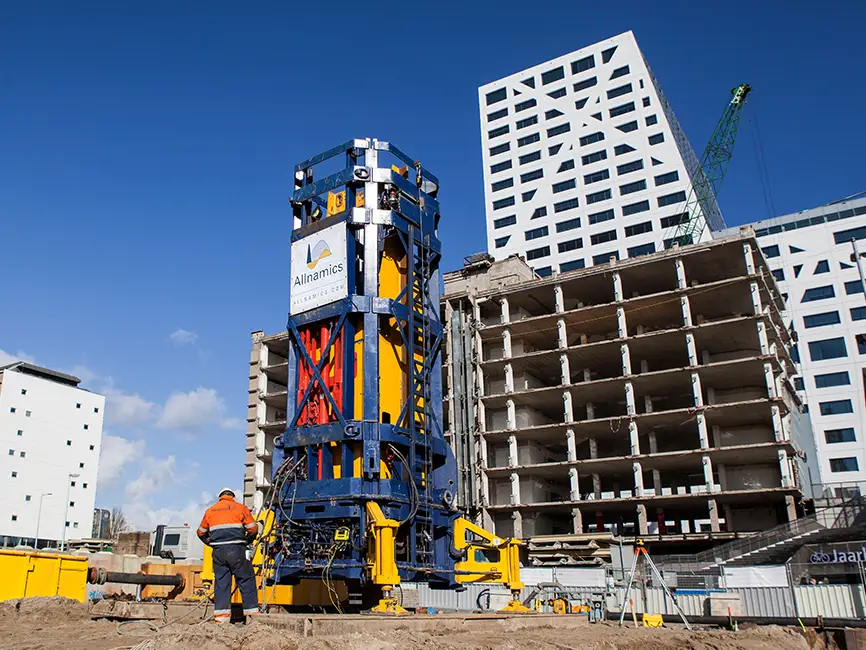
- Test execution: We mobilize and operate the StatRapid system, a modular drop-mass installation that can be transported by road and set up efficiently on site
- Result interpretation: We apply appropriate analysis methods, including the Unloading Point Method and non-linear damping approaches, and account for soil-specific rate effects, particularly in cohesive ground
- Reporting and technical review: We deliver clear, well-documented reports that meet the requirements of ASTM D7383, ISO 22477-10, or the applicable project standard
- Independent review: If your team needs a second opinion on a rapid load test specification or result interpretation, we provide independent technical assessments
If you are planning a foundation test program in the USA or on an internationally specified project, contact us to discuss whether Rapid Load Testing is the right method for your conditions and how we can support your program from specification through to final reporting.