


Is there a Rapid Load Testing code for the Netherlands?
Yes, the Netherlands has a national standard that governs Rapid Load Testing: NEN 7201:2025. This standard, published in 2025, provides the current normative framework for pile load testing in the Netherlands, including specific requirements for Rapid Load Testing as a distinct test category. It applies to foundation contractors, geotechnical engineers, and project teams working on Dutch construction and infrastructure projects where pile capacity verification is required.
The sections below address the most common questions about how Rapid Load Testing is regulated, interpreted, and applied under Dutch practice.
Which standard currently governs Rapid Load Testing in the Netherlands?
NEN 7201:2025 is the standard that currently governs Rapid Load Testing in the Netherlands. It is the national Dutch standard for pile load testing and explicitly addresses Rapid Load Testing as a separate test category alongside Static Load Testing and Dynamic Load Testing. The standard sets requirements for test execution, measurement, interpretation, and the conditions under which test results are considered valid.
NEN 7201:2025 recognizes two main execution principles within Rapid Load Testing: the falling weight with spring pack system (as used in the StatRapid method) and the Statnamic method, where a reaction mass is propelled upward to generate a downward force on the pile. Both approaches aim to produce a force pulse of sufficient duration to reduce stress wave interference in the pile, but the standard treats them as distinct execution variants with their own technical characteristics.
The standard also sets explicit limits on how test results may be extrapolated. When a test does not reach a clear failure load, NEN 7201:2025 restricts the conditions under which an unobserved failure load can be inferred from the load-displacement curve. This reflects the broader principle that Rapid Load Testing requires specialist interpretation and cannot be reduced to a simple reading of peak measured force.
How does Rapid Load Testing differ from Static and Dynamic Load Testing under Dutch practice?
Under Dutch practice, Rapid Load Testing is treated as a separate test category, not as a faster version of a Static Load Test or a slower version of a Dynamic Load Test. NEN 7201:2025 defines each method by its load duration and the physical behavior it produces, and it assigns different interpretation requirements to each category accordingly.
The distinction comes down to load duration and its consequences for pile and soil behavior:
- Static Load Testing (SLT) applies load slowly enough that inertia effects in the pile and rate-dependent soil behavior are negligible. The measured resistance directly reflects static pile capacity.
- Dynamic Load Testing (DLT) applies a very short impact, typically from a drop hammer. The load duration is so brief that stress wave phenomena dominate the pile response, requiring wave equation analysis to separate soil resistance from inertia and damping effects.
- Rapid Load Testing (RLT) uses a load duration that is long enough to suppress stress wave problems in the pile, but short enough that soil inertia and rate-dependent effects still need to be accounted for. The measured force is not equivalent to static capacity without a correction step.
This intermediate position is intentional. The longer force pulse in RLT reduces the complexity of pile dynamic behavior, making inertia correction relatively straightforward using methods such as the Unloading Point Method. However, rate-dependent soil behavior, particularly in cohesive soils, does not disappear automatically. Dutch practice, consistent with NEN 7201:2025, requires that the conversion from measured rapid response to static-equivalent capacity be performed by a qualified geotechnical specialist using an appropriate model for the specific pile-soil combination.
What is the role of ISO 22477-10 in Dutch Rapid Load Testing projects?
ISO 22477-10:2016 is the international standard for Rapid Load Testing and serves as an important reference document alongside NEN 7201:2025 on Dutch projects. While NEN 7201:2025 is the governing national standard, ISO 22477-10 provides detailed technical guidance on test execution, instrumentation, data quality, and interpretation methods that practitioners apply in practice.
ISO 22477-10 defines the physical criteria a test must meet to qualify as a Rapid Load Test, including requirements on load duration relative to pile wave travel time. It also addresses the Unloading Point Method and related analysis approaches, and it treats both execution and analysis as specialist activities requiring geotechnical expertise. This aligns directly with the position taken in NEN 7201:2025.
On Dutch projects, the two documents work together. NEN 7201:2025 defines the normative requirements and acceptance criteria within the Dutch regulatory context, while ISO 22477-10 provides the technical depth on how tests should be designed, executed, and analyzed. Project specifications may reference both, and geotechnical engineers working in the Netherlands are expected to be familiar with the requirements of each.
When is Rapid Load Testing accepted as an alternative to Static Load Testing in the Netherlands?
Rapid Load Testing is accepted as an alternative to Static Load Testing in the Netherlands when the test is properly executed, correctly interpreted, and the project conditions support a reliable conversion from rapid to static-equivalent capacity. NEN 7201:2025 defines the test classes and conditions under which RLT results may be used for pile capacity verification without a parallel static test.
In practice, Rapid Load Testing tends to be a suitable alternative when:
- High test loads are required and a conventional static reaction structure would be costly, time-consuming, or spatially impractical
- Multiple piles need to be tested within a limited timeframe
- The pile type and soil profile support a reliable rate-effect correction, particularly in non-cohesive soils where rate dependency is less pronounced
- The test reaches a sufficient load level to mobilize the information needed, including ideally a clear failure or near-failure response
For cast-in-place concrete piles, Rapid Load Testing can offer an advantage over Dynamic Load Testing because the force is measured directly and the longer load duration reduces peak stresses in the pile. However, the soil profile always plays a role in the acceptance decision. In cohesive soils, rate-dependent effects are more significant, and NEN 7201:2025 may require project-specific correlation with a static test depending on the test class applied. The decision to use RLT as a standalone alternative should always be made in consultation with a geotechnical specialist who can assess the pile-soil combination and the applicable normative requirements.
What are the limitations of Rapid Load Testing that Dutch codes address?
Dutch codes, primarily NEN 7201:2025, address several important limitations of Rapid Load Testing that affect how results may be interpreted and used. These limitations do not disqualify the method, but they define the conditions under which RLT results are reliable and the boundaries beyond which additional testing or correction is required.
The main limitations addressed in Dutch and international standards include:
- No direct measurement of static capacity: A Rapid Load Test measures a rapid soil response, not a static one. Converting this to static-equivalent capacity requires a validated analysis method and appropriate modeling of rate-dependent soil behavior. This conversion is not automatic.
- Rate dependency in cohesive soils: In clay and other cohesive soils, the high loading rate can mobilize a higher apparent resistance than would occur under static loading. No universal correction factor applies across all soil types and test configurations. The appropriate correction depends on the specific soil, pile type, and test setup.
- Extrapolation restrictions: When a test does not reach a clear failure load, NEN 7201:2025 explicitly restricts the conditions under which an unobserved failure load may be inferred. Extrapolating beyond the measured load-displacement response is not freely permitted under Dutch practice.
- Specialist interpretation required: Both NEN 7201:2025 and ISO 22477-10 treat the analysis of Rapid Load Test results as specialist work. The standard does not allow the peak measured force to be used directly as pile capacity without a qualified assessment of inertia, damping, and rate effects.
- Test design and prediction: A reliable RLT requires advance prediction of the required drop mass, spring configuration, and drop height to achieve the target load level and a valid load duration. This prediction should also assess pile stresses, the validity of the chosen analysis method, and compliance with the applicable standard.
These limitations reflect a broader principle embedded in Dutch and international standards: Rapid Load Testing is a physically distinct test category whose value comes from a deliberately chosen load duration. Reliability depends on meeting both the physical conditions for a valid test and applying an appropriate conversion method for the specific pile-soil combination.
How We Support Rapid Load Testing Projects in the Netherlands
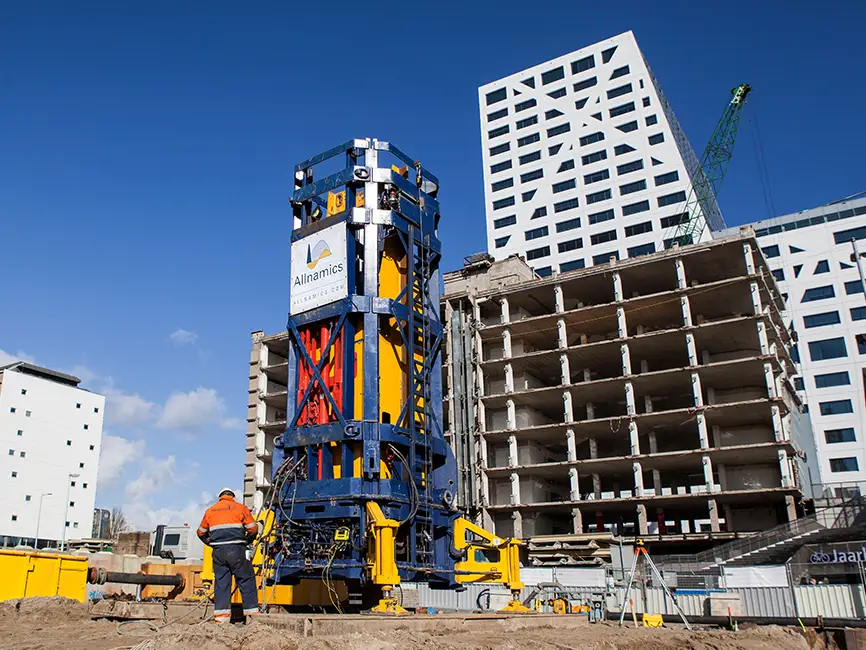
At Allnamics, we have been involved in the development and application of Rapid Load Testing for decades. Our founders contributed directly to the early research on stress wave behavior in piles and the development of testing methods that form the technical basis of modern RLT practice. We developed the StatRapid system, a modular falling weight and spring pack installation that generates a controlled force pulse without a combustion process, and we apply it on projects across the Netherlands and internationally.
When your project requires Rapid Load Testing under NEN 7201:2025 or ISO 22477-10, we provide:
- Test design and prediction: We determine the required drop mass, spring configuration, and drop height to achieve the target load level and a valid load duration for your specific pile-soil combination
- Full test execution: We mobilize and operate the StatRapid system, including instrumentation, data acquisition, and quality control during the test
- Specialist interpretation: We analyze the results using appropriate methods for your soil conditions, including rate-effect corrections for cohesive soils where relevant
- Normative compliance: We ensure the test design, execution, and reporting meet the requirements of NEN 7201:2025 and, where applicable, ISO 22477-10
- Independent review: We provide independent technical assessments of RLT results produced by others, including signal matching, interpretation review, and capacity verification
If you are planning a foundation testing program and want to understand whether Rapid Load Testing is the right approach for your project, contact our team to discuss your pile type, soil conditions, and normative requirements.