


Is there a Rapid Load Testing code for Europe?
There is currently no dedicated European code for Rapid Load Testing. The international standard ISO 22477-10:2016 fills this gap for European engineers, providing the primary normative framework for conducting and interpreting rapid load tests on piles. Until a Europe-specific code is adopted, ISO 22477-10 combined with national standards such as the Dutch NEN 7201:2025 represents the most authoritative guidance available. The sections below address the most common questions engineers raise about RLT standards, comparisons, limitations, and method selection.
Which standard currently governs Rapid Load Testing in Europe?
ISO 22477-10:2016 is the primary standard governing Rapid Load Testing in Europe. Published by the International Organization for Standardization, it defines the requirements for performing and interpreting rapid load tests on piles and is referenced across European geotechnical practice. No dedicated Eurocode or CEN standard for RLT currently exists, which means ISO 22477-10 functions as the de facto European reference.
Alongside ISO 22477-10, national standards play an important complementary role. In the Netherlands, for example, NEN 7201:2025 provides detailed national requirements for pile load testing, including specific provisions for rapid load tests. This standard sets explicit restrictions on extrapolating capacity from test results where failure has not been reached, which has direct consequences for how engineers plan and report RLT programs.
The American standard ASTM D7383 is also widely referenced in international projects, particularly where US-based clients or contractors are involved. However, for European projects, ISO 22477-10 takes precedence as the governing normative document.
The development of formal RLT standards has a clear historical trajectory. Japan published the first formal standard for Rapid Load Testing in 2002 through the Japanese Geotechnical Society (JGS 1815-2002), following a structured research and standardization program that began in the early 1990s. International standardization followed, with ISO 22477-10 representing the current global benchmark. European engineers working on projects that require rapid load testing should verify which national standard applies in their jurisdiction alongside ISO 22477-10.
How does ISO 22477-10 define Rapid Load Testing?
ISO 22477-10 defines Rapid Load Testing as a pile test method in which a force pulse is applied to the pile head with a duration long enough to mobilize the full pile as a rigid body, but short enough that inertia effects in the surrounding soil remain manageable. This distinguishes RLT from both static load testing and dynamic load testing, placing it in a separate test category with its own physical conditions and interpretation requirements.
The standard recognizes that the load duration in a rapid load test is deliberately chosen. The force pulse is long enough to reduce stress wave complications within the pile itself, which is a significant advantage over dynamic load testing for certain pile types. At the same time, the pulse is short enough that a relatively straightforward inertia correction can be applied to separate the pile’s response from soil resistance.
ISO 22477-10 treats both the execution and the analysis of RLT as specialist activities. It does not allow a simple direct conversion of the maximum measured force to a static capacity. Instead, the standard requires that engineers apply a recognized interpretation method, account for rate-dependent soil behavior, and confirm that the test conditions satisfy the physical requirements for the method to be valid.
The standard acknowledges multiple interpretation approaches. The Unloading Point Method (UPM), developed by Middendorp, is the most widely used. The Sheffield Method offers a more explicit treatment of rate-dependent soil behavior and is particularly relevant in cohesive soils. The Variable Damping Method treats damping as variable throughout the loading process. ISO 22477-10 does not mandate a single method, but it requires that the chosen approach is appropriate for the pile-soil combination being tested.
How does Rapid Load Testing compare to Static Load Testing under European standards?
Under European standards, Rapid Load Testing is not treated as a direct equivalent to Static Load Testing. ISO 22477-10 and NEN 7201:2025 both recognize RLT as a separate test category. The measured response during a rapid load test reflects a combination of static soil resistance, inertia effects, and rate-dependent soil behavior. Deriving a static-equivalent capacity requires specialist interpretation, not a direct reading of the peak measured force.
The table below summarizes the key differences between RLT and SLT under European normative practice:
- Load application: SLT applies load incrementally over hours or days; RLT applies a single force pulse lasting typically 100 to 200 milliseconds.
- Measured response: SLT measures load and displacement directly under quasi-static conditions; RLT measures force, velocity, and acceleration, requiring post-processing to derive static-equivalent behavior.
- Interpretation complexity: SLT results are interpreted directly; RLT results require inertia correction and, in cohesive soils, a rate-effect correction.
- Failure mobilization: Both methods require the test to load the pile sufficiently to mobilize the desired information. NEN 7201:2025 explicitly restricts extrapolation of failure load from RLT results where failure has not been reached.
- Normative status: SLT is the reference method in European geotechnical standards; RLT is accepted as an alternative where its conditions of applicability are satisfied.
For in-situ concrete piles, RLT can offer an advantage over Dynamic Load Testing because the force is measured directly and the longer load duration reduces peak stresses in the pile. However, this advantage does not make RLT equivalent to SLT. The reliability of an RLT result depends on the appropriateness of the load duration, the quality of the measurements, the accuracy of the inertia correction, and the suitability of the rate-effect model for the specific soil conditions.
What are the limitations of using RLT without a dedicated European code?
Without a dedicated European code, engineers face inconsistency in how RLT results are accepted, interpreted, and validated across different projects and jurisdictions. ISO 22477-10 provides a solid technical foundation, but the absence of a Eurocode-level standard means that national interpretations, client requirements, and regulatory expectations can vary significantly from one country to another.
Several practical limitations follow from this gap:
- No universal rate-effect correction for cohesive soils: Different research programs have used different correction values and analysis methods depending on soil type, test setup, and interpretation model. ISO 22477-10 does not prescribe a single universal correction, which means engineers must justify their chosen approach on a project-by-project basis.
- Restrictions on extrapolation: NEN 7201:2025 sets explicit limits on what can be concluded when the pile has not been loaded to failure. Engineers cannot freely extrapolate a failure load from a load-displacement curve where the failure point was not actually reached.
- Specialist knowledge requirement: ISO 22477-10, ASTM D7383, and the broader research literature all treat RLT interpretation as specialist work. Without a harmonized European code, there is no standardized minimum competency framework that applies consistently across the continent.
- Acceptance by authorities: Some national authorities and clients may not accept RLT results without a supplementary static load test or project-specific correlation data, particularly in cohesive soils where rate dependency is a recognized concern.
- Variability in reporting requirements: The absence of a single European code means that reporting formats, required deliverables, and quality assurance expectations are not harmonized, which can complicate cross-border projects.
These limitations do not make RLT unsuitable for European projects. They do mean that careful planning, transparent methodology, and specialist interpretation are non-negotiable when using the method under the current normative framework.
When should engineers choose Rapid Load Testing over other pile testing methods?
Rapid Load Testing is most suitable when high test loads are needed and a conventional static reaction system would be costly, time-consuming, or physically impractical. It is also a strong choice when multiple piles need to be tested within a short timeframe, or when the site conditions make installing a static reaction frame difficult.
Several factors support choosing RLT over alternatives:
- High required test loads: Assembling a static reaction system for very high loads is expensive and slow. RLT equipment such as the StatRapid, which uses a drop mass and a modular spring system, can generate large forces without the logistical burden of kentledge or anchor piles.
- In-situ concrete piles: For bored piles and CFA piles, RLT offers an advantage over Dynamic Load Testing because the force is measured directly and the longer load pulse reduces peak stresses in the pile shaft.
- Multiple piles in a short period: RLT can be mobilized and demobilized relatively quickly, making it practical for programs that require testing across a large number of piles.
- Space constraints: Where site access limits the installation of a static reaction frame, the compact footprint of RLT equipment can be a practical advantage.
RLT is not always the right choice. In cohesive soils, rate-dependent behavior requires careful attention, and the conversion from measured rapid response to static-equivalent capacity demands a suitable correction method and, in some normative contexts, project-specific correlation with a static load test. The method should always be selected based on pile type, soil profile, required information, available space, applicable standard, and the specific objectives of the testing program.
How Allnamics Supports Your Rapid Load Testing Program
We have been involved in the development and application of Rapid Load Testing for decades, and our team includes specialists who contributed directly to the methods and standards that govern RLT practice today. When you work with us, you get more than equipment and measurements. You get a complete technical service built around the specific requirements of your project and the applicable normative framework.
Here is what we provide:
- Pre-test prediction and planning: We assess the required drop mass, spring configuration, and drop height to achieve the target load level and load duration, and we verify that the planned test will satisfy the conditions required by ISO 22477-10 or the applicable national standard.
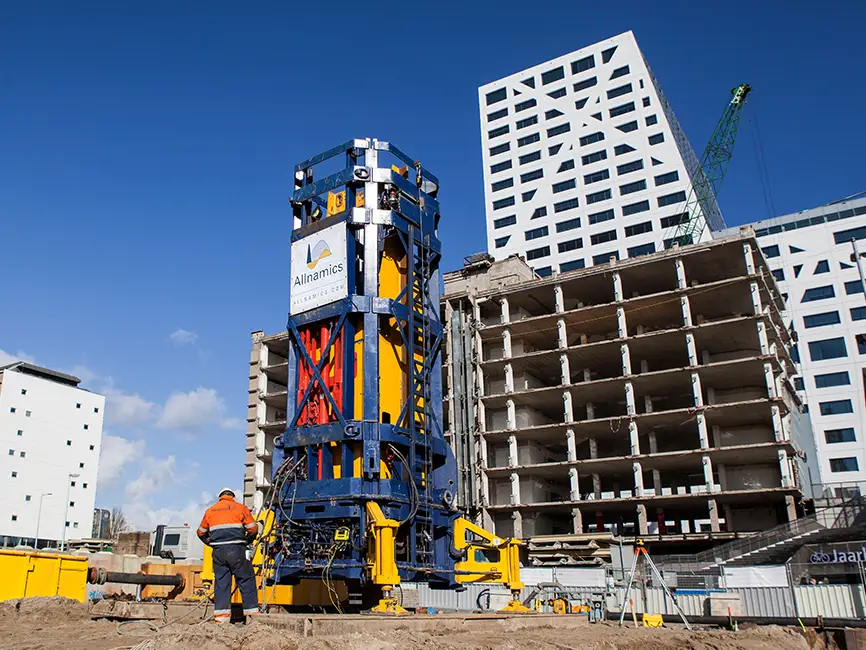
- StatRapid execution: Our proprietary StatRapid system generates the load pulse using a drop mass and a modular spring package, without combustion. The system is modular, road-transportable, and configurable for a wide range of pile capacities.
- Specialist interpretation: We apply the appropriate analysis method for your pile-soil combination, whether that is the Unloading Point Method, the Sheffield Method, or another approach, and we document the reasoning clearly for regulatory and client review.
- Rate-effect assessment: For cohesive soils, we evaluate rate-dependent behavior explicitly and apply corrections that are appropriate for the specific ground conditions, rather than applying a generic factor.
- Reporting aligned with applicable standards: Our reports address the requirements of ISO 22477-10, NEN 7201:2025, and any other applicable standard, including the restrictions on extrapolation where failure has not been mobilized.
- Independent technical review: If your team has already conducted RLT and needs an independent assessment of the results or interpretation methodology, we provide that service as well.
If you are planning a pile testing program and want to understand whether Rapid Load Testing is the right method for your project, contact our team to discuss your specific requirements.