


Are there international codes for Rapid Load Testing?
Yes, international codes for Rapid Load Testing exist and are actively used across multiple countries. The most widely recognized standards are ISO 22477-10:2016, ASTM D7383-19, and national codes such as NEN 7201:2025 in the Netherlands and the JGS standard in Japan. These documents govern how a rapid load test must be executed, measured, and interpreted. The sections below walk through each standard, what it requires, and how regulators and clients respond to rapid load test results in practice.
Which countries have adopted Rapid Load Testing standards?
Several countries have adopted formal standards for Rapid Load Testing, with Japan, the United States, and the Netherlands leading the way. Japan published the first recognized national standard in 2002, followed by the ASTM standard in the United States and the ISO standard that now provides an international reference framework used across Europe and beyond.
Japan was the first country to formalize Rapid Load Testing through a national standard. The first Statnamic test in Japan took place in 1991, carried out by Takenaka Corporation on a cast-in-situ concrete pile. Comparative testing against static load tests followed in 1992. By 1993, a dedicated research group had formed under the Tokyo Institute of Technology, and a formal standardization committee was established within the Japanese Geotechnical Society in 1998. This work resulted in the inclusion of Rapid Load Testing in the 2002 Standards of the Japanese Geotechnical Society for Vertical Load Tests of Piles (JGS 1815-2002), recognized as the first formal national standard for this test method in the world.
The United States followed with ASTM D7383, which has since been updated to the 2019 version. This standard is widely referenced in North American practice and is also used as a reference document on international projects where no local standard exists.
The Netherlands has integrated Rapid Load Testing into its national geotechnical testing standard, NEN 7201:2025, which replaced the earlier NPR 7201:2017+A1:2020. The Dutch standard explicitly includes Rapid Load Testing alongside static and dynamic methods, and it defines when a rapid load test may be used as an alternative to a static load test.
At the international level, ISO 22477-10:2016 provides a framework that member countries can adopt or reference directly. This standard is particularly relevant for projects in Europe and for international contracts where a single recognized reference is needed.
What does ASTM D7383 require for Rapid Load Testing?
ASTM D7383-19 defines two distinct test procedures for axial rapid load testing of deep foundations and requires that both execution and interpretation be carried out by qualified specialists. The standard covers equipment specifications, measurement instrumentation, test preparation, and reporting, and it explicitly states that converting measured force pulses into static-equivalent capacity is not a straightforward process.
The two procedures are:
- Procedure A: Uses a gas-pressure system to accelerate a reaction mass upward, generating a compressive force pulse on the pile head.
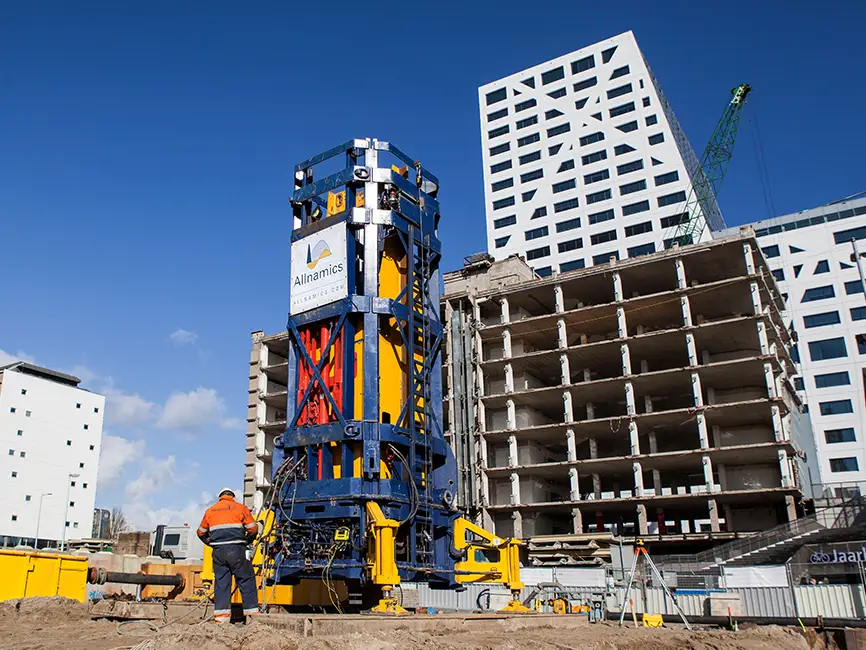
- Procedure B: Uses a drop mass combined with a damping or spring system to deliver the load pulse. This is the approach used by the StatRapid system, which generates the load through a falling mass and a modular spring package.
ASTM D7383 requires that the test system produce a force pulse of sufficient duration to satisfy the conditions that distinguish a rapid load test from a dynamic load test. The standard also requires continuous measurement of force and velocity at the pile head, and it specifies minimum instrumentation quality and calibration standards.
Critically, ASTM D7383 treats interpretation as specialist work. The standard does not allow the maximum measured force to be taken directly as static pile capacity. Instead, it requires that inertia corrections be applied and that rate-dependent soil behavior be accounted for using an appropriate analysis method such as the Unloading Point Method or a more advanced model. This reflects the broader principle that a rapid load test measures a dynamic soil response that must be converted to a static equivalent through informed engineering judgment.
How does the Dutch NEN 7201:2025 guideline govern Rapid Load Testing?
NEN 7201:2025 is the current Dutch national standard for determining the axial bearing capacity of foundation piles through load testing. It explicitly includes Rapid Load Testing as a recognized test method and defines the conditions under which it may serve as an alternative to a static load test, depending on the test class and soil conditions around the pile tip.
The standard distinguishes between different load test classes, each with different requirements for what must be demonstrated and what level of interpretation is acceptable. For Rapid Load Testing, NEN 7201:2025 sets out additional requirements related to soil conditions near the pile tip, particularly for cohesive soils, where rate-dependent effects on soil resistance are more pronounced and harder to correct for reliably.
One important provision in NEN 7201:2025 concerns failure load extrapolation. The standard explicitly restricts the conditions under which a failure load may be inferred from a test that did not reach clear failure. If the pile was not loaded to failure during the test, the standard limits how far an engineer may extrapolate the measured response to estimate ultimate capacity. This is a meaningful constraint for project planning, as it affects how test programs are designed and what load levels must be targeted.
NEN 7201:2025 replaced NPR 7201:2017+A1:2020 and represents the most current Dutch regulatory position on pile load testing. It aligns with the broader ISO framework while adding country-specific provisions that reflect Dutch soil conditions and construction practice.
What’s the difference between Rapid Load Testing and Static Load Testing standards?
The core difference between Rapid Load Testing and Static Load Testing standards is what they measure and how results are interpreted. Static Load Testing standards govern a direct measurement of pile response under sustained load, while Rapid Load Testing standards govern a short-duration force pulse test whose results must be converted to a static equivalent through engineering analysis.
Static Load Testing standards, such as ASTM D1143 or the relevant sections of ISO 22477, describe how to apply a load incrementally, hold it for defined periods, and measure settlement directly. The result is a load-settlement curve that represents actual static pile behavior without further conversion. Regulators and clients generally treat static load test results as the most direct evidence of pile capacity.
Rapid Load Testing standards, including ISO 22477-10 and ASTM D7383, acknowledge that the test does not measure static behavior directly. Instead, they define how the force pulse must be applied and measured, and they treat the analysis of results, including inertia correction and rate-effect modeling, as a specialist task. The standards provide guidance on analysis methods but do not prescribe a single universal correction factor, particularly for cohesive soils where rate dependency varies with soil type and test configuration.
This distinction has practical consequences. A rapid load test result carries more interpretive uncertainty than a static load test result, and that uncertainty must be managed through appropriate analysis methods, comparison with reference tests where available, and compliance with the applicable standard’s requirements for the specific test class. The standards for both methods agree on one point: neither test should be treated as a simple pass/fail measurement without qualified engineering interpretation.
Are Rapid Load Testing results accepted by regulators and clients worldwide?
Yes, Rapid Load Testing results are accepted by regulators and clients in many countries, provided the test is executed and interpreted in accordance with a recognized standard and the results are presented with appropriate engineering documentation. Acceptance depends heavily on which standard applies to the project, the soil conditions involved, and whether the test class permits a rapid load test as a substitute for a static load test.
In countries where a national standard exists, Japan, the United States, and the Netherlands, regulators have a clear framework for evaluating rapid load test submissions. In other countries, ISO 22477-10:2016 often serves as the reference document, and acceptance depends on the regulator’s familiarity with the method and the quality of the submitted analysis.
Client acceptance follows a similar pattern. Engineering consultancies and foundation contractors who work regularly with pile testing are generally comfortable with rapid load test results when they are supported by a clear analysis report. Clients who are less familiar with the method may require additional explanation or a comparison test against a static load test to build confidence in the results.
One factor that consistently influences acceptance is the soil type. In granular soils, the conversion from rapid to static response is well supported by research and comparative testing, and acceptance tends to be straightforward. In cohesive soils, rate-dependent effects are more complex, and some regulators or clients may require project-specific correlation data or impose additional conditions before accepting rapid load test results as equivalent to static test results.
How Allnamics Supports Rapid Load Testing Compliance
We have been involved in the development and application of Rapid Load Testing for decades, and we work directly with the standards that govern it, ISO 22477-10, ASTM D7383, and NEN 7201:2025. When your project requires a rapid load test that will hold up to regulatory review and client scrutiny, we provide the full chain of expertise from test design to final reporting.
Here is what we offer:
- Test program design: We assess your pile type, soil profile, required load level, and applicable standard to define the right test configuration and target load, including the drop mass, spring configuration, and drop height needed to meet the required force pulse duration.
- StatRapid execution: We operate our own StatRapid system, a modern Rapid Load Testing installation that uses a falling mass and modular spring package to generate a controlled force pulse without combustion. The system is modular and transportable, making it suitable for a wide range of site conditions.
- Specialist interpretation: We apply appropriate analysis methods, including the Unloading Point Method and more advanced rate-effect models, to convert measured rapid load test data into reliable static-equivalent capacity estimates, with full documentation of assumptions and limitations.
- Standard-compliant reporting: Our reports are structured to meet the documentation requirements of ISO 22477-10, ASTM D7383, and NEN 7201:2025, giving your team and your regulators a clear, auditable record of the test and its interpretation.
- Independent review: If your project involves a rapid load test carried out by another party, we can provide an independent technical review of the test data and interpretation report.
If you are planning a foundation testing program and want to understand which standard applies to your project and whether a rapid load test is the right approach, contact our team to discuss your specific situation.