


What is the difference between Rapid Load testing and Dynamic Load testing?
Rapid Load Testing (RLT) and Dynamic Load Testing (DLT) are both dynamic pile testing methods, but they differ fundamentally in how long the load is applied and how that load is measured and interpreted. RLT applies a load over a much longer duration than DLT, which reduces the influence of stress wave propagation in the pile and allows the pile to behave more like a concentrated mass. DLT uses a short hammer impact that generates strong stress waves, requiring a different measurement and analysis approach. The sections below unpack each key difference in practical terms.
How does each method actually load the pile?
Dynamic Load Testing applies a very short, high-energy impact to the pile head using a drop hammer or hydraulic hammer. This impact lasts only a few milliseconds and generates strong stress waves that travel down the pile and back. Rapid Load Testing applies a much longer load pulse, typically lasting between 50 and 200 milliseconds, using a falling mass combined with a spring system or a gas-propelled reaction mass.
In DLT, the hammer strikes the pile head and the resulting stress wave travels through the pile at the material’s wave speed. The entire event is over before the wave has time to travel the full pile length more than once or twice. This means different parts of the pile are moving at different velocities at any given moment during the test.
In a rapid load test, the load duration is long enough relative to the pile’s wave travel time that stress wave effects within the pile are significantly reduced. Under the right conditions, the pile moves largely as a single body during the relevant part of the test. This is the defining physical criterion that places RLT in its own category between Static Load Testing and DLT.
What does each test actually measure?
DLT measures strain and acceleration near the pile head using strain gauges and accelerometers. Force is then calculated from the measured strain combined with the pile’s cross-sectional area and elastic modulus. RLT measures force directly at the pile head using a calibrated load cell, and displacement is measured independently, making the force measurement less dependent on pile material properties.
This distinction matters in practice. For cast-in-place concrete piles, the actual concrete properties and cross-section can vary along the pile length. In DLT, any uncertainty in those properties directly affects the calculated force. In RLT, the load cell measures force independently of pile material, which can be an advantage for bored or augered piles where material variability is more common.
Both methods also measure displacement and velocity, but the way these signals are used in analysis differs significantly. DLT analysis relies on stress wave theory and signal matching software. RLT analysis applies an inertia correction to account for the pile’s mass and acceleration, then uses a damping model to separate the rate-dependent soil resistance from the resistance that would be mobilized under static loading.
Which method is more accurate for predicting static capacity?
Neither method directly measures static capacity. Both require analysis to derive an equivalent static resistance from a dynamic event. The accuracy of each depends on the quality of the measurements, the appropriateness of the analysis model, and the soil conditions. RLT is generally considered closer to static behavior because the longer load duration reduces pile stress wave effects, but soil rate effects still require careful correction, particularly in cohesive soils.
In DLT, CAPWAP or similar signal matching analysis is used to separate soil resistance from inertia and damping effects. This is a well-established approach, but it depends on the analyst’s expertise and the quality of the input signals. The short load duration means strong stress wave phenomena must be modeled accurately.
In RLT, the Unloading Point Method or similar approaches are used to derive the equivalent static load-displacement response. The reliability of this result depends on several factors:
- Whether the load duration was long enough to limit stress wave effects in the pile
- Whether the inertia correction is applied correctly using accurate mass estimates
- Whether the damping model appropriately captures rate-dependent soil behavior
- Whether the test mobilized sufficient displacement to reach or approach failure
In cohesive soils, loading rate effects on soil resistance can be significant, and no single universal correction factor applies across all conditions. Standards including ISO 22477-10 and ASTM D7383 treat RLT interpretation as specialist work, not a simple conversion of peak measured force to static capacity.
When should you choose RLT over DLT, or vice versa?
Choose RLT when you need to test at high load levels and a conventional static reaction system would be impractical, costly, or spatially difficult to install. Choose DLT when speed and economy are the primary drivers, when existing installation equipment can be used, or when testing a large number of piles during installation monitoring.
RLT becomes particularly attractive in these situations:
- Very high test loads are required and a static reaction frame would be disproportionately large or expensive
- Multiple piles need to be tested within a short timeframe
- The pile type makes direct force measurement preferable, such as with large-diameter bored piles
- Site access or space constraints make a static reaction system impractical
DLT is often preferred when:
- Piles are being driven and monitoring during installation is already planned
- A large number of acceptance tests are needed across a site
- Budget and time constraints favor a faster, lower-mobilization approach
- The pile type and soil conditions are well suited to stress wave analysis
For cohesive soils, RLT can still be applied, but your team should plan for appropriate rate-effect corrections and, depending on the applicable standard, consider whether a correlation with a static test is required.
Can RLT and DLT replace a static load test?
Both RLT and DLT can provide reliable estimates of pile capacity and load-displacement behavior, but neither is a direct substitute for a Static Load Test in all situations. Whether they can replace an SLT depends on the applicable standard, the project’s risk category, the soil conditions, and whether the test mobilizes sufficient displacement to produce meaningful results.
Standards such as NEN 7201:2025 set explicit limits on what can be concluded from a rapid load test depending on the test load class and whether a failure load was actually reached during the test. If the pile did not reach a clear failure point, extrapolating a capacity from the measured curve is not permitted without specific justification.
In practice, RLT and DLT are most effective when used as part of a broader testing program. They can reduce the number of static load tests required, help screen a larger number of piles efficiently, and provide valuable data on soil resistance distribution. When properly executed and interpreted by qualified specialists, both methods deliver results that support sound foundation design decisions.
How Allnamics Supports Your Pile Testing Program
We have been involved in the development and application of Rapid Load Testing and Dynamic Load Testing for decades. Our team combines deep technical knowledge with hands-on field experience across onshore and offshore projects worldwide, helping you select the right method and get reliable results from it.
When you work with us on pile testing, we provide:
- Method selection advice based on your pile type, soil conditions, required load levels, applicable standards, and project constraints
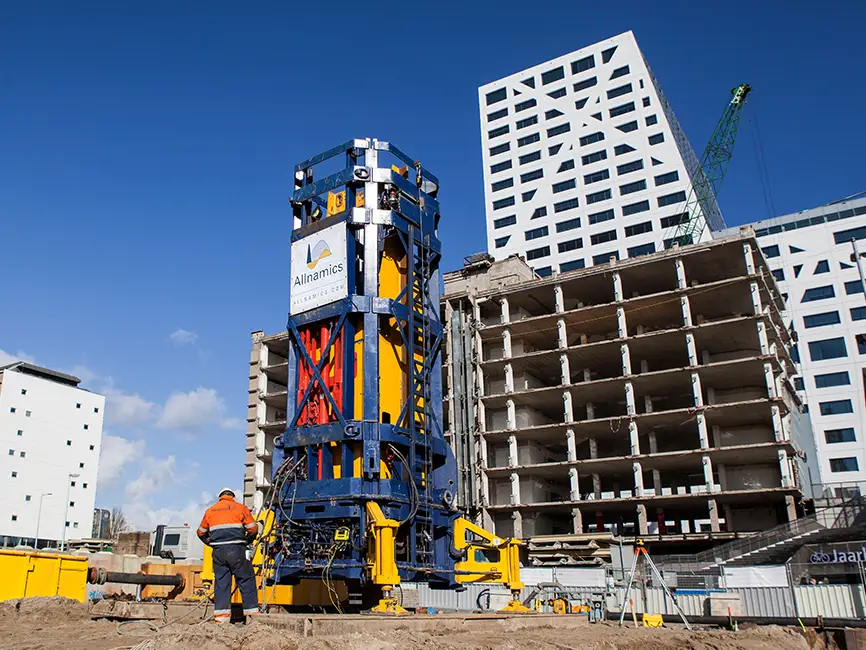
- RLT execution using the StatRapid, our in-house-developed rapid load testing system that measures force directly via calibrated load cells and generates controlled load pulses without combustion
- DLT and Pile Driving Analysis (PDA) for installation monitoring and acceptance testing, including signal matching and CAPWAP-equivalent analysis
- Specialist interpretation of test results, including inertia correction, rate-effect assessment, and derivation of equivalent static capacity in line with ISO 22477-10, ASTM D7383, and NEN 7201:2025
- Independent technical review of test programs and results for clients who need a second opinion or regulatory validation
If you are planning a foundation testing program and want to discuss which approach fits your project, contact our team and we will help you find the most effective and reliable solution.