


How do you account for pile relaxation in test results?
To account for pile relaxation in test results, you need to perform a restrike test after a defined waiting period following installation, then compare the measured capacity at restrike with the end-of-drive resistance. This comparison reveals how much bearing capacity has changed over time and whether the pile meets design requirements under realistic, stabilized soil conditions.
Relaxation is most significant in certain soil types and pile configurations, and ignoring it can lead to unconservative capacity estimates that put a foundation program at risk. The sections below address the most common questions engineers and project teams raise when dealing with relaxation in pile load testing programs.
What causes pile relaxation after driving?
Pile relaxation is a reduction in bearing capacity that occurs after driving stops. It happens when the soil surrounding or beneath the pile toe recovers in a way that reduces resistance rather than increasing it. The most common cause is the release of locked-in stresses in dense, brittle materials such as dense sands, silts, or soft rocks that were temporarily compressed or displaced during driving.
In these materials, driving generates high compressive stresses in the soil structure. Once the hammer stops, the soil partially rebounds elastically, reducing the contact stress between the pile and the surrounding material. This rebound can lower both shaft friction and toe resistance below the values recorded at the end of drive.
Relaxation is also observed in certain shales, chalks, and weak rocks where the driving process fractures or disturbs the material. The fractured zone around the pile toe may consolidate or shift after driving, reducing the mechanical interlock that contributed to resistance during installation. In these cases, the capacity measured immediately after driving can be significantly higher than the long-term static capacity the pile will actually deliver in service.
How does pile relaxation affect measured bearing capacity?
Pile relaxation causes the bearing capacity measured at the end of drive to overestimate the pile’s true static capacity. If your team uses end-of-drive resistance as the acceptance criterion without accounting for relaxation, you may accept piles that will underperform once construction loads are applied.
The magnitude of the effect varies with soil type, pile material, and time elapsed after driving. In dense granular soils prone to relaxation, the drop in capacity between the end of drive and restrike can be substantial enough to change whether a pile passes or fails acceptance criteria. In extreme cases involving weak rock or structured dense sands, the capacity at restrike can be a fraction of what was recorded during driving.
This has direct consequences for how you interpret dynamic load testing results. A dynamic test performed at the end of drive in a relaxation-prone profile will produce an optimistic capacity estimate. The signal matching analysis will correctly reflect the resistance mobilized at that moment, but that resistance does not represent the stabilized, long-term condition. Any bearing capacity derived from end-of-drive data in these conditions needs to be treated with caution and supplemented with restrike testing after an appropriate waiting period.
What is the difference between pile relaxation and set-up?
Pile relaxation and pile set-up are opposite phenomena. Set-up is an increase in bearing capacity over time after driving, while relaxation is a decrease. Both are time-dependent responses to the disturbance caused by pile installation, but they occur in different soil types and through different mechanisms.
Set-up: capacity gain over time
Set-up is most pronounced in cohesive soils such as soft to medium clays. During driving, excess pore water pressures build up around the pile shaft. These pressures temporarily reduce effective stress and, with it, shaft friction. As pore pressures dissipate over hours, days, or weeks after driving, effective stress recovers and shaft friction increases. The pile gains capacity progressively until the soil reaches a new equilibrium. This is why driven piles in clay are typically tested at restrike after a waiting period long enough for meaningful pore pressure dissipation.
Relaxation: capacity loss over time
Relaxation occurs primarily in dense granular soils, silts, and weak or structured rocks. The mechanism is elastic rebound and stress redistribution rather than pore pressure dissipation. The soil or rock around the pile toe partially recovers its original structure after the dynamic disturbance of driving, reducing the resistance that was temporarily mobilized. Unlike set-up, relaxation can happen quickly, sometimes within hours of driving stopping.
In practice, a single pile profile can exhibit both effects simultaneously. A pile driven through soft clay into a dense sand layer may show set-up in the clay contribution to shaft friction while showing relaxation in the toe resistance from the sand. Separating these contributions requires careful restrike testing and signal matching analysis that distributes resistance along the pile shaft and at the toe independently.
How do restrike tests account for pile relaxation?
A restrike test accounts for pile relaxation by measuring bearing capacity after a defined waiting period, capturing the stabilized soil resistance rather than the temporarily elevated resistance recorded during driving. The test applies a hammer blow to the installed pile and records the dynamic response, which is then analyzed using signal matching to derive the mobilized static capacity at that point in time.
To use restrike results correctly for relaxation assessment, your team needs to plan the test timing deliberately. The waiting period must be long enough for the relaxation process to reach a stable state. In most granular soils and weak rocks, relaxation occurs relatively quickly, but the exact timeframe depends on the material. Testing too soon after driving may still capture elevated resistance that has not yet fully relaxed.
A structured approach to restrike testing for relaxation typically involves the following steps:
- Record end-of-drive data using dynamic monitoring during installation to establish a baseline resistance.
- Define a waiting period based on soil type, pile dimensions, and any available site-specific experience or literature guidance for the material in question.
- Perform the restrike test after the waiting period, applying sufficient hammer energy to fully mobilize soil resistance.
- Compare restrike capacity with end-of-drive capacity to quantify the relaxation effect and determine whether the pile meets design requirements under stabilized conditions.
- Apply appropriate safety factors to the restrike result, accounting for the inherent bandwidth in dynamic load testing signal matching.
If the restrike capacity falls below the design requirement, the pile program needs adjustment before construction proceeds. This might mean driving piles deeper, changing the installation sequence, or revising acceptance criteria for the site.
Which pile testing methods best detect relaxation effects?
Dynamic load testing at restrike is the most practical method for detecting and quantifying pile relaxation in most foundation programs. It allows direct comparison between end-of-drive and post-waiting-period resistance using the same measurement approach, making the change in capacity clearly attributable to time-dependent soil behavior rather than differences in test method.
For end-bearing driven piles in granular soils, dynamic load testing at restrike produces reliable results when performed with well-maintained equipment and interpreted by experienced engineers using signal matching software. Under these conditions, the capacity estimate falls within an acceptable range for most project requirements.
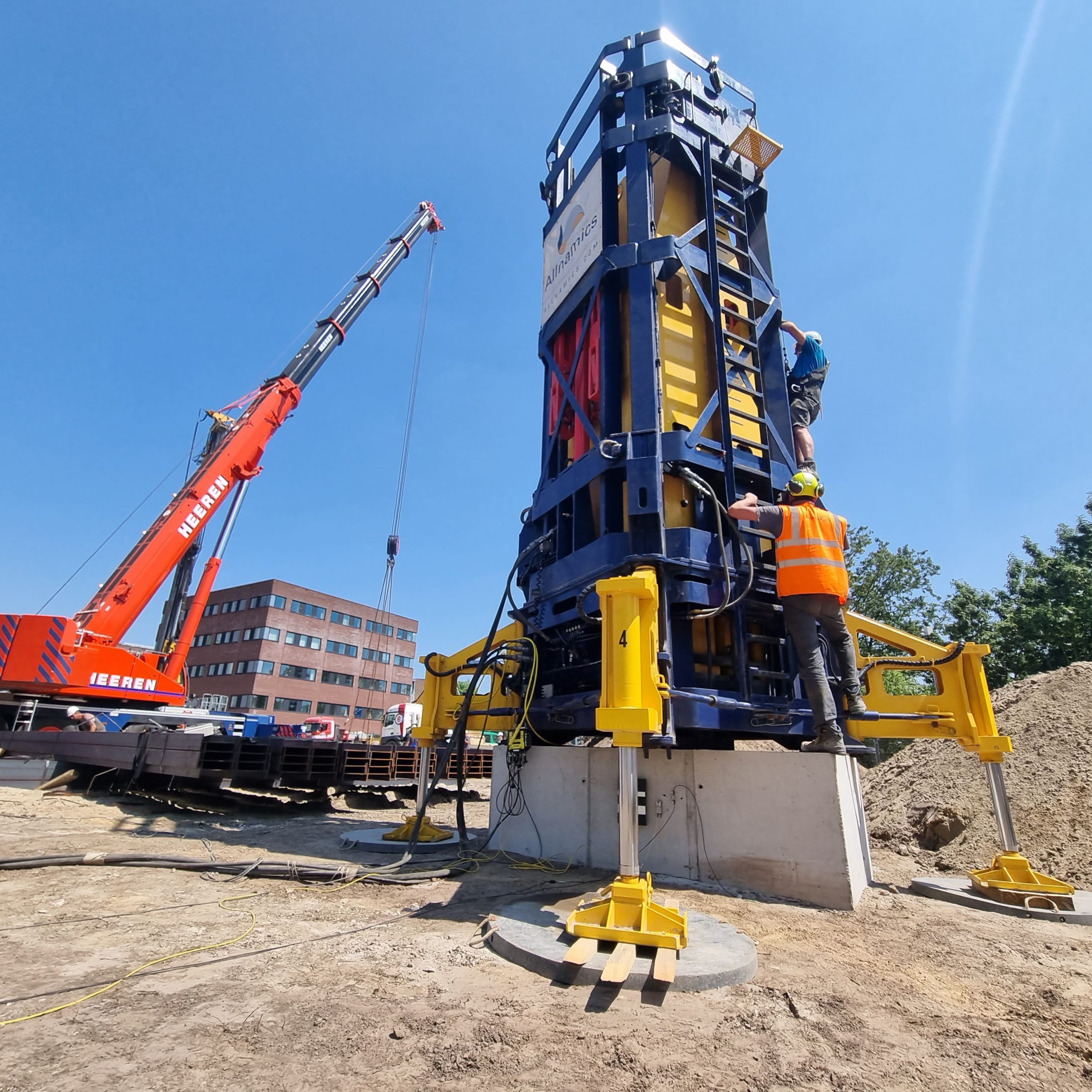
Static load testing provides the most direct and unambiguous measurement of pile capacity and is the preferred method when load-settlement behavior governs design or when regulatory requirements demand independent verification. However, static testing is logistically more demanding and is typically used on a smaller number of trial piles rather than across an entire production program. When relaxation is suspected, a pile load testing program performed after the appropriate waiting period gives a definitive answer that does not require the interpretive steps involved in dynamic testing.
Rapid Load Testing offers a useful middle ground. It applies a controlled impulse load over a longer duration than a dynamic test blow, eliminating stress wave effects and improving the accuracy of capacity determination. For sites where relaxation is a concern and static testing is impractical, Rapid Load Testing on selected piles after the waiting period can provide higher confidence than dynamic testing alone.
The choice of method should reflect the pile type, soil conditions, and the consequence of an incorrect capacity estimate. In high-consequence applications where relaxation is a known risk, combining dynamic testing across the pile program with static or Rapid Load Testing on a subset of piles gives the most defensible dataset.
When should relaxation testing be included in a foundation program?
Relaxation testing should be included in a foundation program whenever the pile design relies on resistance from soil or rock types known to exhibit time-dependent capacity reduction. This includes dense sands and silts, chalk, weak shales, structured soft rocks, and any profile where the toe is founded in a brittle or compressible material that may rebound after driving.
The following situations specifically call for planned restrike testing with relaxation assessment:
- Piles driven into weak or fractured rock, where the driving process disturbs the material around the toe and capacity at the end of drive is likely to overstate long-term resistance.
- Dense granular profiles where high end-of-drive blow counts suggest significant temporary resistance that may not be sustained.
- Mixed profiles where set-up in cohesive layers and relaxation in granular or rock layers may offset each other, making net capacity change difficult to predict without testing.
- Offshore foundation programs where pile acceptance is based on driving criteria and there is no opportunity for static verification after installation.
- Projects with tight safety margins, where the difference between end-of-drive and stabilized capacity could determine whether a pile meets design requirements.
Early-stage planning is important. If relaxation testing is not built into the program schedule from the start, the waiting periods required between driving and restrike can create delays that are difficult to accommodate later. Identifying relaxation-prone materials during the ground investigation phase and incorporating restrike test windows into the installation program avoids last-minute schedule pressure and ensures the data collected is actually usable for acceptance decisions.
How Allnamics Helps You Account for Pile Relaxation
We work with project teams from the planning stage through to final acceptance to make sure relaxation effects are identified, tested, and correctly interpreted. Our approach combines field experience, advanced testing equipment, and signal matching expertise to give you a clear picture of stabilized pile capacity rather than a snapshot taken at the wrong moment.
Here is what we bring to relaxation-related pile testing programs:
- Program design: We help you identify relaxation-prone soil and rock types from ground investigation data and design a restrike testing program with appropriate waiting periods built into the installation schedule.
- Dynamic load testing at restrike: Our teams perform dynamic load testing during driving and at restrike using our own PDA systems, giving you a direct before-and-after comparison of mobilized resistance.
- Signal matching analysis: We use AllWave-DLT software, developed in-house, to perform signal matching that separates shaft and toe resistance contributions, helping you understand where relaxation is occurring along the pile.
- Rapid Load Testing for higher accuracy: Where dynamic testing alone does not provide sufficient confidence, we deploy Rapid Load Testing on selected piles to verify stabilized capacity with reduced interpretive uncertainty.
- Independent technical review: For projects where relaxation has already produced unexpected results, we provide forensic analysis and independent assessment to determine whether the foundation program needs adjustment.
- Offshore capability: We support offshore programs where restrike testing logistics require specialized planning, equipment mobilization, and integration with the installation vessel schedule.
If your project involves soil or rock conditions where relaxation is a realistic concern, contact us to discuss your project to discuss how to structure your pile load test program so that acceptance decisions are based on stabilized, reliable capacity data.
Related Articles
- How is pile fatigue calculated with AllWave-VDP?
- How accurate is Rapid Load Testing compared to Static Load Testing?
- What is the environmental impact of Rapid Load Testing?
- What causes discrepancies between static and dynamic test results?
- How is pile driveability assessed before offshore installation begins?