

AllWave-PDP and AllWave-VDP give foundation engineers a simulation environment to predict pile installation behavior before a single hammer blow is struck. AllWave-PDP covers impact driving, while AllWave-VDP handles vibratory driving. Together, they form the drivability prediction core of the AllWave Software Package, helping project teams assess whether a chosen pile and hammer combination can reach the required penetration depth safely and efficiently. The sections below answer the most common questions about what these programs do, how they work, and when to use them.
What do AllWave-PDP and AllWave-VDP actually simulate?
AllWave-PDP and AllWave-VDP simulate the coupled interaction between a hammer, a pile, and the surrounding soil during installation. Both programs use one-dimensional stress-wave analysis based on the Method of Characteristics (MoC), a mathematically rigorous approach that treats the pile as a flexible body through which stress waves travel, rather than a rigid object that moves as a single unit.
This distinction matters in practice. When a hammer strikes a pile, the impact generates a stress wave that travels downward through the pile, interacts with shaft resistance and toe resistance along the way, and partially reflects back upward. AllWave-PDP models this process for impact driving, calculating forces, velocities, displacements, and stresses as a function of both time and depth. AllWave-VDP applies the same wave-equation framework to vibratory driving, where the loading mechanism is continuous and oscillatory rather than a discrete impact, and where the soil response behaves differently under sustained vibration.
The MoC approach has a long development history. Its application to foundation piles in the Netherlands began in the 1950s and was progressively refined through contributions from researchers at HBG and TNO, eventually forming the basis of TNOWAVE. AllWave-PDP and AllWave-VDP are the direct successors of that development line.
How does AllWave-PDP improve drivability study accuracy?
AllWave-PDP improves drivability study accuracy by evaluating multiple installation criteria simultaneously rather than reducing the analysis to a single pass-or-fail question. A complete drivability prediction using AllWave-PDP addresses blow count versus penetration depth, maximum compression and tension stresses in the pile, energy transfer from hammer to pile, hammer operational limits, refusal risk at specific depths, and the stress cycles accumulated over the full installation, which feed into fatigue analysis.
Soil modeling quality is a major driver of prediction accuracy. AllWave-PDP supports input from CPT, SPT, and laboratory data, and the software allows direct coupling between measured CPT values and the drivability soil model. This approach, developed and refined through decades of offshore installation experience, reduces the uncertainty introduced by intermediate interpretation steps. Where CPT data are available and of good quality, a more direct link between measurement and model parameter generally produces a more reliable prediction.
The software also includes a hammer library, which means your team can model realistic hammer performance rather than relying on idealized energy assumptions. Sensitivity analyses for uncertain soil and hammer parameters allow you to understand the range of possible outcomes, not just a single central estimate. This is particularly valuable on projects where ground conditions vary laterally or where the soil investigation data contain gaps.
What makes AllWave-VDP suited for vibratory pile installation?
AllWave-VDP is suited for vibratory pile installation because it models the fundamentally different loading mechanism and soil response that distinguish vibratory driving from impact driving. While AllWave-PDP applies a discrete impulse load at each hammer blow, AllWave-VDP applies a continuous oscillatory force and uses a soil model calibrated for the behavior of soil under sustained vibration, where pore pressure changes, liquefaction effects, and frequency-dependent resistance play a more prominent role.
Vibratory driving prediction is inherently more uncertain than impact driving prediction, partly because the soil response to vibration is harder to characterize from standard ground investigation data. AllWave-VDP addresses this by supporting post-analysis workflows: after a vibratory installation is completed and monitored, the measured data can be used to back-calculate a refined soil model. This updated model then improves the accuracy of future predictions in similar ground conditions.
A practical example of this approach involved a 4.5-meter-diameter monopile installed using a CV-960-12 VLT vibratory hammer. The pile reached approximately 25 meters of penetration before early refusal occurred, after which an impact hammer completed the installation to around 31.5 meters. The vibratory phase provided a direct calibration opportunity: the original CPT-based soil model was compared against a model derived from vibratory signal matching, and both were subsequently validated against impact driving data at the beginning and end of restrike. This kind of closed learning loop is exactly what AllWave-VDP is designed to support.
How do AllWave-PDP and AllWave-VDP reduce construction risk?
AllWave-PDP and AllWave-VDP reduce construction risk by identifying potential installation problems before mobilization, when changes are still low-cost. By simulating the full installation sequence, both programs allow your team to detect critical depth zones where blow counts may approach refusal, where pile stresses may exceed structural limits, or where hammer performance may fall outside its operational envelope.
Early identification of these risks creates room for informed decisions: adjusting the hammer selection, modifying the pile wall thickness at vulnerable sections, planning for a combined vibratory and impact installation sequence, or revising the target penetration depth. Without a drivability prediction, these decisions are made reactively during installation, where the cost of a wrong choice is significantly higher.
The risk reduction extends beyond the installation phase. Fatigue analysis based on the stress cycles predicted by AllWave-PDP provides input for structural assessments of the pile over its service life. Tension stress predictions help avoid pile damage in soils with strong setup or in layered profiles where reflected waves can generate significant upward forces. These outputs give structural and geotechnical engineers a shared technical basis for evaluating whether a proposed installation plan is safe.
Who should use AllWave-PDP and AllWave-VDP?
AllWave-PDP and AllWave-VDP are designed for geotechnical engineers and foundation specialists who need to produce or review drivability predictions for impact-driven or vibro-driven piles. They are relevant for any project where pile installation involves meaningful technical risk, including offshore wind foundations, oil and gas jacket piles, large-diameter monopiles, onshore infrastructure piles in variable or difficult ground, and marine or port structures.
EPC contractors and foundation contractors benefit from the software when planning installation sequences and selecting equipment. Engineering consultancies and independent reviewers use it to verify that proposed installation plans are technically sound. Offshore wind developers and energy companies rely on drivability studies produced with tools like AllWave-PDP and AllWave-VDP as part of their project risk management and regulatory documentation.
The software requires a working understanding of stress-wave theory, soil mechanics, and pile installation practice. It is not a black-box tool. As the AllWave-PDP manual describes it, drivability engineering is the art of prediction: the software provides a rigorous calculation framework, but the quality of the output depends on the quality of the input assumptions and the engineer’s ability to interpret results critically, question assumptions, and recognize when additional data or calibration are needed.
How do AllWave-PDP and AllWave-VDP fit into the broader AllWave software package?
AllWave-PDP and AllWave-VDP are two of the core programs within the AllWave Software Package, which covers the full range of stress-wave applications in foundation engineering. The package also includes AllWave-DLT for Dynamic Load Testing signal matching and AllWave-SIT for Sonic Integrity Testing, among other modules.
The programs share a common theoretical foundation in one-dimensional stress-wave analysis and the Method of Characteristics, which means that data and soil models developed during a drivability study can be carried forward into post-installation analysis. When a pile is instrumented during driving and Dynamic Load Testing is performed, AllWave-DLT signal matching can be used to back-calculate the soil resistance and compare it against the original AllWave-PDP prediction. This creates a technically consistent workflow from pre-installation prediction through installation monitoring to post-installation capacity assessment.
This integration is one of the practical advantages of working within a single software environment. The soil model is not rebuilt from scratch at each stage. Instead, it is progressively refined as real installation data become available, and the updated model feeds into an experience database that improves the accuracy of future predictions on similar projects and ground conditions.
How We Support Your Drivability Predictions
We develop and apply AllWave-PDP and AllWave-VDP as part of our drivability study services, helping project teams move from ground investigation data to a technically defensible installation plan. Our support covers the full prediction workflow:
- Soil model development from CPT, SPT, and laboratory data, with direct coupling to drivability parameters where data quality allows
- Hammer and pile modeling, including selection from the hammer library and definition of realistic operational parameters
- Drivability simulation covering blow count, pile stresses, energy transfer, refusal risk, and fatigue input across the full penetration range
- Sensitivity analysis for uncertain soil and hammer parameters, giving your team a clear picture of prediction uncertainty
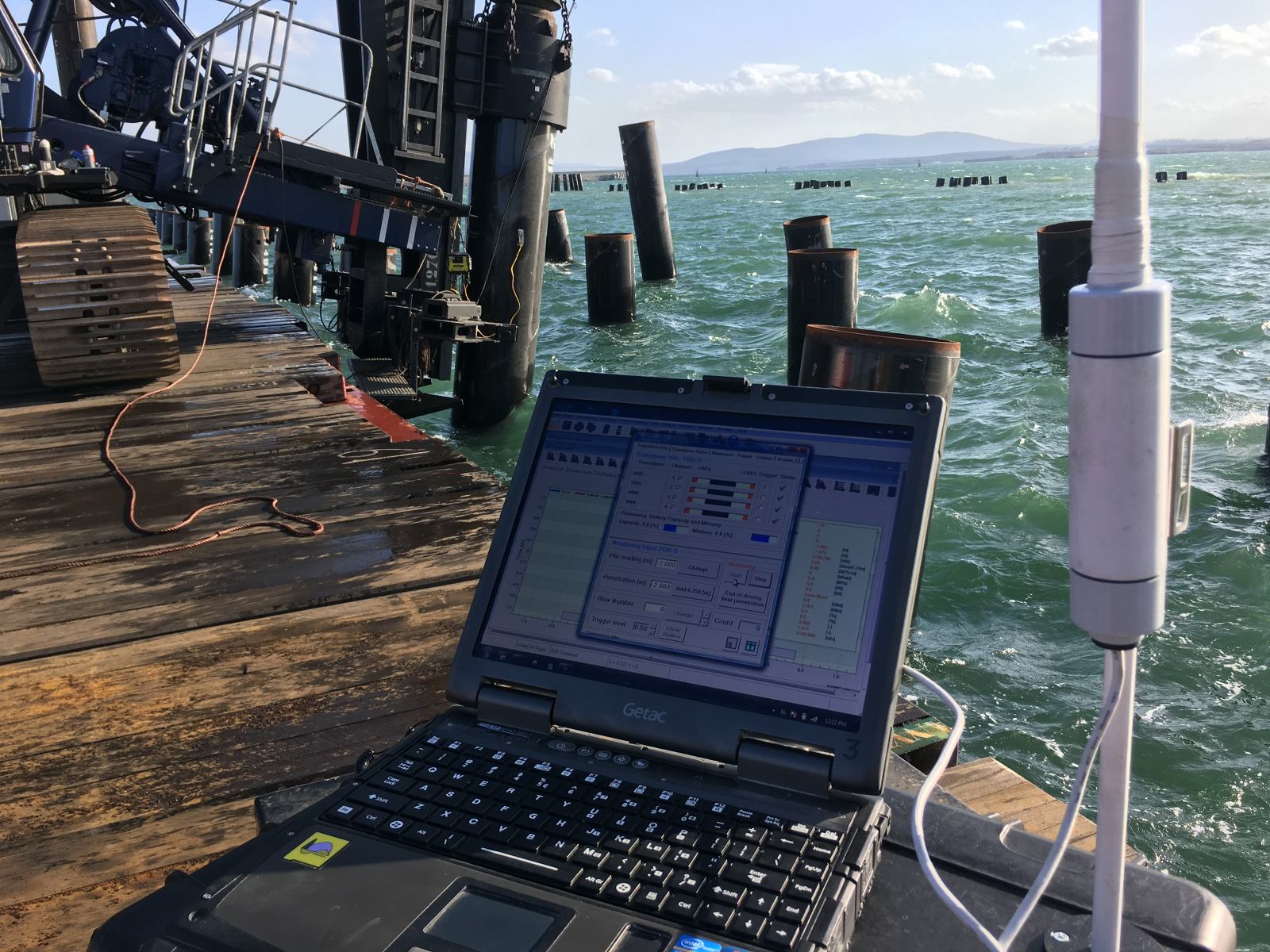
- Installation monitoring and signal matching to compare predicted and actual behavior, update the soil model, and build a validated record for future projects
- Combined impact and vibratory analysis for projects where both installation methods are used in sequence
Whether you need a standalone drivability study, independent review of an existing prediction, or a fully integrated prediction-monitoring-postdiction workflow, we can support your project from the earliest planning stage through to installation completion. Contact us to discuss your project requirements.