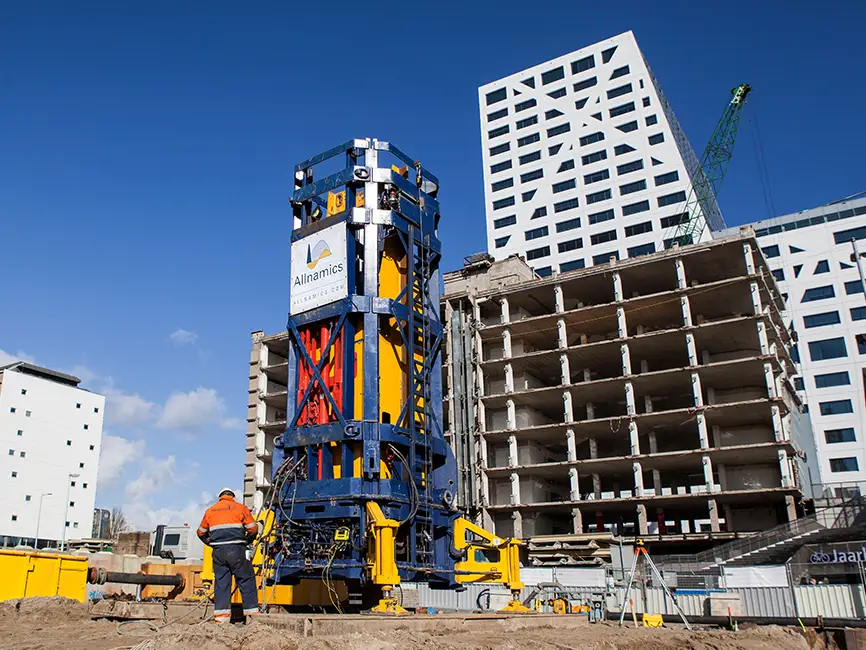



Yes, multiple loading cycles can be applied during a Rapid Load Test. In practice, a test typically consists of two to five loading cycles, with the number depending on the test objective, the required load level, and the specifications set by the applicable standard. Each cycle delivers a controlled axial force pulse to the pile, and the results from successive cycles provide useful information about pile behaviour under repeated loading.
The ability to apply multiple cycles is one of the practical advantages of Rapid Load Testing. Because the loading device, whether a Statnamic device or a StatRapid installation, resets between drops, the test setup supports repeated application without the logistical complexity that multiple cycles would introduce in a Static Load Test. The sections below address the most common questions about cyclic loading in Rapid Load Testing.
How many loading cycles can rapid load testing deliver?
A Rapid Load Test typically delivers between two and five loading cycles in a single test session. The exact number depends on the test objective, the pile-soil combination, the required load level, and the requirements of the governing standard. Standards such as ISO 22477-10 and ASTM D7383 specify minimum cycle requirements for different test classes, and project-specific programmes may call for additional cycles.
In a standard test programme, a common approach is to apply an initial cycle at a lower load level to condition the pile and verify the measurement setup, followed by one or more cycles at the target load. Some programmes include a final cycle at a reduced load to assess residual behaviour. The rapid load test method is well suited to this multi-cycle approach because the loading device can be reset and re-dropped without dismantling the test arrangement.
The practical upper limit on the number of cycles is influenced by the time available on site, the condition of the spring pack or cushion system, and the degree to which earlier cycles have already mobilised the pile’s resistance. Applying a large number of cycles beyond what the standard or test objective requires does not automatically improve the quality of the result and may complicate interpretation.
Why would multiple loading cycles be needed in pile testing?
Multiple loading cycles serve several distinct purposes in pile testing. They allow the engineer to condition the pile-soil interface, verify repeatability of the measured response, assess behaviour at different load levels, and identify whether the pile’s resistance changes between cycles. Each of these objectives contributes to a more complete picture of foundation performance than a single loading event can provide.
The most common reasons for applying more than one cycle in a Rapid Load Test are:
- Conditioning: The first cycle often produces a slightly different response because the pile-soil contact has not yet been fully engaged. A conditioning cycle at a moderate load level stabilises the system before the main test cycle.
- Repeatability verification: Comparing the response from two cycles at the same load level confirms that the measurement is consistent and that the pile is behaving predictably.
- Load progression: Applying cycles at increasing load levels allows the engineer to observe how shaft friction and base resistance develop as the load approaches the target level.
- Post-peak behaviour: Where the test objective includes understanding behaviour beyond the point of full mobilisation, an additional cycle at a higher load can provide that information.
In cohesive soils, multiple cycles also help the engineer assess whether loading-rate effects are consistent across cycles, which is relevant when converting the measured rapid response to a statically equivalent capacity.
How does each additional cycle affect pile behaviour?
Each additional loading cycle can alter the pile-soil interaction in measurable ways. The most common effect is a gradual change in the mobilised resistance between the first and subsequent cycles, driven by changes at the pile-soil interface, pore water pressure development in cohesive soils, and the progressive engagement of shaft friction and base resistance.
In granular soils, the response between cycles tends to stabilise relatively quickly. After an initial conditioning cycle, successive cycles at the same load level typically produce similar force-displacement curves, which supports reliable interpretation using the Unloading Point Method or similar analysis approaches.
In cohesive soils, the picture is more complex. Repeated rapid loading can generate excess pore water pressure around the pile shaft, which temporarily alters the effective stress and therefore the measured resistance. This means that the response in the second or third cycle may differ from the first, not because the pile’s static capacity has changed, but because the soil’s rate-dependent behaviour is responding to the cumulative effect of the loading sequence. This is one of the reasons why loading-rate corrections in cohesive soils require careful, soil-specific analysis rather than a universal factor.
It is also worth noting that if the pile has been loaded to near its capacity in an earlier cycle, subsequent cycles may show increased permanent displacement. This is useful information for the engineer, but it also means that the interpretation of later cycles must account for the changed state of the pile-soil system.
How does rapid load testing compare to static load testing for cyclic loading?
Rapid Load Testing and Static Load Testing approach cyclic loading in fundamentally different ways. In a Static Load Test, each load increment is held for a defined period to allow the soil to respond under sustained stress, and the load-displacement curve reflects true static behaviour. In a Rapid Load Test, each cycle applies a short-duration force pulse, and the static-equivalent response must be derived from the measured data using an appropriate analysis method.
For cyclic loading specifically, the differences are significant:
- Speed of execution: Applying multiple cycles in a Rapid Load Test takes a fraction of the time required for a multi-cycle Static Load Test. This makes Rapid Load Testing more practical when several cycles are needed within a constrained programme.
- Load application: In a Static Load Test, the load is applied incrementally and held. In a Rapid Load Test, the load is applied as a pulse and the pile rebounds. The loading history experienced by the pile-soil system is therefore different between the two methods.
- Interpretation complexity: Each Rapid Load Test cycle requires correction for pile inertia and rate-dependent soil behaviour before a static-equivalent result can be derived. A Static Load Test measures the static response directly, without this correction step.
- Reaction system: A Static Load Test requires a reaction structure, kentledge or anchor piles, that can sustain the full test load over time. A Rapid Load Test does not require this, which is a practical advantage when high loads are needed or space is limited.
The two methods are not interchangeable for cyclic loading programmes. Where the objective is to study long-term cyclic degradation under sustained loading, a Static Load Test or a dedicated cyclic static test is more appropriate. Where the objective is to verify capacity at multiple load levels efficiently, Rapid Load Testing offers a practical and well-standardised alternative.
What standards govern multiple-cycle rapid load testing?
ISO 22477-10:2016 is the primary international standard for Rapid Load Testing and sets out requirements for test execution, measurement, and analysis, including provisions that apply to multi-cycle programmes. ASTM D7383 provides equivalent guidance under the American framework. In the Netherlands, NEN 7201:2025 governs pile load testing and includes specific requirements for different test classes, some of which place explicit limits on how results may be interpreted when the pile has not been loaded to failure.
Key points from these standards relevant to multiple-cycle testing include:
- The standards define minimum requirements for the number of cycles and the load levels to be applied in different test classes.
- They specify that the maximum measured force during a Rapid Load Test cannot be used directly as the static capacity, the inertia of the pile and rate-dependent soil behaviour must be accounted for in every cycle.
- NEN 7201:2025 sets explicit restrictions on extrapolating an unmeasured failure load from a load-displacement curve when the pile has not been loaded to a clear failure point in any cycle.
- All three standards treat the execution and analysis of Rapid Load Tests as specialist work requiring geotechnical expertise, not a straightforward conversion of measured peak force to static capacity.
When planning a multi-cycle Rapid Load Test, the applicable standard should be identified at the start of the project, as it will determine the minimum number of cycles, the required load levels, the instrumentation needed, and the analysis method that must be applied to each cycle’s data.
How Allnamics Supports Your Rapid Load Testing Programme
We design and execute Rapid Load Test programmes that meet the requirements of ISO 22477-10, ASTM D7383, and NEN 7201:2025, including multi-cycle test setups tailored to your project’s objectives and soil conditions. Our team covers the full scope from pre-test prediction to on-site execution and specialist interpretation.
When you work with us on a Rapid Load Testing project, we provide:
- Pre-test prediction: We calculate the required drop mass, spring configuration, and drop height to achieve the target load level and loading duration for each cycle, using wave-equation analysis and empirical data from comparable projects.
- On-site execution: We mobilise and operate the StatRapid or Statnamic equipment, manage the multi-cycle test sequence, and monitor the measurements in real time to confirm that each cycle meets the required conditions.
- Specialist analysis: We apply the Unloading Point Method and, where soil conditions require it, soil-specific rate corrections to derive static-equivalent capacity from each cycle’s data.
- Standard compliance: We ensure the test programme, instrumentation, and reporting meet the requirements of the applicable standard and your project’s contractual specifications.
- Cohesive soil expertise: Where your project involves clay or other cohesive soils, we apply appropriate loading-rate corrections and advise on whether project-specific correlation with a static test is warranted.
If you are planning a foundation testing programme and want to understand whether Rapid Load Testing with multiple cycles is the right approach for your project, contact our team to discuss your requirements.