


Pile testing data directly informs foundation design by revealing how individual piles actually behave under load, rather than relying solely on soil investigation predictions. The data produced during testing allows engineers to calibrate design assumptions, confirm bearing capacity, and identify where the original design can be refined. The sections below address the most common questions engineers and project teams ask about putting pile testing data to work.
What types of data does pile testing actually produce?
Pile testing produces measurements of force, displacement, acceleration, and strain at the pile head, which engineers then use to derive bearing capacity, soil resistance distribution, pile integrity, and load-settlement behaviour. The specific data generated depends on the testing method used, but all methods ultimately aim to characterise how a pile transfers load to the surrounding soil.
Dynamic Load Testing (DLT) measures strain and acceleration at the pile head during a hammer impact. These raw signals feed into a wave equation analysis called signal matching, which models how stress waves travel through the pile and interact with soil resistance along the shaft and at the toe. The output is a calibrated soil model that yields estimates of total bearing capacity, shaft friction distribution, and end-bearing contribution. Software such as AllWave-DLT processes these signals iteratively until the calculated response matches the measured one.
Static Load Testing (SLT) produces a direct load-settlement curve by applying a sustained, controlled load using load cells and displacement gauges. Forces and displacements are measured independently, making the result straightforward to interpret without a computational model. SLT also captures time-dependent behaviour, including creep under constant load and long-term settlement, which dynamic methods cannot replicate because the load duration is only milliseconds.
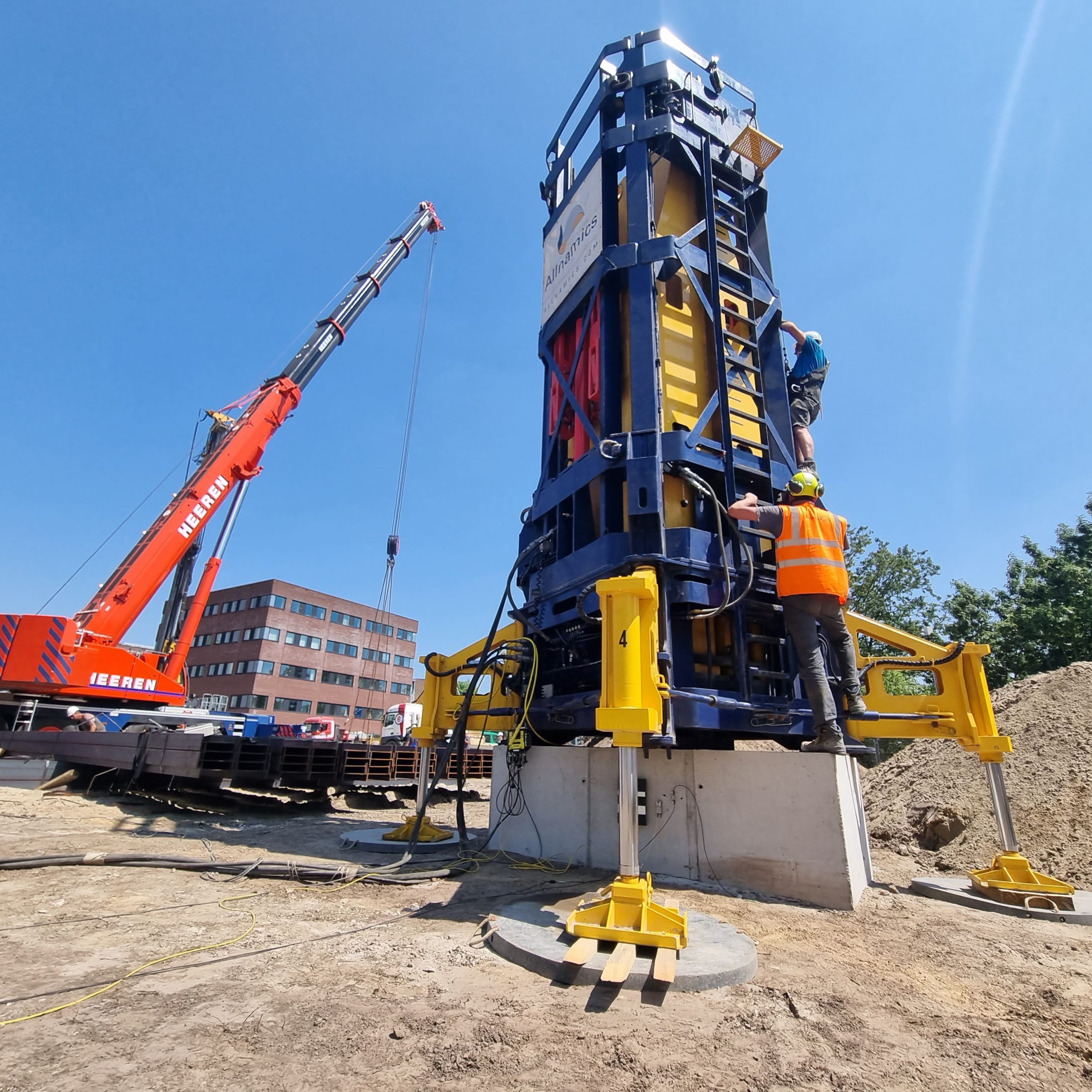
Rapid Load Testing (RLT), including the StatRapid and Statnamic methods, applies a controlled impulse load over a significantly longer duration than a DLT blow. This eliminates stress wave effects and produces a direct measurement of load and settlement, increasing the accuracy of capacity determination compared to dynamic testing alone.
Pile Integrity Testing (PIT) generates data on the structural condition of the pile, detecting cracks, voids, necking, or other defects that visual inspection cannot reveal. During installation monitoring through Pile Driving Analysis (PDA) and Vibratory Driving Analysis (VDA), real-time data on driving stresses, blow counts, hammer performance, and penetration rate are also recorded, giving the project team a continuous record of the installation process.
How does pile testing data inform foundation design decisions?
Pile testing data informs foundation design by confirming or correcting the assumptions made during the design phase. Soil investigation and predictive models estimate pile behaviour before installation, but the actual interaction between a pile and the ground can differ from those predictions. Testing data closes that gap and gives engineers a factual basis for design decisions.
The most direct application is bearing capacity verification. If a pile load testing programme shows that a pile achieves its required capacity at a shorter length than designed, the project team can reduce pile lengths across the programme. Conversely, if measured capacity falls short of predictions, the design must be adjusted before the structure above is built. Catching this at the piling stage is far more manageable than discovering a shortfall after a superstructure is in place.
Soil resistance distribution data from signal matching analysis is particularly useful for refining design models. When testing reveals that most resistance comes from shaft friction rather than end bearing, or that resistance is concentrated in a specific layer, engineers can update their geotechnical model and apply those corrections to the remaining piles on the project. This is especially valuable on large programmes where early test results can influence installation criteria for hundreds of subsequent piles.
Load-settlement curves from static testing provide the full picture of how a pile deforms under increasing load, including the point at which settlement accelerates. This behaviour directly feeds into structural design, particularly for structures sensitive to differential settlement. The curve also allows engineers to determine the pile’s stiffness, which influences how loads are distributed across a pile group.
Real-time installation monitoring through PDA adds another layer of design feedback. Driving stress data allows the installation team to adjust hammer energy or driving sequence to stay within safe limits, preventing pile damage before structural loading begins. Blow count records and set-up measurements inform decisions about when to perform a redrive test to assess capacity after soil consolidation has occurred.
What’s the difference between using pile testing data for new designs versus existing foundations?
For new foundation designs, pile testing data is used to verify and optimise before construction is complete. For existing foundations, the same data types are used to assess current condition, remaining capacity, and suitability for continued use or increased loading. The underlying measurements are similar, but the questions being answered are fundamentally different.
Pile testing in new construction
In new construction, testing typically begins with a programme of preliminary or proof load tests on trial piles. These results calibrate the design model and confirm that the chosen pile type, length, and installation method will deliver the required performance. If early results are consistently stronger than predicted, the design team can reduce pile dimensions or lengths for the remaining works, saving material and cost. If results are weaker, the design is adjusted before the full installation programme proceeds.
Installation monitoring during new construction also generates a continuous quality record. Every driven pile can be monitored during driving, and selected piles can be retested after set-up to confirm that capacity has developed as expected. This data forms part of the project’s quality assurance documentation and supports regulatory sign-off.
Pile testing for existing foundations
For existing foundations, the starting point is often uncertainty rather than a design gap. The original design records may be incomplete, the piles may have been in service for decades, or the structure is being considered for a change of use that would increase loading. In these situations, pile integrity testing identifies structural defects, while load testing establishes the actual current capacity rather than the theoretical design capacity.
Foundation reuse assessments rely heavily on this data. Before a developer commits to retaining an existing pile foundation, testing must confirm that the piles are structurally sound and capable of carrying the new loads. This avoids unnecessary demolition and replacement, reducing both cost and carbon impact. The data also supports decisions about whether strengthening or supplementary piling is needed, and where.
How can pile testing reduce foundation costs without compromising safety?
Pile testing reduces foundation costs by replacing conservative design assumptions with measured performance data, allowing engineers to use fewer or shorter piles while maintaining the required safety margins. The savings come from optimising the design based on evidence rather than over-engineering to compensate for uncertainty.
The mechanism works in both directions. When test results show that piles consistently outperform predictions, the project team can reduce pile lengths, adjust installation criteria, or reduce the total number of piles required. These adjustments translate directly into lower material costs, shorter installation programmes, and reduced carbon emissions from less steel or concrete used.
The cost of testing is almost always small relative to the savings it enables on a medium or large project. A single static load test or a programme of dynamic tests on a fraction of the total pile count can generate data that justifies design changes across the entire foundation. The earlier in the programme that testing takes place, the greater the opportunity to apply those savings.
Testing also reduces cost by preventing expensive remediation. Identifying a capacity shortfall or a structural defect at the piling stage, before the superstructure is installed, is manageable. Discovering the same problem after a building frame, bridge deck, or offshore jacket is in place can require intervention that costs many times more than the original piling works. The risk reduction that testing provides has a direct financial value that is easy to underestimate when looking only at the upfront cost of the tests.
For projects in unfamiliar ground conditions, testing reduces the conservatism that engineers must build into designs when relying on soil investigation data alone. Soil variability means that predictions carry uncertainty, and that uncertainty is typically managed by applying larger safety factors. Testing replaces some of that uncertainty with measured data, allowing safety factors to be applied more precisely and the design to be leaner as a result.
When should pile testing data trigger a redesign?
Pile testing data should trigger a redesign when measured capacity, settlement behaviour, or structural integrity falls outside the acceptable range defined in the design criteria. The threshold for action depends on the magnitude of the discrepancy, the pile type, the soil conditions, and the consequences of foundation underperformance for the structure above.
The following situations typically warrant a design review:
- Measured bearing capacity is significantly below the design value. For end-bearing driven piles in granular soils, dynamic and static results typically correlate within 10 to 20 percent. For friction piles or cast-in-situ concrete piles, the correlation range widens to 20 to 40 percent. If measured capacity falls outside the lower bound of the expected range, the design assumption needs to be revisited.
- Settlement at working load exceeds the allowable limit. A load-settlement curve that shows excessive displacement before the design load is reached indicates that the pile stiffness or capacity is lower than assumed. This has direct implications for structural performance, particularly for differential settlement-sensitive structures.
- Integrity testing reveals structural defects. Cracks, necking, voids, or other anomalies detected during pile integrity testing may reduce the pile’s ability to carry load safely. Depending on the severity and location of the defect, the response may range from additional testing to confirm the extent of the damage, through to replacement or supplementary piling.
- Driving records show early refusal or anomalous blow counts. Unexpected behaviour during installation, such as a pile refusing at a shallower depth than predicted or showing irregular driving resistance, can indicate that the pile has not reached the intended bearing stratum or has been damaged during driving.
- Soil resistance distribution differs significantly from the design model. If signal matching analysis shows that resistance is concentrated in a different layer or mechanism than assumed, the design model may need to be updated, particularly if the discrepancy affects long-term settlement or group behaviour.
Not every discrepancy requires a full redesign. Minor variations within the expected accuracy range of the testing method may be acceptable within the existing design margins. The decision requires engineering judgement, taking into account the testing method’s inherent accuracy, the soil conditions, and the structural consequences of the measured behaviour. When the data raises a genuine concern, acting on it at the piling stage is always more cost-effective than deferring the decision.
How Allnamics Helps You Get More from Pile Testing Data
We work with project teams at every stage where pile testing data matters, from preliminary design through installation monitoring to post-construction assessment. Our approach combines field testing, signal matching analysis, and engineering interpretation to give you data you can act on.
Here is what we bring to your project:
- Full range of testing methods: We perform Dynamic Load Testing, Static Load Testing, and Rapid Load Testing, including our own StatRapid method, onshore and offshore, so the right method is matched to your pile type and project conditions.
- Signal matching by experienced engineers: Our team uses AllWave-DLT software to perform signal matching analysis, reducing the user-dependent bandwidth and giving you results you can rely on for design decisions.
- Installation monitoring: Through PDA and VDA, we monitor pile behaviour in real time during driving, giving your installation team the data to adjust hammer energy, avoid pile damage, and build a quality assurance record for every pile.
- Integrity testing and damage assessment: When a pile shows signs of distress during installation or when an existing foundation needs evaluation, we identify the cause and propose remedial actions based on measured data rather than assumptions.
- Foundation reuse and optimisation studies: For existing structures, we assess current pile condition and capacity to support decisions about reuse, increased loading, or targeted strengthening.
- Independent technical review: We provide independent verification for projects where regulatory requirements or client specifications call for a third-party assessment of foundation performance.
If your project involves foundation design decisions that depend on reliable pile performance data, contact us to discuss your project and how we can support your programme from the ground up.