

AllWave-PDP is the right choice when you are installing piles with an impact hammer, while AllWave-VDP is designed for vibratory driving. The decision comes down to the installation method your project uses, because the two programs model fundamentally different load mechanisms and soil responses. The sections below answer the most common questions about when and how to use each program.
What is the core difference between AllWave-PDP and AllWave-VDP?
AllWave-PDP simulates pile installation by impact driving, while AllWave-VDP simulates installation by vibratory driving. Both programs are built on one-dimensional stress-wave analysis using the Method of Characteristics, but the load input and the soil reaction models differ substantially between the two.
In impact driving, each hammer blow generates a short, high-energy stress pulse that travels down the pile. The soil reacts with a combination of static resistance and velocity-dependent damping. AllWave-PDP models this blow-by-blow interaction between hammer, pile, and soil, producing results such as blow count versus penetration depth, maximum compression and tension stresses, energy transfer, and pile set per blow.
Vibratory driving works on a completely different principle. A vibratory hammer generates a continuous oscillating force that reduces the effective soil resistance around the pile, allowing it to penetrate under its own weight combined with the dynamic excitation. AllWave-VDP models this sustained, cyclic loading and the associated soil behavior, which cannot be represented by the impact driving model. The soil resistance to driving, friction fatigue effects, and the way resistance builds or degrades under vibration all require a separate modeling approach.
When should AllWave-PDP be used for a project?
Use AllWave-PDP whenever your project involves pile installation with an impact hammer, whether hydraulic, diesel, or drop hammer. It is the appropriate tool for drivability predictions where the pile is advanced through discrete blows rather than continuous vibration.
AllWave-PDP is particularly useful when your project requires answers to questions beyond simply whether the pile can reach target penetration. A complete impact drivability analysis addresses:
- Drivability: whether blow count stays within a workable range throughout installation
- Pile integrity: whether compression and tension stresses remain within structural limits
- Hammer operation: whether the selected hammer can operate within its rated limits
- Refusal risk: at which depth further penetration may become practically impossible
- Fatigue: what stress cycles accumulate over the full installation sequence
- Installation time: how many blows and how much time are needed to reach the required depth
AllWave-PDP includes a hammer library and supports input from CPT, SPT, and laboratory data, making it well suited to projects where detailed geotechnical investigation data is available. It is widely used for offshore monopiles, driven steel pipe piles, precast concrete piles, and any foundation element installed by impact.
When should AllWave-VDP be used instead?
AllWave-VDP is the correct program when the planned installation method uses a vibratory hammer. If your contractor intends to use a vibratory driver to install sheet piles, tubular piles, or other foundation elements, AllWave-VDP provides the simulation framework that matches that installation physics.
Vibratory driving is common in projects where noise and vibration limits restrict impact driving, where installation speed is a priority, or where soil conditions are favorable for vibro methods. AllWave-VDP helps you assess whether a vibratory hammer can achieve the required penetration depth, identify the risk of early refusal under vibration, and evaluate how soil resistance evolves during continuous oscillation.
The program is also relevant when you need to predict penetration rate as a function of depth, assess the influence of different vibratory hammer settings, or evaluate whether a transition to impact driving will be needed to reach final penetration. This last scenario is more common than many project teams expect, particularly in layered soils or when dense layers are encountered at depth.
Can AllWave-PDP and AllWave-VDP be used together on the same project?
Yes, and on many projects using both programs together produces a more complete picture than either program alone. A combined approach is especially relevant when the installation sequence involves vibratory pre-driving followed by impact driving to reach final penetration depth.
A well-documented example of this combined workflow is the NAM L13-F1-1 case, where a 4.5-meter-diameter monopile was first driven with a vibratory hammer to approximately 25 meters of penetration before early refusal occurred. An impact hammer was then used to reach the final penetration of around 31.5 meters. Predicting this sequence accurately required both vibratory and impact drivability models, along with signal matching to calibrate the soil model against measured installation data.
Using both programs on the same project also supports a learning loop: the vibratory phase generates monitoring data that can be used to update the soil model before the impact phase begins, improving the reliability of the impact drivability prediction.
What input data does each program require?
Both AllWave-PDP and AllWave-VDP require pile geometry, material properties, and a soil model as their core inputs. The differences lie primarily in how the hammer is described and how the soil resistance model is structured.
Shared inputs for both programs
- Total pile length and target penetration depth
- Cross-section geometry, wall thickness, and any changes along the pile length
- Material properties including elastic modulus and density
- Toe configuration and any followers or connectors
- Soil resistance profile derived from CPT, SPT, or laboratory data, translated into layer-by-layer shaft and toe resistance
Program-specific inputs
- AllWave-PDP: hammer selection from the built-in hammer library, ram weight, stroke or rated energy, hammer efficiency, helmet, cushion properties, and blow-by-blow energy input
- AllWave-VDP: vibratory hammer specifications including eccentric moment, operating frequency, bias weight, and clamp force, along with soil model parameters that reflect the cyclic degradation behavior relevant to vibration-induced driving
For both programs, the quality of the soil model is the most important factor in prediction reliability. Impedance changes along the pile length deserve particular attention because they generate local stress wave reflections that affect the calculated stress distribution.
How do AllWave-PDP and AllWave-VDP fit into a broader drivability study?
AllWave-PDP and AllWave-VDP are simulation tools within a broader drivability prediction workflow that connects ground investigation, modeling, installation monitoring, and post-analysis. Neither program should be treated as a standalone calculation that produces a final answer.
A reliable drivability study follows a structured sequence: ground investigation leads to an initial soil model, which feeds into a drivability prediction. During installation, monitoring data is collected. After installation, signal matching and back-analysis are used to compare predicted behavior with actual behavior. The updated soil model then improves future predictions. This cycle turns each installation into a calibration opportunity rather than a one-time event.
The AllWave software package supports this full workflow, covering impact drivability, vibratory drivability, Dynamic Load Testing signal matching, and Sonic Integrity Testing analysis within a consistent stress-wave modeling framework. The programs are not isolated tools but components of an integrated approach to foundation installation prediction and verification.
Sensitivity analyses are an important part of this workflow. Soil parameters carry uncertainty, and hammer performance in the field rarely matches theoretical values exactly. Running sensitivity cases with AllWave-PDP or AllWave-VDP for different soil resistance assumptions and hammer efficiencies gives your team a realistic range of outcomes rather than a single predicted blow count or penetration rate.
How We Support Your Drivability Predictions
We use AllWave-PDP and AllWave-VDP as part of our drivability study services, combining software simulation with engineering judgment and field experience built over decades of pile installation projects onshore and offshore.
When you work with us on a drivability study, we provide:
- Soil model development from CPT, SPT, and laboratory data, including friction fatigue and soil resistance to driving assessments
- Impact drivability predictions using AllWave-PDP, covering blow count, stress limits, refusal risk, and fatigue cycle assessment
- Vibratory drivability predictions using AllWave-VDP, including penetration rate forecasts and early refusal risk identification
- Combined impact and vibratory analyses for projects where both installation methods are planned or where a transition between methods is anticipated
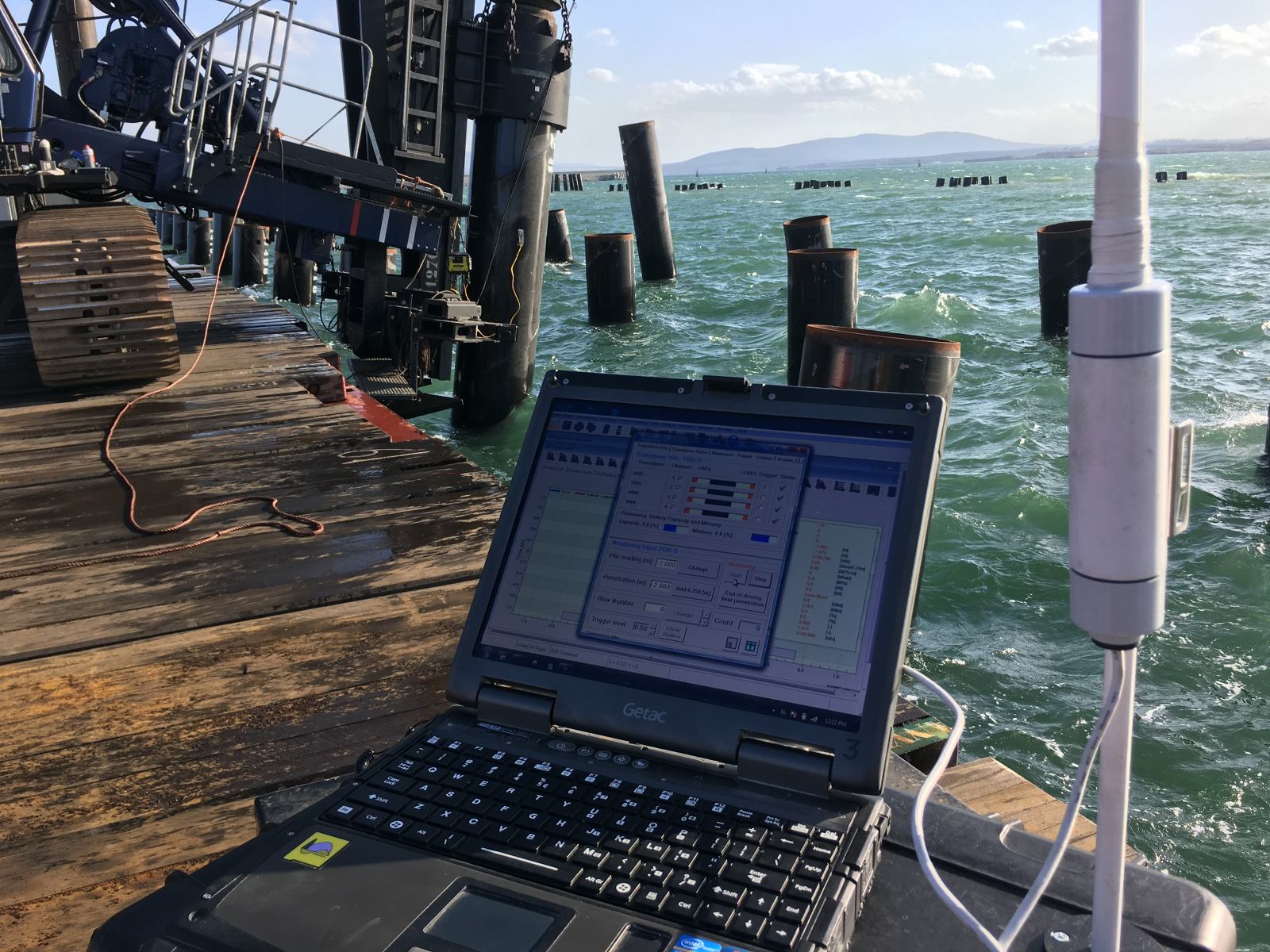
- Installation monitoring and signal matching to validate predictions against measured data and update the soil model for subsequent piles
- Sensitivity analyses to quantify the effect of soil and hammer parameter uncertainty on predicted outcomes
- Independent technical review of drivability studies prepared by others, providing an additional layer of verification for your project
Our approach treats a drivability prediction as the beginning of a learning process, not a final deliverable. Each installation generates data that makes the next prediction more reliable. If you want to discuss how this applies to your project, contact our team and we will be glad to help.