

To select the right impact hammer for pile installation, you need to match the hammer’s energy output to the soil resistance your pile must overcome, while keeping the forces transferred to the pile within its structural limits. The correct choice depends on the combination of hammer type, pile material, pile geometry, and the ground conditions along the full installation depth. The sections below address the most common questions that arise when making this decision.
What are the main types of impact hammers used in pile driving?
The two dominant types of impact hammers used in pile driving are hydraulic impact hammers and diesel impact hammers. Both generate a blow by dropping or driving a ram onto the pile head, but they differ significantly in how they control energy, stroke height, and blow rate. Drop hammers, which rely purely on gravity, are also used in specific situations but are far less common on modern construction sites.
Hydraulic hammers use pressurized fluid to lift the ram and, in many designs, to accelerate it downward as well. This gives the operator precise control over stroke height and therefore over the energy delivered per blow. Diesel hammers operate through a combustion cycle: the falling ram compresses air and fuel in a cylinder, igniting the mixture and driving the ram back up for the next blow. The energy output of a diesel hammer is strongly influenced by the stiffness of the pile-soil system, which means its performance is less predictable across varying ground conditions.
Vibratory hammers are sometimes grouped alongside impact hammers in general discussions, but they work on a fundamentally different principle, using rotating eccentric masses to generate oscillating forces rather than discrete blows. For impact pile driving specifically, hydraulic and diesel hammers remain the primary tools.
How does soil type affect impact hammer selection?
Soil type directly determines the resistance the pile must overcome at every depth increment, and this resistance profile is the starting point for any hammer selection. Dense sand layers, hard clay, and rock require higher energy per blow to achieve penetration, while soft clays and loose sands offer lower resistance and can be driven with less energy. The full soil profile, not just the conditions at the target depth, governs which hammer is appropriate.
A practical example from driveability analysis illustrates this well: a prestressed concrete pile may require a heavier hammer to penetrate a strong sand layer at intermediate depth, yet that same hammer could generate excessive compressive stresses in softer layers above or below. This means the hammer selection must account for the worst-case resistance along the entire installation path, not only at the final penetration level.
Soil type also affects how resistance is distributed between shaft friction and toe resistance. In cohesive soils, shaft friction tends to dominate and can build up progressively, increasing the driving resistance as the pile advances. In granular soils, toe resistance often plays a larger role, particularly for closed-ended piles. Understanding this distribution helps define both the minimum energy needed to advance the pile and the maximum energy the pile can safely absorb without damage.
Friction fatigue is another soil-related factor. As a pile is driven deeper, the unit shaft friction in the upper layers tends to decrease due to stress relaxation and soil disturbance. Driveability predictions that account for friction fatigue produce more realistic blow count profiles than those that assume constant friction throughout installation.
What role do pile material and geometry play in choosing a hammer?
Pile material and geometry set the structural limits within which the hammer must operate. A hammer that delivers too much energy relative to the pile’s capacity will cause tensile or compressive stress damage, while one that delivers too little will fail to advance the pile. The pile’s cross-sectional area, wall thickness, length, and material stiffness all influence how stress waves travel through it and what force levels are acceptable.
Pile material and stress limits
Concrete piles, whether precast or prestressed, are vulnerable to tensile cracking during driving. When a compressive stress wave reflects from a soft soil layer or a free pile toe, it returns as a tensile wave. If this tensile stress exceeds the pile’s tensile capacity, cracking occurs. Steel piles tolerate higher tensile stresses but can buckle or yield under extreme compressive loading. Timber piles have their own stress limits and are sensitive to repeated high-energy blows. Each material therefore defines a specific allowable stress envelope that the hammer selection must respect.
Pile geometry and plugging behavior
Geometry matters beyond simple cross-section. A closed-ended pile mobilizes full toe resistance from the first blow, making it significantly harder to drive than an open-ended tubular pile of similar dimensions. Open-ended steel tubes can drive in an unplugged condition, where soil enters the interior and reduces effective toe resistance. However, plugging can develop as driving progresses, particularly in dense granular soils, which changes the resistance distribution and increases driving difficulty. For very long piles, the pile’s own impedance, which is the product of its cross-sectional area, material stiffness, and wave speed, determines how efficiently the hammer’s energy is transmitted downward rather than reflected back.
How is hammer energy matched to pile and soil requirements?
Hammer energy is matched to pile and soil requirements by identifying an operational window: the range of energy levels that are sufficient to overcome the maximum soil resistance encountered during installation, while remaining below the threshold that would cause structural damage to the pile. This window is determined through driveability analysis, not by rule of thumb or hammer rating alone.
A key principle here is that rated hammer energy is not equal to energy delivered to the pile. Losses occur in the hammer mechanism, through the cushion and helmet system, and at the pile head contact. The cushion, in particular, plays an active role: it changes both the peak stress and the duration of the load pulse. A stiffer cushion transmits higher peak forces over a shorter time, while a softer cushion spreads the impulse and reduces peak stress at the cost of some energy transfer efficiency. For concrete piles, cushion selection is therefore part of the hammer-pile matching process, not an afterthought.
Driveability prediction tools simulate this full system, including the hammer’s impact force-time history, the cushion’s elastic modulus and restitution coefficient, the pile’s impedance, and the soil resistance model. The output includes blow count versus penetration depth, maximum tensile and compressive stresses, energy transfer, and pile displacement per blow. These results allow you to verify whether the selected hammer keeps the pile within safe stress limits across all penetration depths, not just at the target depth.
For wooden cushions specifically, the properties of the consolidated cushion after initial blows should be used in the analysis, rather than the properties of a fresh cushion. Cushion condition changes during driving and can affect stress predictions meaningfully.
What is the difference between hydraulic and diesel impact hammers?
The main difference between hydraulic and diesel impact hammers is energy controllability. Hydraulic hammers allow the operator to set the stroke height precisely, giving direct control over the energy delivered per blow. Diesel hammers generate energy through a combustion cycle, and their output depends on the pile-soil system’s response, making them less predictable and harder to adjust during driving.
In practical terms, this distinction has several consequences for hammer selection and monitoring:
- Energy consistency: Hydraulic hammers deliver more consistent blow energy, which makes it easier to interpret driving records and correlate blow count with soil resistance.
- Adaptability: With a hydraulic hammer, you can reduce stroke height when driving through soft layers to avoid overstressing the pile, then increase it when encountering harder resistance.
- Diesel hammer behavior: A diesel hammer’s combustion efficiency depends on how hard the pile-soil system is. In very soft ground, the system may not provide enough reaction for the combustion to develop fully, resulting in lower-than-expected energy output. In stiff ground, the hammer performs closer to its rated capacity.
- Monitoring complexity: Because diesel hammer energy varies with ground conditions, dynamic load testing and hammer monitoring are particularly valuable when using diesel hammers, as they allow you to measure actual transferred energy rather than relying on rated values.
Both hammer types are widely used and both can be modeled accurately in driveability analysis, provided the correct physical parameters are used. The choice between them often comes down to equipment availability, project scale, and the degree of energy control the installation requires.
When should dynamic load testing be used alongside hammer selection?
Dynamic load testing should be used alongside hammer selection whenever you need to verify that the actual energy transfer, pile stresses, and soil resistance during installation match the predictions made during the design phase. It is particularly relevant when ground conditions are variable, when the pile type is sensitive to stress damage, or when the hammer’s actual performance is uncertain.
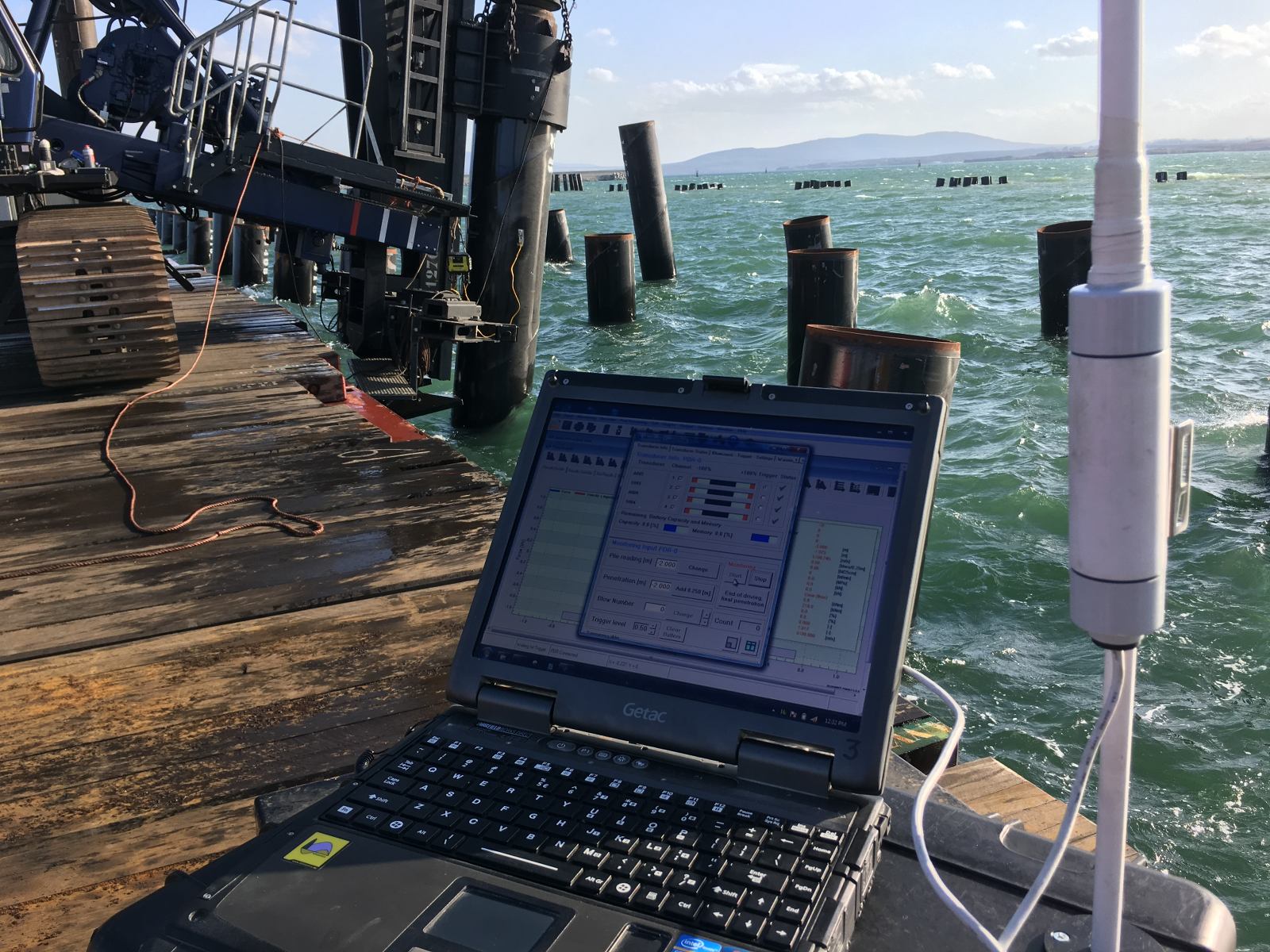
During pile driving, dynamic load testing measures force and velocity at the pile head in real time. From these measurements, you can determine the energy actually reaching the pile, the maximum compressive and tensile stresses generated, and the soil resistance at the time of testing. This information serves two purposes: it confirms whether the hammer is operating within the intended energy window, and it provides data on bearing capacity that can be used to validate or refine the foundation design.
Dynamic load testing is also useful when open-ended piles are involved, because plugging behavior during dynamic installation may differ from behavior under static load. A pile that drives in an unplugged condition may develop a soil plug under static loading, changing the effective toe resistance. Recognizing this distinction during installation monitoring helps you interpret the driving record correctly and avoid misreading blow count as a direct indicator of static capacity.
From a risk management perspective, combining a well-executed driveability prediction with dynamic load testing during the installation of the first piles of a project gives you the feedback loop needed to confirm assumptions, adjust hammer settings if necessary, and reduce installation risk for the remaining piles.
How We Help with Impact Hammer Selection and Driveability Analysis
At Allnamics, we support your team through the full process of impact hammer selection and driveability assessment, from early-stage feasibility through installation monitoring and post-drive verification. Our approach is grounded in decades of experience with stress-wave analysis and pile installation across a wide range of soil conditions, pile types, and project scales.
Here is what we provide concretely:
- Driveability predictions using our AllWave software package, which simulates the full hammer-pile-soil system to predict blow count, energy transfer, and pile stresses across the entire installation depth
- Hammer selection advice based on your specific pile geometry, material, and soil profile, including assessment of cushion properties and helmet configuration
- Soil modeling from CPT, SPT, and laboratory data to build accurate resistance profiles, including friction fatigue and variable resistance distributions
- Dynamic load testing during pile installation to verify actual energy transfer and soil resistance, and to identify any deviation from predicted behavior early
- Hammer monitoring and installation support for projects where real-time feedback on driving performance is needed to protect pile integrity and meet installation criteria
- Risk assessment covering refusal risk, early refusal scenarios, and the consequences of alternative installation strategies if the primary approach encounters unexpected resistance
Whether you are planning a new foundation program or reviewing an existing installation approach, we can help you identify the right hammer configuration and verify that your installation plan is both technically sound and practically executable. Contact us to discuss your project requirements.