

A drivability prediction reduces the risk of early refusal by identifying, before a single pile is driven, whether your chosen hammer and installation system can overcome the soil resistance at every depth along the pile’s path. When the analysis reveals that resistance exceeds the hammer’s capacity at a particular layer, you can adjust the equipment, the pile design, or the installation strategy before mobilization, not during it. The sections below unpack the mechanics of early refusal, how drivability studies work, and what they reveal about installation risk.
What causes early refusal during pile driving?
Early refusal occurs when the soil resistance at a given penetration depth exceeds the energy the hammer can deliver to the pile, bringing installation to a halt before the pile reaches its target depth. Unlike refusal at final set, which can be acceptable, early refusal is an unplanned stop that typically signals a mismatch between the installation system and the ground conditions encountered.
Several factors drive early refusal. Unexpected hard layers (dense sand, cemented soils, or rock) can generate shaft and toe resistance far above what the pre-installation soil model predicted. Friction fatigue plays a role too: as a pile penetrates, the cumulative shaft friction along its length increases, and in some soil profiles this build-up outpaces the hammer’s ability to advance the pile. Plug formation inside open-ended tubular piles can also create a sudden, dramatic increase in toe resistance.
On the installation system side, early refusal can result from insufficient hammer energy, poor energy transfer through the cushion or helmet, or a hammer that is simply undersized for the pile and soil combination. In vibratory driving, early refusal often reflects a mismatch between the vibrator’s frequency and the soil’s dynamic response, or a soil layer with high friction that the vibrator cannot overcome. The 2022 NAM L13-F1-1 case illustrates this directly: a 4.5 m diameter monopile driven with a vibratory hammer reached early refusal at approximately 25 m penetration, requiring a switch to an impact hammer to reach the final depth of around 31.5 m.
Understanding these causes matters because the remedial actions available after early refusal (switching to a larger hammer, removing soil or plug material, or changing installation strategy) are costly, time-consuming, and can in some cases damage the pile or affect its long-term bearing capacity.
How does a drivability prediction work?
A drivability prediction works by simulating the complete pile installation process using one-dimensional stress wave analysis, modelling the coupled interaction between the hammer, the helmet and cushion system, the pile, and the soil at every blow throughout the full penetration depth. The result is not a single number but a continuous picture of how the installation is expected to behave from start to finish.
The core principle follows this chain: hammer impact generates a stress wave that propagates down the pile, interacts with the soil’s shaft and toe resistance, produces permanent penetration, and reflects back up, and the cycle repeats for the next blow. At each penetration level, the model calculates blow count, transferred energy, hammer efficiency, maximum compressive and tensile stresses, and pile displacement. For concrete piles, stresses in the concrete and reinforcement are also tracked.
The four coupled components of the model
Every drivability model consists of four interacting parts. The hammer and drive mechanism generate the impact energy. The helmet, cap, and cushion determine how that energy reaches the pile head. The pile itself transmits the stress wave along its length, with its geometry and material properties governing wave speed and impedance. The soil provides time-, velocity-, and displacement-dependent shaft and toe resistance that the pile must overcome at every depth.
Sensitivity analysis and scenario runs
Because soil resistance is inherently uncertain, a single nominal run gives an incomplete picture. A robust drivability study runs lower-bound, best-estimate, and upper-bound soil resistance profiles to explore the full range of plausible outcomes. This sensitivity analysis reveals where refusal risk is concentrated, what the maximum tensile and compressive stresses could be under adverse conditions, and whether the chosen hammer has sufficient reserve capacity across the realistic range of ground variability. The AllWave software package supports both impact driving prediction (AllWave-PDP) and vibratory driving prediction (AllWave-VDP), enabling this kind of multi-scenario analysis within a single modelling environment.
What risks does a drivability study identify before installation?
A drivability study identifies installation risks that would otherwise only become visible, and expensive, during the actual driving operation. By running the analysis before mobilization, you gain a structured view of where the installation could fail, where the pile could be damaged, and whether the planned equipment is fit for purpose.
The key risks a well-executed drivability study surfaces include:
- Early refusal risk: Depth intervals where soil resistance is likely to exceed hammer capacity, flagging where the pile may stop prematurely.
- Pile overstress: Penetration zones where compressive or tensile stresses approach or exceed the pile’s structural limits, risking cracking or material damage.
- Insufficient energy transfer: Conditions where the cushion, helmet, or hammer configuration delivers inadequate energy to the pile head, reducing installation efficiency.
- Excessive blow count or installation time: Depth ranges where driving becomes very slow, increasing fatigue loading on the pile and raising operational costs.
- Hammer undersizing: Scenarios where the selected hammer lacks the reserve capacity to handle upper-bound soil resistance, requiring a contingency plan.
- Vibratory driving limitations: Soil layers where a vibratory hammer is unlikely to achieve the required penetration, indicating that a switch to impact driving may be needed.
Identifying these risks before installation means you can address them through equipment selection, pile geometry adjustments, or a revised installation sequence, rather than through costly remedial actions in the field.
When should a drivability prediction be carried out?
A drivability prediction should be carried out as early as the soil investigation data allows, ideally during the design phase, before equipment procurement and well before mobilization. The earlier the analysis is done, the more influence its findings can have on decisions that are expensive to reverse.
In practice, there are several points in a project where a drivability study adds the most value:
- During pile design: To verify that the proposed pile dimensions and material can be installed with available equipment without exceeding structural stress limits.
- During hammer selection: To confirm that the chosen hammer, or shortlisted options, can achieve the required penetration across the realistic range of soil conditions.
- Before contract award or equipment procurement: To reduce the risk of specifying equipment that proves inadequate once installation begins.
- When soil conditions are uncertain or variable: To quantify how sensitive the installation outcome is to ground variability, and to define contingency strategies in advance.
- Before a new project in unfamiliar geology: To build a site-specific understanding of installation behavior before committing to a full installation program.
The prediction should also be revisited whenever significant new ground investigation data becomes available, or when the pile design or hammer selection changes materially from the original assumptions.
How accurate are drivability predictions in practice?
Drivability predictions are engineering models, not deterministic guarantees. Their accuracy depends directly on the quality of the soil model, the reliability of the hammer performance data, and how well the model captures the actual pile-soil interaction during driving. A prediction based on high-quality CPT data and a well-calibrated hammer model will perform significantly better than one built on sparse or uncertain input.
The most important factor limiting prediction accuracy is uncertainty in the soil resistance to driving (SRD). Dynamic shaft and toe resistance, friction fatigue behavior, remoulding effects, and velocity-dependent soil response are all difficult to characterize precisely from static ground investigation data alone. This is why sensitivity analysis (running lower-bound, best-estimate, and upper-bound resistance profiles) is technically more valuable than relying on a single nominal output.
In practice, the gap between prediction and reality narrows significantly when predictions are systematically compared against measured installation data. This creates a learning loop: ground investigation feeds an initial soil model, the drivability prediction is made, installation is monitored, signal matching and back-analysis update the soil model, and the comparison between prediction and measurement improves future predictions. A deviation between the predicted and actual blow count is not just an error to explain: it is information that makes the next prediction more reliable.
The NAM L13-F1-1 case demonstrates this directly: the vibratory installation of a large-diameter monopile was monitored in detail, the measured data was used for signal matching, and the resulting updated soil model was then compared against the original CPT-based prediction. The installation itself became a calibration experiment for both drivability and capacity assessment.
What’s the difference between a drivability study and pile monitoring during installation?
A drivability study is a predictive analysis carried out before installation, while pile monitoring during installation is a real-time measurement program carried out while the pile is being driven. The two serve different purposes but are most powerful when used together as part of a connected workflow.
The drivability study answers the question: Can this pile be installed with this equipment, and what will the installation look like? It produces forecasts of blow count, pile stresses, energy transfer, and refusal risk across the full penetration depth, based on the soil model and hammer assumptions available before work begins.
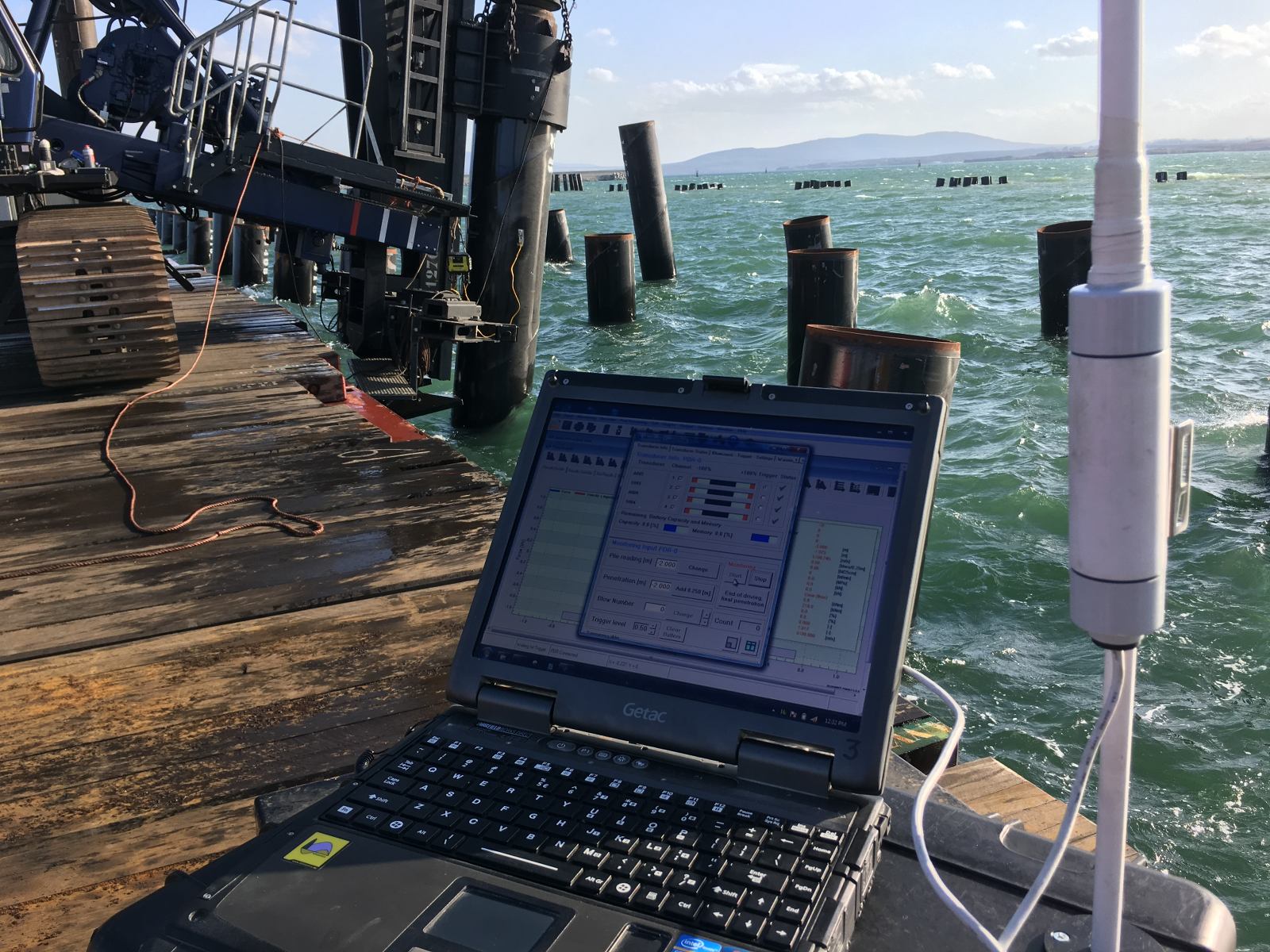
Pile monitoring during installation, using sensors on the pile head to measure force and velocity in real time, answers a different question: What is actually happening during this blow? It captures the true hammer performance, the actual energy delivered to the pile, and the real soil resistance being mobilized at each depth. This data can be processed immediately to verify that driving is proceeding within safe stress limits, or analyzed afterward through signal matching to back-calculate the actual soil resistance profile.
The relationship between the two is iterative rather than sequential. Monitoring data from one installation updates the soil model, which improves the drivability prediction for the next pile or the next project in similar geology. A drivability prediction without subsequent monitoring misses the opportunity to validate and improve the model. Monitoring without a prior drivability study loses the reference point needed to interpret whether what is being measured is expected or anomalous.
How Allnamics Supports Your Drivability Analysis
We carry out drivability studies for foundation piles across a wide range of project types (offshore wind, oil and gas, marine infrastructure, and onshore construction) using our in-house AllWave software and decades of accumulated installation experience. Our approach treats a drivability prediction not as a one-off calculation but as the starting point of a structured learning process that continues through installation and into post-analysis.
When you work with us on a drivability study, we provide:
- Stress wave-based installation simulation using AllWave-PDP for impact driving and AllWave-VDP for vibratory driving, covering blow count, pile stresses, energy transfer, and penetration resistance across the full depth profile.
- Multi-scenario sensitivity analysis with lower-bound, best-estimate, and upper-bound soil resistance profiles to quantify refusal risk and structural stress limits under realistic ground variability.
- Hammer selection and equipment review to verify that your planned installation system has sufficient capacity and reserve across the range of expected soil conditions.
- Contingency strategy development identifying where alternative equipment or installation methods may be needed before mobilization.
- Integration with installation monitoring and back-analysis so that measured data from the actual driving operation feeds back into an updated soil model, improving predictions for subsequent piles.
- Independent technical review of third-party drivability studies for projects where you need an expert second opinion.
If your project involves complex soil conditions, large-diameter piles, or tight installation tolerances, a well-structured drivability study is one of the most effective ways to reduce installation risk before it becomes a field problem. Contact us to discuss your project and find out how we can support your installation planning.
Gerelateerde artikelen
- What documentation is required after a pile load test?
- What challenges does saltwater exposure create for testing equipment?
- How does stand-alone data logging work during monopile installation?
- What is a reaction system in static pile load testing?
- How is a reference pile selected for a load test programme?