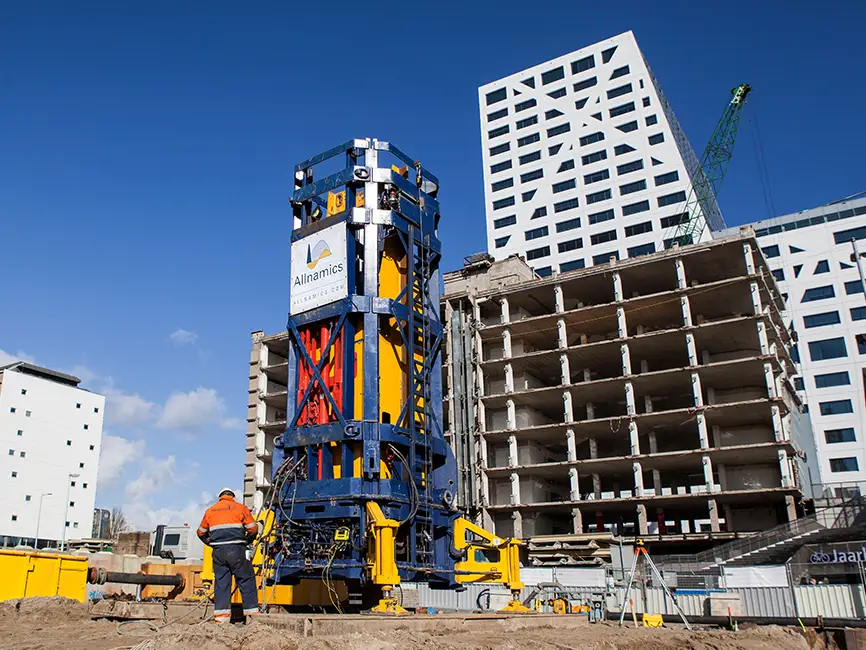



A Rapid Load Test requires a defined set of safety measures covering exclusion zones, personal protective equipment, site preparation, and clear assignment of responsibilities. These requirements are set out in international standards such as ISO 22477-10 and ASTM D7383, and they apply to everyone present on site during the test. The sections below walk through each safety requirement in detail, from governing standards to on-site responsibilities.
What standards and regulations govern Rapid Load Testing?
Rapid Load Testing is governed primarily by three standards: ISO 22477-10:2016, ASTM D7383-19, and NEN 7201:2025 (the Dutch national standard). Each addresses equipment, instrumentation, test preparation, safety, and reporting. ISO 22477-10 and ASTM D7383 both treat execution and interpretation as specialist activities requiring trained personnel.
ISO 22477-10:2016, titled Geotechnical investigation and testing: Testing of geotechnical structures: Part 10: Testing of piles: rapid load testing, is the primary international reference. It specifies how a rapid load test must be set up, executed, and reported, and it includes provisions specifically addressing safety and pile integrity checks before testing begins.
ASTM D7383-19 distinguishes between two execution procedures. Procedure A uses gas pressure to accelerate a reaction mass. Procedure B uses a drop mass combined with a damping or spring system, the approach used by the StatRapid device. Both procedures require specialist knowledge for safe execution and result interpretation.
NEN 7201:2025 is the current Dutch national standard, replacing NPR 7201:2017+A1:2020. It explicitly includes Rapid Load Testing, defines test load classes, and sets out conditions under which a non-static load test may substitute for a static one. It also contains specific provisions for soil conditions around the pile tip, which directly affect how the test must be set up and interpreted.
What are the main hazards associated with a Rapid Load Test?
The main hazards during a Rapid Load Test are the sudden release of a large drop mass, the generation of high-energy force pulses into the pile, and the potential for equipment movement or pile head failure. Because the test applies a rapid, high-magnitude compressive force, any structural weakness in the pile or test setup can result in sudden, uncontrolled energy release.
The key hazards to account for include:
- Drop mass release: The falling mass used to generate the load pulse poses a direct impact hazard to anyone in the vicinity. The mass must be secured at all times except during the controlled drop sequence.
- High-force pulse transmission: The rapid load pulse travels through the pile and into the surrounding ground. This can cause unexpected ground movement, vibration, or displacement near the pile head.
- Pile head or cap failure: If the pile has structural defects or the pile cap is not properly prepared, the pile head may crack or fail under the applied load, sending fragments outward.
- Equipment instability: The test rig, spring package, and associated instrumentation must be correctly assembled and stable. An improperly secured configuration can shift or topple during the drop sequence.
- Instrumentation cables and trip hazards: Load cells, displacement sensors, and accelerometers require cabling that must be routed safely to avoid creating hazards for personnel on site.
Predicting the test in advance reduces several of these risks. Before execution, engineers typically estimate the required drop mass, spring configuration, and drop height needed to reach the target load level. This prediction also checks expected pile stresses so that the applied force does not exceed what the pile can safely sustain.
What exclusion zones are required during a Rapid Load Test?
During a Rapid Load Test, a clearly defined exclusion zone must be established around the test pile and equipment. No unauthorized personnel may enter this zone while the drop mass is raised or during the test sequence. The exact dimensions depend on the equipment configuration, drop height, and site conditions, but the zone must be large enough to protect against mass movement, pile head fragments, and ground displacement.
The exclusion zone serves two purposes. First, it protects personnel from direct physical hazards such as a falling mass, ejected material from the pile head, or equipment movement. Second, it prevents interference with the instrumentation, which requires stable conditions to produce accurate measurements.
In practice, the zone is typically marked with physical barriers and signage before any lifting or loading begins. Access control must be enforced throughout the test, not only at the moment of the drop. Personnel operating instrumentation remotely should be positioned outside the exclusion zone, with data acquisition systems set up at a safe distance from the pile head.
For larger configurations, such as those requiring higher drop masses to reach load levels of 4 MN or 8 MN, the exclusion zone should be reviewed and potentially extended to reflect the greater energy involved. The method statement for the specific equipment and configuration should define the minimum required zone dimensions.
What personal protective equipment is required for RLT personnel?
All personnel present during a Rapid Load Test must wear standard construction site personal protective equipment as a baseline. This includes a hard hat, safety footwear, high-visibility clothing, and eye protection. Additional PPE may be required depending on site-specific conditions and the risk assessment carried out before the test.
The baseline PPE requirements for RLT personnel are:
- Hard hat: Protects against falling objects during equipment assembly and the drop sequence.
- Safety footwear: Steel-toed boots protect against dropped equipment and provide grip on potentially unstable ground near the pile head.
- High-visibility vest or jacket: Ensures all personnel are visible to equipment operators and crane drivers during setup and testing.
- Eye protection: Shields against debris, particularly during pile head preparation and at the moment of load application.
- Hearing protection: The impact of the drop mass generates significant noise. Personnel within the site perimeter should use hearing protection during the test sequence.
Where the test is conducted in confined spaces, near water, or in other hazardous environments, the site-specific risk assessment will determine whether additional PPE, such as life jackets, respiratory protection, or fall arrest equipment, is also required. PPE requirements should be communicated to all personnel before site access is granted.
How should the test site be prepared to meet safety requirements?
Test site preparation for a Rapid Load Test covers three areas: the pile head condition, the ground around the test location, and the access and logistics setup. All three must be addressed before the equipment is assembled and before any drop sequence begins.
Pile head and structural preparation
The pile head must be clean, level, and free of loose material. Any irregularities in the pile head surface can cause uneven load distribution during the test, increasing the risk of pile head damage or instrumentation failure. A structural integrity check of the pile should be completed before testing. ISO 22477-10 includes explicit provisions for this step. If the pile shows signs of damage or defects, the test must not proceed until the issue is assessed and resolved.
The load cell and spring package must be positioned concentrically on the pile head. Misalignment introduces eccentric loading, which can damage both the pile and the equipment. The assembly process should follow the method statement for the specific equipment configuration being used.
Ground conditions and access
The ground around the pile must be stable enough to support the test rig and any crane or transport equipment used during setup. Soft or uneven ground can cause the rig to shift during the drop sequence. Where ground conditions are marginal, temporary ground improvement or load-spreading measures may be needed.
Access routes to the site must accommodate the transport units required for the equipment. Depending on the configuration and required drop mass, two or three trucks may be needed to deliver the equipment to site. These logistics must be planned in advance to avoid delays that could compromise the test schedule or create unsafe conditions during setup.
Exclusion zone barriers and signage should be in place before the equipment is assembled, not after. This ensures that the controlled area is established from the start of the operation, not only at the moment of the test.
Who is responsible for safety compliance during a Rapid Load Test?
Responsibility for safety compliance during a Rapid Load Test is shared between the test engineer in charge, the site supervisor, and the client organization. The test engineer or geotechnical specialist leading the test is responsible for the technical execution and for ensuring the test is carried out in accordance with the applicable standard. The site supervisor is responsible for enforcing site access controls and PPE compliance. The client organization is responsible for ensuring the site meets the conditions required for safe testing.
In practice, this means that before the test begins, the responsible engineer should confirm that:
- The pile has been checked for structural integrity.
- The test prediction has been completed and reviewed, confirming that the planned drop mass, spring configuration, and drop height are appropriate for the pile and soil conditions.
- The exclusion zone is established and access is controlled.
- All personnel on site have been briefed on the hazards and their responsibilities.
- PPE requirements are communicated and enforced.
- The equipment assembly has been checked against the method statement.
Both ISO 22477-10 and ASTM D7383 treat the execution of a Rapid Load Test as specialist work. This means the person leading the test must have the training and experience to recognize when conditions are unsafe and to halt the test if necessary. Safety compliance is not a checklist exercise, it requires active judgment throughout the setup and execution process.
How We Support Safe Rapid Load Test Execution
At Allnamics, we manage every aspect of Rapid Load Testing from prediction and site preparation through to execution and reporting. Our approach to safety is built into the process from the start, not added as an afterthought. Here is what working with us looks like in practice:
- Pre-test prediction: We calculate the required drop mass, spring configuration, and drop height in advance, checking expected pile stresses and load duration against the requirements of the applicable standard.
- Equipment and instrumentation: We use calibrated load cells, optical displacement measurement systems, and accelerometers. Where needed, we instrument the pile at multiple depths to separate shaft friction from toe resistance.
- Site setup and exclusion zone management: Our team establishes and enforces exclusion zones, prepares the pile head, and verifies equipment alignment before any drop sequence begins.
- Standards compliance: We work in accordance with ISO 22477-10, ASTM D7383, and NEN 7201:2025, and we adapt our approach to any additional project-specific or national requirements.
- Specialist interpretation: Our engineers interpret results using appropriate analysis methods, applying corrections for pile inertia and rate-dependent soil behavior to derive reliable static-equivalent capacity values.
- Full reporting: We deliver clear, documented reports that meet the reporting requirements of the applicable standard and support your project decisions.
If you are planning a Rapid Load Test and want to make sure the safety requirements are met from day one, contact our team to discuss your project.
Gerelateerde artikelen
- How is the maximum load controlled with Rapid Load Testing?
- What geotechnical data is needed before offshore pile testing?
- How is pile driving behaviour predicted before construction starts?
- How do you determine pile failure from test results?
- What is the difference between static and dynamic pile load testing?