


Pile load testing reveals how much load a pile can safely carry, how it deforms under that load, and whether its structural integrity meets design requirements. The results give engineers and project teams direct, measurable evidence of foundation performance rather than relying solely on design assumptions or soil models. Below, we answer the most common questions about what pile load testing produces, how different methods compare, and when to use it.
What types of results does pile load testing produce?
Pile load testing produces measurements of load-bearing capacity, pile head displacement, and the relationship between applied load and settlement. These results allow engineers to confirm whether a pile performs as designed, identify any unexpected behavior under load, and establish a reliable basis for foundation acceptance or further investigation.
Depending on the method used, the results can include:
- Ultimate bearing capacity — the maximum load the pile can sustain before failure or excessive settlement occurs
- Load-settlement curves — graphs showing how the pile head moves as load increases, revealing stiffness and deformation behavior
- Shaft friction and end bearing distribution — how load is transferred along the pile shaft versus at the pile tip
- Elastic and plastic deformation — how much displacement is recoverable after unloading
- Pile integrity indicators — in dynamic methods, stress wave data can also flag structural anomalies
These outputs feed directly into foundation design decisions, acceptance criteria, and risk assessments. For projects where soil conditions are variable or design assumptions are uncertain, the data from pile load testing provide the factual grounding that design models alone cannot offer.
How does pile load testing differ from pile integrity testing?
Pile load testing measures a pile’s capacity to carry structural loads, while pile integrity testing assesses the physical condition of the pile itself. The two serve different purposes: load testing answers “can this pile carry the required load?”, whereas integrity testing answers “is this pile structurally sound and free from defects?”
Pile integrity testing, often referred to as Sonic Integrity Testing (SIT) or Pile Integrity Testing (PIT), uses low-strain stress waves to detect discontinuities, cracks, necking, or inclusions within the pile shaft. It does not measure bearing capacity. Load testing, by contrast, applies a controlled force to the pile and measures its response, producing capacity and deformation data.
In practice, the two methods are often used together. Integrity testing can screen a large number of piles quickly and cost-effectively, identifying those that warrant further investigation. Load testing then provides the quantitative performance data needed for structural acceptance. Using both gives your team a more complete picture of foundation quality than either method alone.
When should pile load testing be carried out during a project?
Pile load testing should be carried out at three key stages: before construction begins (preliminary testing), during the main piling works (working pile testing), and after construction if performance concerns arise. The timing depends on the project phase, the level of risk, and what decisions the results need to support.
- Preliminary or trial pile testing takes place before production piling starts. It validates the design assumptions, confirms installation methods, and can allow pile lengths or diameters to be optimized, potentially reducing costs across the full pile program.
- Working pile testing is carried out on a sample of production piles during or after installation. It confirms that the piles as built meet the required performance criteria and provides a basis for formal acceptance.
- Post-construction or forensic testing is used when concerns arise about pile performance, unexpected settlement, or structural changes. It provides the evidence needed to diagnose problems and plan remediation.
Regulatory requirements, contract specifications, and geotechnical risk classifications often define the minimum testing scope. In variable ground conditions or on projects with a high consequence of failure, more extensive testing programs are justified.
What’s the difference between static, dynamic, and rapid load testing?
The three main pile load testing methods differ in how the load is applied, how long it acts on the pile, and what kind of data they produce. Each has specific strengths depending on project conditions, pile type, and the level of detail required.
Static Load Testing (SLT)
Static load testing applies a slow, sustained load to the pile using a reaction system such as kentledge weights or anchor piles. The load is held at each increment for a defined period, and settlement is measured directly. SLT is widely regarded as the most direct method for determining pile capacity and produces highly reliable load-settlement curves. It is, however, time-consuming, requires significant setup, and can be costly for large-diameter or high-capacity piles.
Dynamic Load Testing (DLT)
Dynamic load testing uses a drop hammer to apply a brief, high-energy impact to the pile head. Sensors measure strain and acceleration, and the resulting stress wave data are analyzed using signal matching software to derive bearing capacity and soil resistance distribution. DLT is faster and less expensive than SLT and is particularly well suited to driven piles. The accuracy of DLT depends on the quality of the signal matching analysis and the experience of the engineer interpreting the results, but the results of dynamic pile load testing are inherently user dependent. The consequence is that there will always be a certain bandwidth of the results, even when elaborated by certified and highly experienced engineers and regardless of the used signal matching software. Obviously, this inherent user dependency and corresponding bandwidth affect the accuracy and reliability of dynamic pile load testing: the larger the bandwidth, the less accurate the result. Also important: the larger the bandwidth, the more impossible it becomes to establish a clear correlation with SLT results.
Rapid Load Testing (RLT)
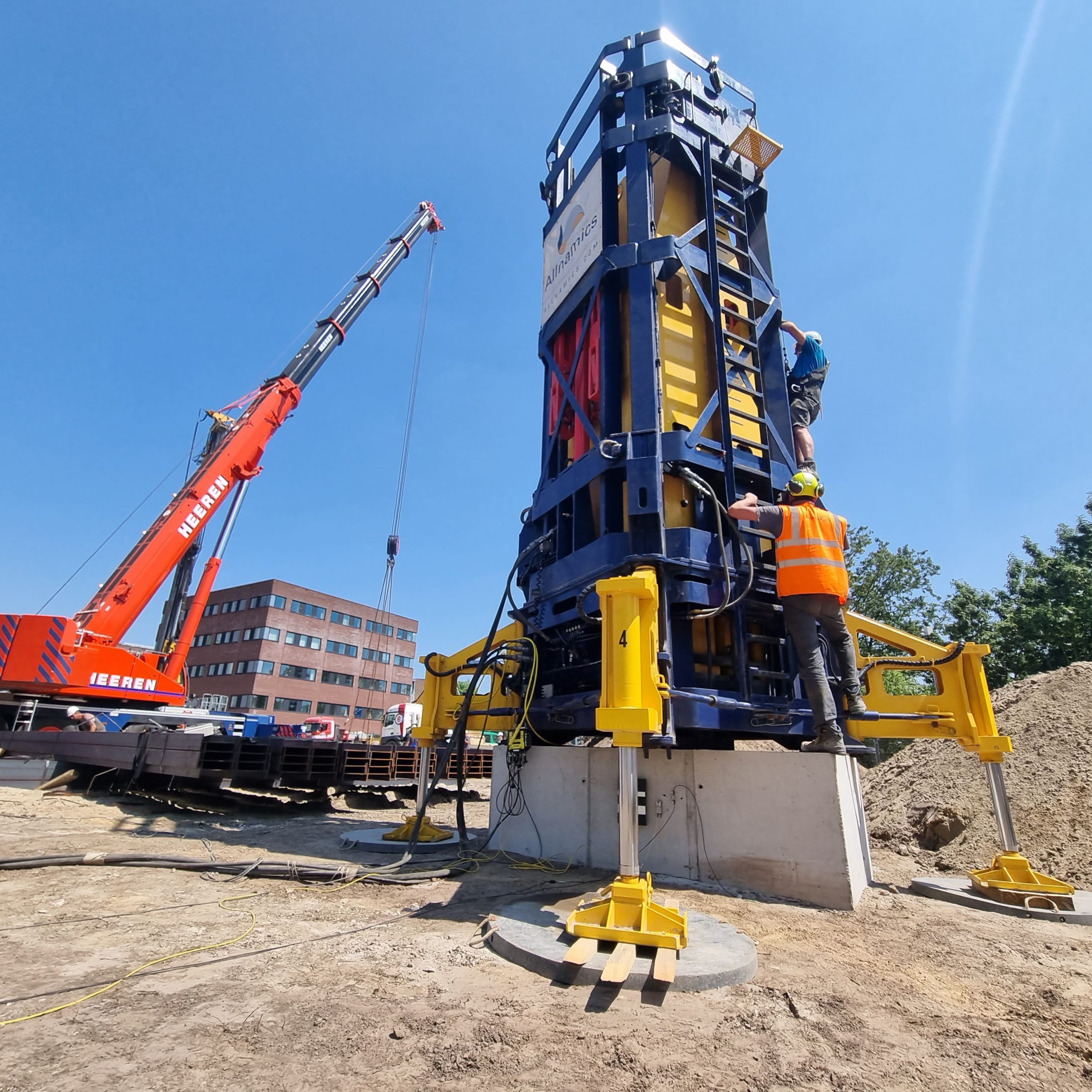
Rapid load testing falls between static and dynamic methods in terms of load duration. A device such as the Statnamic or StatRapid applies a force lasting roughly 100 to 200 milliseconds, which is (for most piles) more than 10 times the travel time for a stress wave from pile head to pile toe. That makes it possible (and physically allowed!) to model the pile as lumped mass and apply the user-independent Unloading Point Method (UPM), as described in ASTM D7383 and NEN-EN ISO 22477-10, for elaboration of the results. This is one of the most important differences between RLT and DLT: elaboration of RLT by UPM is user-independent, whereas elaboration of DLT by stresswave analysis (signal matching / capwap) is highly user dependent. As a result, elaborated results of RLT have a much smaller bandwidth than elaborated results of DLT and are therefore more reliable. Also important: the small bandwidth that comes with the user-indepency of RLT makes it possible to establish a clear correlation with SLT results. For DLT this is much harder and in many cases even impossible.
The second important difference between RLT and DLT is that RLT involves direct and accurate measurement of load and displacement (just like SLT), whereas DLT establishes load by multiplying measured strain by pile stiffness and establishes displacement by numeric double integration of acceleration. Especially in case of concrete cast in situ piles the pile stiffness is not (at all) clearly defined and therefore a significant source of inaccuracy for DLT. As a result of the direct measurements of load and displacement, another important difference between RLT and DLT is that RLT produces direct results and information about pile stiffness (= load-settlement behavior), especially when performed with multiple load cycles.
How accurate is dynamic load testing compared to static load testing?
Dynamic pile load testing can be reasonably accurate when properly performed on end bearing steel piles in suitable soil conditions and if interpreted correctly by experienced engineers doing signal matching. Under such favorable conditions bearing capacity estimates can be achieved within 10 to 20 percent of static load test results. Depending on the project and the objectives of the test this can be acceptable in many cases. But in other conditions, especially in case of (bored) cast in situ concrete piles, bearing capacity estimates obtained with dynamic load testing are not very accurate and will at best be within 20 to 40 percent of static load test results.
Static load testing remains the reference standard because it directly measures pile response under sustained load without the need for analytical corrections. For projects where the highest level of confidence is required, or where dynamic methods carry greater uncertainty, SLT provides the most direct and defensible results. In many programs, RLT or DLT is used across a larger number of piles while SLT is reserved for a smaller subset to calibrate and validate the dynamic results.
How accurate is Rapid Load Testing compared to static load testing?
Rapid Load Testing is pretty accurate when properly performed on piles in granular soils and when the criteria for minimum load duration are met. Under such conditions established bearing capacity is well within 10 percent of static load test results. For most projects this is acceptable.
But in other conditions, especially in case of piles in stiff cohesive soils established bearing capacity will be within 10 to 30 percent of static load test results, mostly depending on the site specific properties of the cohesive soil. However, because elaboration of RLT (by application of the unloading point method) is user-independent, the (site specific) correlation between RLT and SLT will be fairly constant for each project in such conditions and can thus be established by performing comparative SLT and RLT on the same pile.
Next to that, Rapid Load Testing can be performed on piles with embedded instrumentation, in the same way SLT is performed on instrumented piles. That makes it possible to separate toe resistance from shaft resistance and establish the distribution of shaft friction along the pile length. With those results the relevant design parameters can be established and/or optimized.
Static load testing remains the reference standard for piles in cohesive soils because it captures time dependent behavior (creep) that quick tests (rapid or dynamic) simply will not capture. In many programs with piles in cohesive soils, RLT is used across a larger number of piles while SLT is reserved for reference if needed.
What can pile load testing reveal about an existing foundation?
Pile load testing on an existing foundation can reveal its load-bearing capacity ‘as-is’, the condition of the load transfer mechanism, and whether the foundation can safely support new or increased demands. This information is particularly valuable when assessing foundations for reuse, evaluating structural changes, or investigating unexplained settlement or movement.
For existing structures, pile load testing can answer questions such as:
- Does the foundation still meet its original design capacity after years of service?
- Can the structure support additional floors, equipment, or changed loading conditions?
- Has deterioration, ground movement, or adjacent construction affected pile performance?
- Is the foundation suitable for reuse in a redevelopment project, avoiding the cost and carbon impact of new piling?
Foundation reuse is a growing priority in urban redevelopment and sustainability-driven projects. Testing existing piles before committing to a reuse strategy gives your team the evidence needed to make that decision with confidence rather than assumption. In forensic investigations, load testing combined with integrity testing can identify whether a pile has been damaged and to what extent its capacity has been compromised.
How We Help with Pile Load Testing
We provide the full range of pile load testing services, from preliminary trial pile programs through to forensic investigations on existing foundations. Our team combines decades of experience in foundation engineering with in-house developed equipment and software, giving you accurate, reliable results across all project types and ground conditions.
Here is what working with us looks like in practice:
- Method selection and test design — we help you choose the right testing approach for your pile type, ground conditions, and project requirements, balancing accuracy, cost, and program constraints
- Static Load Testing (SLT) — full setup, execution, and reporting for projects requiring the highest level of direct capacity verification
- Dynamic Load Testing (DLT) and Pile Driving Analysis (PDA) — rapid, cost-effective capacity assessment during or after pile installation, with expert signal matching analysis
- Rapid Load Testing (RLT) and Statnamic testing — efficient testing for large-diameter piles, offshore conditions, or sites where reaction systems are impractical
- Pile Integrity Testing (PIT/SIT) — screening of production piles to identify structural anomalies before they become costly problems
- Foundation reuse assessments — testing and analysis to determine whether existing piles can support new demands, supporting sustainability and carbon-reduction goals
- Offshore pile testing — specialized services for marine, port, and offshore wind foundation verification
If you are planning a piling program, evaluating an existing foundation, or need independent technical validation, contact us to discuss your project.