


Statnamic is a rapid load testing method for foundation piles in which a reaction mass is accelerated upward from the pile head, generating a downward force on the pile as a result. Developed from 1988 onward by Berminghammer Corporation in Canada and TNO Building and Construction Research in the Netherlands, Statnamic sits between static and dynamic load testing in terms of loading duration, equipment requirements, and interpretation complexity. The sections below answer the most common questions engineers ask about how the method works, how it compares to alternatives, and when to use it.
How does Statnamic load testing work?
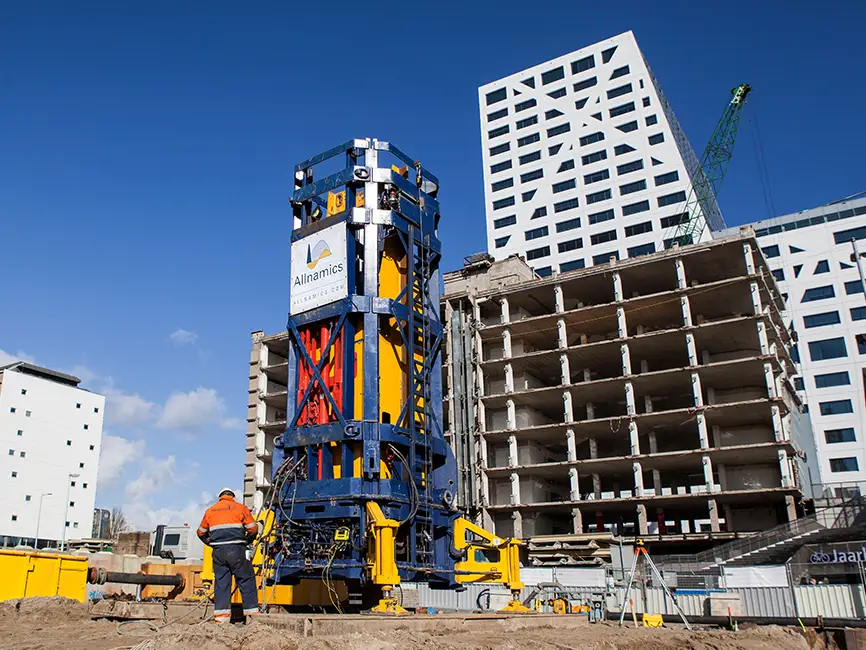
In a Statnamic test, a reaction mass is placed above the pile head. Combustion of a special fuel inside a cylinder generates rapidly expanding gas, which accelerates the reaction mass upward. By Newton’s third law, an equal and opposite downward force acts on the pile. The name Statnamic combines the words static and dynamic, directly reflecting its position between the two conventional test methods.
The applied force is measured directly at the pile head using a calibrated load cell, which means the measurement does not depend on the material properties of the pile itself. Pile head displacement is recorded with a laser system. Because both measurements are integrated into the Statnamic device, the setup is compact relative to the loads it can generate.
The loading duration is significantly longer than a hammer blow in dynamic load testing. This longer pulse reduces the dominance of stress wave phenomena inside the pile, making the pile behave more like a single moving body during the test. The reaction mass required is only about 5 to 10 percent of the intended maximum test load, which is one of the method’s most practical advantages. For a 2 MN test load, for example, a reaction mass of roughly 10 to 20 tonnes is sufficient. Early Statnamic devices could generate loads up to approximately 16 MN, and the modular design allowed for higher capacities as the technology developed.
What is the difference between Statnamic and static load testing?
The main difference between Statnamic and static load testing is how the test load is generated and applied. A static load test applies a sustained, gradually increasing load to the pile head using ballast, anchor piles, or reaction beams, and directly measures load-settlement behavior. Statnamic generates a dynamic force pulse lasting roughly 100 to 200 milliseconds, which requires additional interpretation to derive equivalent static capacity.
Static load testing gives you a direct, unambiguous load-settlement curve. It is the reference method against which other pile test methods are often validated. However, achieving high test loads statically requires a substantial reaction system. Ballast weights, anchor piles, and heavy reaction beams must be assembled on or around the test pile, which takes time and adds cost, particularly for high-capacity piles or difficult site access conditions.
Statnamic removes the need for that large reaction structure. Because the reaction mass needs to be only a fraction of the target test load, mobilizing and positioning the equipment is considerably faster. The trade-off is that the raw Statnamic measurement is not a direct static result. The measured force includes inertial and damping components from the pile mass and the soil, which must be separated from the static soil resistance through analysis before you can use the result in design.
How does Statnamic differ from dynamic load testing?
Statnamic and dynamic load testing both apply a transient force to the pile, but the loading duration is fundamentally different. A dynamic load test uses a drop hammer impact lasting only a few milliseconds, generating strong stress waves that travel up and down the pile during the test. Statnamic applies its force over a much longer period, typically long enough that stress wave effects are far less dominant and the pile can be treated as a single moving body in analysis.
In a rapid load test such as Statnamic, different parts of the pile experience similar stress states at the same moment, which simplifies the relationship between the measured signal and the pile’s static behavior. In a dynamic load test, different pile sections can simultaneously experience different stresses, velocities, and directions of movement. This makes dynamic load test interpretation more complex and, in unfavorable conditions, can introduce tensile or bending stresses in the pile.
Another practical difference is force measurement. In dynamic load testing, force is typically calculated from strain measurements at the pile head using the pile’s cross-sectional area and elastic modulus. In Statnamic, the force is measured directly with a load cell, independent of pile material properties. This is particularly useful for piles whose material properties are uncertain or variable.
What pile types and projects is Statnamic suitable for?
Statnamic is suitable for a wide range of pile types and project contexts. The method has been applied to driven piles, bored piles, CFA piles, and other cast-in-place systems. Because the force is applied gradually relative to a hammer blow, the risk of pile damage during testing is lower than with high-energy dynamic testing, making Statnamic appropriate for pile types that are sensitive to tensile stress.
The method is well suited to projects where high test loads are required but assembling a large static reaction system is impractical or costly. Offshore and marine projects, urban construction sites with restricted access, and projects involving long or large-diameter piles are common applications. Early documentation already noted potential applications for raking piles and structural elements such as bridge piers and foundation slabs, reflecting the flexibility of the underlying principle.
Statnamic has been used routinely in North America, Japan, Korea, Singapore, and Europe since the early 1990s. It is recognized in standards including NEN 7201:2025, which explicitly distinguishes between Statnamic and other rapid load testing variants such as the falling-weight-with-spring-pack approach used in the StatRapid method.
How is Statnamic data interpreted to get static capacity?
The raw Statnamic measurement cannot be used directly as static pile capacity. The measured force at the pile head includes three components: the static soil resistance, an inertial force from accelerating the pile mass, and a velocity-dependent damping force from the soil. These components must be separated before you can derive a load-settlement curve equivalent to a static test result.
The most widely used interpretation approach is the Unloading Point Method (UPM). This method identifies the point in the loading cycle where pile velocity reaches zero, which is the moment when the inertial and damping contributions can be isolated. By subtracting these dynamic contributions from the total measured force, the method produces an estimate of the static soil resistance at maximum displacement.
More advanced interpretation uses signal matching and numerical modeling. Tools such as TNOWAVE allow engineers to model the pile, the soil, and the Statnamic device together. The model is adjusted until the simulated response matches the measured data, producing a detailed picture of static resistance distribution along the pile shaft and at the toe. This approach is particularly useful for long piles or complex soil profiles where the simplified UPM assumptions may not hold. Importantly, the maximum measured Statnamic force should never be equated directly to static pile capacity without this analysis step.
When should engineers choose Statnamic over other pile tests?
Statnamic is a strong choice when you need to test high-capacity piles efficiently and a full static reaction system is impractical, too costly, or too slow to mobilize. It is also preferable to dynamic load testing when the pile type is sensitive to tensile stress or when direct force measurement independent of pile material properties is important.
Consider Statnamic when one or more of the following conditions apply:
- The required test load is high and assembling ballast or anchor systems would be logistically complex
- Site access is restricted and a compact testing setup is needed
- The pile material or cross-section makes strain-based force measurement in dynamic testing unreliable
- The project requires a faster testing program than static load testing allows
- The pile type is susceptible to tensile cracking under high-energy impact
- Offshore or marine conditions make conventional static reaction systems impractical
Static load testing remains the most direct method and is the preferred reference where it is feasible. Dynamic load testing is faster and more economical for routine pile acceptance testing when stress wave effects are manageable. Statnamic fills the space between these two, offering a faster and more compact alternative to static testing while producing results that are easier to interpret than high-energy dynamic tests for certain pile and soil conditions.
How We Support Statnamic and Rapid Load Testing Projects
We have been involved in the development and application of rapid load testing methods since their earliest stages, and we bring that depth of experience directly to your project. Whether you need Statnamic testing as a standalone service or as part of a broader foundation verification program, we provide end-to-end support.
Our support for Statnamic and rapid load testing includes:
- Test planning and pre-test simulation: We model the pile, soil, and Statnamic device before the test to predict the required reaction mass, fuel quantity, and expected load levels, reducing uncertainty on test day
- On-site execution: Our engineers manage the full testing process, including instrumentation, data acquisition, and quality control during the test
- Signal matching and advanced interpretation: We apply UPM and TNOWAVE-based signal matching to extract reliable static capacity estimates from the measured data
- Comparison with other test methods: Where your project involves multiple test types, we integrate Statnamic results with dynamic load testing or static load testing data for a complete picture of pile performance
- Reporting and design support: We deliver clear, actionable reports that your design team can use directly in foundation verification and optimization
If you are planning a pile testing program and want to discuss whether Statnamic is the right approach for your project conditions, contact our team for a direct conversation with one of our foundation engineers.
Gerelateerde artikelen
- Is there a comparison of a static load test to a Rapid Load Test?
- How do accelerometers measure pile response during driving?
- How does a pile driving analyser measure force and velocity?
- How does pile testing support decarbonisation in foundation design?
- How does the PDR data logger work during pile driving?