


Pile testing plays a direct role in sustainable construction by giving engineers the data they need to use materials more efficiently, avoid over-engineering foundations, and assess whether existing piles can be reused rather than replaced. These outcomes reduce waste, lower carbon emissions, and extend the useful life of foundation assets. The sections below address the most common questions about how pile testing connects to sustainability in practice.
How does pile testing reduce waste in construction projects?
Pile testing reduces waste in construction by providing verified performance data that allows engineers to design foundations more precisely. When you know exactly how much load a pile can carry, you avoid the over-specification that leads to unnecessary material use. Fewer piles, shorter piles, or smaller pile diameters can often achieve the same structural outcome once real capacity data replaces conservative assumptions.
Foundation design without test data relies on safety factors that account for uncertainty. The greater that uncertainty, the more conservative the design must be. A pile load test narrows that uncertainty directly, which means safety factors can be applied to a more accurate baseline. The practical result is that pile programs on tested projects often use measurably less concrete and steel than untested programs designed to the same structural requirements.
Testing also reduces waste during the installation phase. Real-time monitoring of driving stresses during pile installation allows the installation team to adjust hammer energy or driving sequence before damage occurs. A damaged pile that must be abandoned and replaced represents a significant material and energy loss. Catching problems during installation prevents that outcome.
When early test results show that piles are consistently achieving higher capacity than predicted, the installation program can be adjusted for the remaining piles. Pile lengths can be reduced, or installation criteria can be revised. This kind of data-driven optimization directly reduces the volume of material driven into the ground across a large pile program.
Can pile testing enable the reuse of existing foundations?
Yes, pile testing can directly enable the reuse of existing foundations by providing objective evidence of their current structural condition and residual load-carrying capacity. Without this data, reuse decisions are based on assumptions that most structural engineers and building owners are not comfortable accepting. With test data, a reuse case can be made with engineering confidence.
Reusing an existing foundation is the most sustainable option available in foundation engineering. It eliminates the carbon and material cost of new piles entirely, avoids excavation and spoil disposal, and reduces construction time on site. The challenge is that existing foundations often have incomplete or missing records, and their condition after years of service is unknown.
A foundation inspection combined with integrity testing can establish the structural condition of existing piles without excavation. Sonic Integrity Testing, for example, detects defects, cracks, and anomalies along the pile shaft by analyzing stress wave reflections. This gives you a picture of pile condition that visual inspection cannot provide.
Once integrity is confirmed, a pile load test on representative piles establishes actual bearing capacity under current soil conditions. Soil conditions around existing piles often differ from original installation conditions due to consolidation, groundwater changes, or adjacent construction activity. A direct capacity measurement accounts for all of these factors in a way that desk-based assessment cannot.
For urban redevelopment projects, heritage building renovations, and brownfield developments, foundation reuse supported by pile testing data is increasingly recognized as both a technically sound and environmentally preferable approach.
What types of pile tests are used in sustainable foundation assessments?
Sustainable foundation assessments draw on several pile testing methods, each suited to different objectives. The three primary methods are Static Load Testing (SLT), Dynamic Load Testing (DLT), and Rapid Load Testing (RLT). Pile integrity testing methods such as Sonic Integrity Testing (SIT) are also used, particularly when assessing existing foundations for potential reuse.
Static Load Testing
Static Load Testing applies a sustained, directly measured load to the pile head and records displacement over time. It produces a direct load-settlement curve that captures long-term behavior, creep, and the full capacity of the pile under realistic loading conditions. SLT is the reference method for foundation design and is particularly useful when load-settlement behavior governs the design, when piles are in cohesive soils, or when regulatory frameworks require direct verification.
Dynamic Load Testing
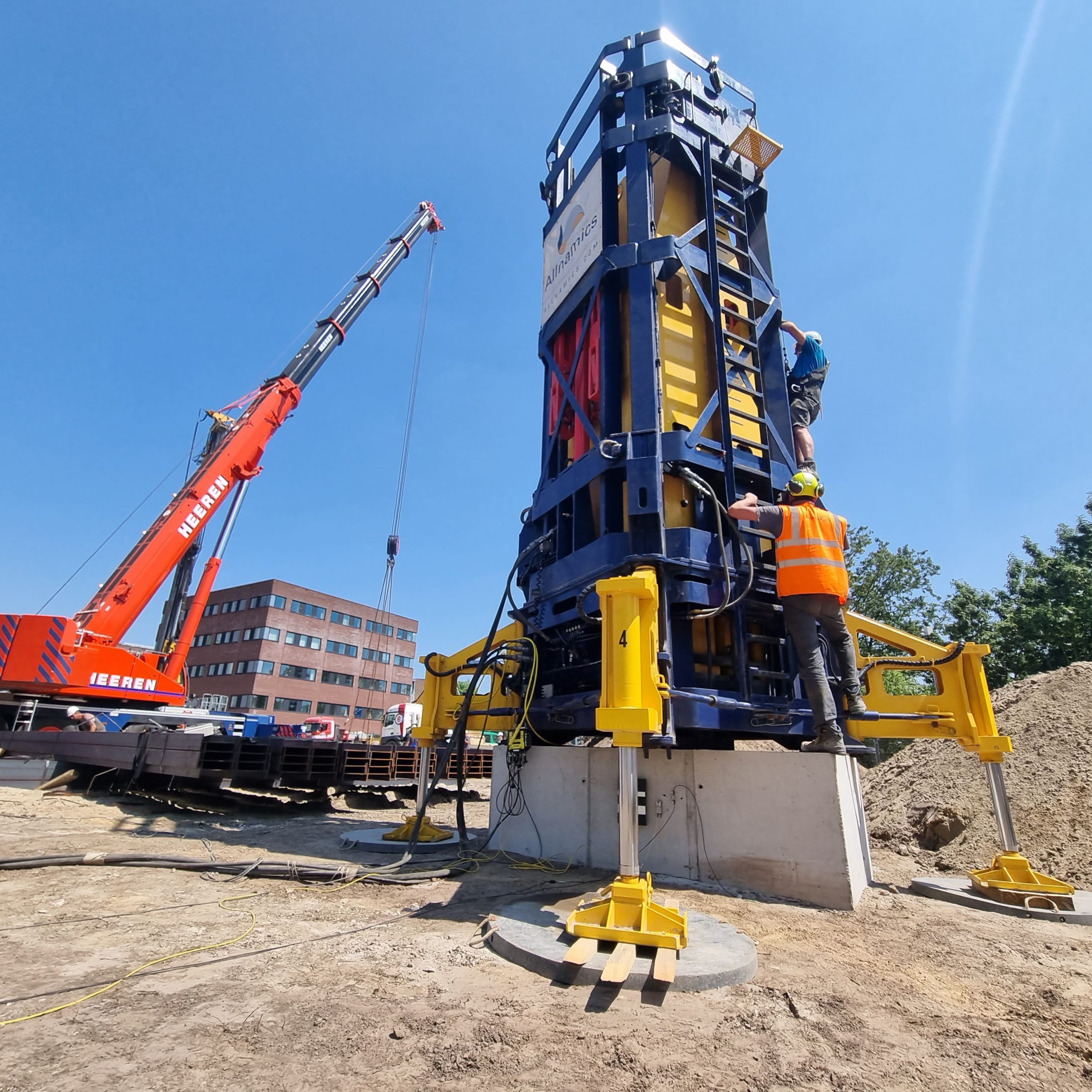
Dynamic Load Testing uses sensors attached to the pile to measure force and velocity during a hammer impact. Signal matching analysis then derives bearing capacity, soil resistance distribution, and pile integrity from the recorded data. DLT is well-suited to driven piles in granular soils and is efficient for large pile programs where testing many piles within schedule and budget is a priority. It is less suitable for cast-in-situ concrete piles or piles in cohesive soils where time-dependent behavior is significant.
Rapid Load Testing
Rapid Load Testing, including the Statnamic and StatRapid methods, applies a controlled impulse load over a longer duration than a DLT blow. This eliminates stress wave effects and increases the accuracy of capacity determination compared to dynamic testing alone. RLT is useful where dynamic testing may not fully capture the soil response, and it produces results that are closer in character to static testing while requiring less setup than a full SLT.
For existing foundation assessments, Sonic Integrity Testing is often the starting point. It is non-destructive, fast, and can be applied to a large number of piles to screen for defects before committing to load testing on selected piles.
How does pile testing lower the carbon footprint of a foundation?
Pile testing lowers the carbon footprint of a foundation by enabling more efficient use of materials. Concrete and steel production are among the most carbon-intensive activities in construction. Any reduction in the volume of these materials used in a foundation program directly reduces the embodied carbon of the structure.
The mechanism is straightforward. A pile load test provides verified capacity data. Verified data reduces the uncertainty that drives conservative design. Reduced uncertainty means smaller safety factors are needed, and smaller safety factors mean fewer or shorter piles can achieve the same structural performance. Less material in the ground means less carbon emitted in its production and installation.
This effect scales significantly on large infrastructure projects. On a wind farm foundation program, for example, if testing data shows that piles are consistently achieving higher capacity than the design model predicted, it may be possible to reduce pile length or adjust installation criteria for the remaining piles across the entire program. The cumulative reduction in steel use across hundreds of piles represents a meaningful carbon saving.
Foundation reuse, enabled by integrity testing and load testing of existing piles, goes further still. Avoiding the production and installation of new piles entirely eliminates their embodied carbon contribution. For projects where existing foundations are structurally sound and have sufficient residual capacity, reuse is the lowest-carbon foundation option available.
Decarbonization in foundation engineering also includes design optimization: using materials with a lower carbon footprint, reducing concrete volumes through more efficient pile geometries, and avoiding over-driven piles that consume excess energy during installation. Pile testing data supports all of these decisions by replacing assumptions with measurements.
When should pile testing be carried out on sustainable construction projects?
Pile testing should be carried out at multiple stages of a sustainable construction project, not only as a final verification step. The timing depends on the project phase, the testing objective, and whether the focus is on new foundations or existing ones.
During the design and engineering phase, drivability studies and pile driving predictions help you select the right pile type, dimensions, and installation method before any material is ordered or driven. This avoids costly design changes later and reduces the risk of pile damage during installation.
During trial pile programs, which typically take place before the main production pile program begins, load testing on a small number of representative piles validates the design assumptions. If the trial results show higher capacity than expected, the production pile design can be optimized before the bulk of the material is committed. This is one of the most effective points at which testing delivers carbon and cost savings.
During production pile installation, real-time monitoring through Dynamic Load Testing or Pile Driving Analysis allows continuous quality control. Problems are identified and corrected before they compound across the pile program. Driving stress monitoring prevents pile damage that would require replacement.
For existing structures and redevelopment projects, testing should be carried out before any decision is made to demolish and replace foundations. An integrity assessment followed by load testing on representative piles establishes whether reuse is viable. Carrying out this assessment early in the project planning phase gives the design team the information they need to pursue reuse as a genuine option rather than an afterthought.
In general, earlier testing generates greater value. Data gathered before design decisions are finalized has the most influence on material efficiency, carbon outcomes, and project cost.
How We Support Sustainable Foundation Engineering
We work with construction teams, developers, and infrastructure owners at every stage where foundation performance and sustainability intersect. Our approach combines independent testing, engineering analysis, and practical advice to help you make better decisions about your foundations.
- Foundation inspections and integrity assessments for existing structures, using Sonic Integrity Testing and other non-destructive methods to establish pile condition without excavation
- Pile load testing using Static Load Testing, Dynamic Load Testing, and Rapid Load Testing methods, including our own StatRapid system, to verify bearing capacity and support design optimization
- Foundation reuse studies that assess whether existing piles can be retained and integrated into a new structure, reducing material use and embodied carbon
- Drivability studies and pile driving predictions using the AllWave software package to optimize pile selection and installation before work begins on site
- Real-time installation monitoring through Pile Driving Analysis and Vibratory Driving Analysis to prevent pile damage and support quality control during production pile programs
- Decarbonization consulting to identify where foundation design can be made more material-efficient and where reuse offers a lower-carbon alternative to new construction
If your project involves new foundations, an existing structure under assessment, or a redevelopment where foundation reuse may be possible, we can help you establish what the ground is actually doing and what your piles can actually carry. Contact our team to discuss your project and find out which testing approach fits your sustainability and engineering objectives.