


Yes, direct comparisons between a rapid load test and a static load test exist, and research consistently shows that a rapid load test can produce results that closely match those of a static load test when the correct interpretation method is applied. The accuracy depends primarily on how well loading-rate effects in the soil are accounted for during analysis. The sections below address the most common questions engineers and project teams ask when evaluating these two methods side by side.
How accurate is a Rapid Load Test compared to a Static Load Test?
A rapid load test can produce results that are comparable to a static load test when an appropriate interpretation method is used to correct for loading-rate effects. Comparative studies, including Japanese field programs that led to the inclusion of rapid load testing in the 2002 Standards of the Japanese Geotechnical Society, demonstrated that rapid load testing with a suitable non-linear damping interpretation method can serve as a valid alternative to a static pile load test.
The key factor governing accuracy is the correction applied to account for the fact that soil mobilizes higher resistance under rapid loading than under slow static loading. In cohesive soils such as clay, this rate effect can be significant. Research by Garner found that measured failure load increased by an average of around 13.7% per logarithmic increase in loading rate, meaning that without proper correction, a rapid load test would overestimate static pile capacity. The magnitude of this correction is project-specific and depends on soil type, plasticity, stress history, and other ground conditions.
When the loading duration is long enough to limit stress wave propagation effects within the pile, and when the soil rate effects are properly corrected, the agreement between rapid load test results and static load test results is generally good. This is why the method is accepted in several national and international standards as a reliable alternative, not merely an approximation.
What are the key differences between a Static Load Test and a Rapid Load Test?
The most important difference between a static load test and a rapid load test is the duration and rate at which the load is applied. A static load test applies load slowly and incrementally over hours or days, allowing the soil to respond under near-static conditions. A rapid load test applies a much larger force over a short duration, typically between 100 and 200 milliseconds, which introduces dynamic soil behavior that must be separated from the static response during analysis.
Several other practical differences follow from this fundamental distinction:
- Load application mechanism: A static load test uses a reaction system such as kentledge or anchor piles to apply a sustained load. A rapid load test uses a falling mass that generates a controlled impulse force on the pile head, measured directly via calibrated load cells.
- Force measurement: In a rapid load test using Statnamic or StatRapid equipment, the force is measured directly at the pile head through load cells, independent of pile material properties. In a dynamic load test, force is typically derived from strain measurements combined with pile material and cross-sectional properties, which introduces additional uncertainty for cast-in-place concrete piles.
- Soil behavior during the test: During a static load test, the soil responds under drained or undrained conditions depending on drainage characteristics. During a rapid load test, the loading rate is fast enough to generate rate-dependent soil resistance, which must be corrected for in the interpretation.
- Data interpretation: A static load test produces a direct load-settlement curve. A rapid load test requires post-processing using methods such as the Unloading Point Method or non-linear damping approaches to derive an equivalent static response.
When is a Rapid Load Test accepted as an alternative to a Static Load Test?
A rapid load test is accepted as an alternative to a static load test when the applicable standard or project specification permits it, when the test is executed correctly, and when the interpretation accounts for loading-rate effects in the soil. Japan formally included rapid load testing in its national pile testing standards in 2002 following extensive comparative research. European and other national frameworks have also developed guidelines that define the conditions under which rapid load testing results can be used in place of static test results.
Acceptance typically depends on several conditions being met:
- The loading duration must be long enough relative to the pile length and wave speed to limit stress wave propagation effects, so the pile can be modeled as a concentrated mass during the relevant part of the test.
- The interpretation method must be appropriate for the soil type, particularly in cohesive soils where rate effects are most pronounced.
- The test must be performed by qualified engineers with experience in both execution and signal interpretation.
- The project specification or geotechnical design report must explicitly allow the method, or the engineer of record must accept it based on technical justification.
In practice, rapid load testing is increasingly accepted on projects where a full static load test would require a large and costly reaction system, or where the pile dimensions make dynamic load testing less suitable due to the risk of high impact stresses. The Barcelona case, for example, involved large-diameter cast-in-place concrete piles with working loads between approximately 6 and 8 MN, where rapid load testing with StatRapid was selected specifically because the impact forces required for a dynamic load test could have caused pile damage.
What are the cost and time differences between the two test methods?
A rapid load test is generally faster and less expensive to mobilize and execute than a static load test, particularly for large-diameter piles or offshore and restricted-access locations. The primary cost advantage comes from the elimination of a reaction system. Static load testing requires either kentledge (dead weight) or anchor piles, both of which involve significant material, installation, and removal costs that scale with the required test load.
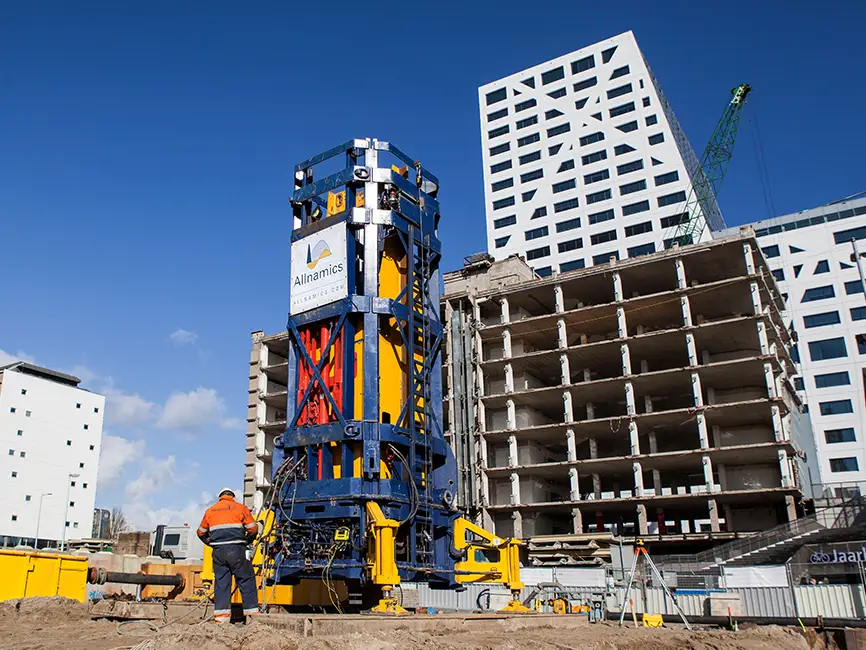
A StatRapid setup, for example, is modular and transportable by road. Depending on the required drop mass and configuration, the equipment can be transported on two or three trucks and assembled on site in approximately two to three hours. This compares favorably to the days or weeks sometimes needed to construct and dismantle a static load test reaction frame, particularly at high load levels.
The time saving during the test itself is also relevant. A static load test typically runs over one or more days, following a defined load-hold cycle. A rapid load test delivers results within a single working day in most cases, with post-processing and interpretation completed shortly after. For projects with tight construction programs, this difference in turnaround time can directly influence scheduling decisions.
That said, the cost comparison is not always straightforward. If a static load test reaction system can be shared across multiple piles, or if existing site equipment can serve as kentledge, the cost gap narrows. The total cost of a rapid load test must also include the interpretation work, which requires specialist expertise and is not trivial for complex soil profiles.
What limitations does a Rapid Load Test have that a Static Load Test does not?
The most significant limitation of a rapid load test compared to a static load test is that it does not directly measure static pile behavior. The test measures pile and soil response under rapid loading, and the static equivalent must be derived through interpretation. This introduces uncertainty that a static load test avoids entirely, since a static test directly produces the load-settlement relationship under conditions that closely represent long-term pile performance.
Additional limitations include:
- Rate effect correction uncertainty: The correction for loading-rate effects in cohesive soils is not universal. The appropriate damping parameters depend on soil type, plasticity, overconsolidation ratio, and other factors that vary by site. An incorrect correction can lead to either overestimation or underestimation of static capacity.
- Interpretation expertise required: Reliable results depend on experienced engineers who understand both the mechanics of rapid loading and the behavior of the specific soil-pile system being tested. The method is less straightforward to apply than reading a static load-settlement curve.
- Limited creep and consolidation information: A static load test, particularly when load is held at each increment, provides information about creep behavior and long-term settlement. A rapid load test does not capture this time-dependent response.
- Soil wave effects: In addition to pile wave behavior, shear stress waves propagate through the soil around friction piles during a rapid load test. This means the required loading duration is not determined solely by pile length and wave speed, but can also depend on pile diameter and the shear wave velocity of the surrounding soil, adding complexity to test design and validation.
None of these limitations make a rapid load test unreliable, but they do mean that the method requires careful planning, competent execution, and rigorous interpretation to produce results that are genuinely comparable to a static load test.
How We Help You Compare and Choose the Right Pile Load Test
Choosing between a rapid load test and a static load test involves more than comparing costs. It requires an understanding of your soil conditions, pile type, project schedule, applicable standards, and the level of certainty your design requires. We help you make that decision with confidence, and we carry out the testing itself to the highest technical standards.
Here is what we offer:
- Independent test method advice: We assess your project conditions and recommend the most appropriate testing approach, whether that is a static load test, rapid load test, or a combination of methods.
- Rapid load testing execution: We perform rapid load tests using StatRapid and Statnamic equipment, with direct force measurement via calibrated load cells and full on-site data acquisition.
- Expert interpretation: Our engineers apply appropriate interpretation methods, including non-linear damping corrections for cohesive soils, to derive reliable equivalent static capacity from rapid load test data.
- Comparative analysis: Where both test types are available or required, we provide side-by-side analysis to support design verification and regulatory acceptance.
- Test prediction and planning: Before any test, we predict the required drop mass, spring configuration, and drop height to achieve the target load level and loading duration, reducing the risk of inconclusive results.
If you are evaluating pile testing options for an upcoming project, contact our team to discuss your specific requirements and find out which approach gives you the most reliable foundation data for your situation.