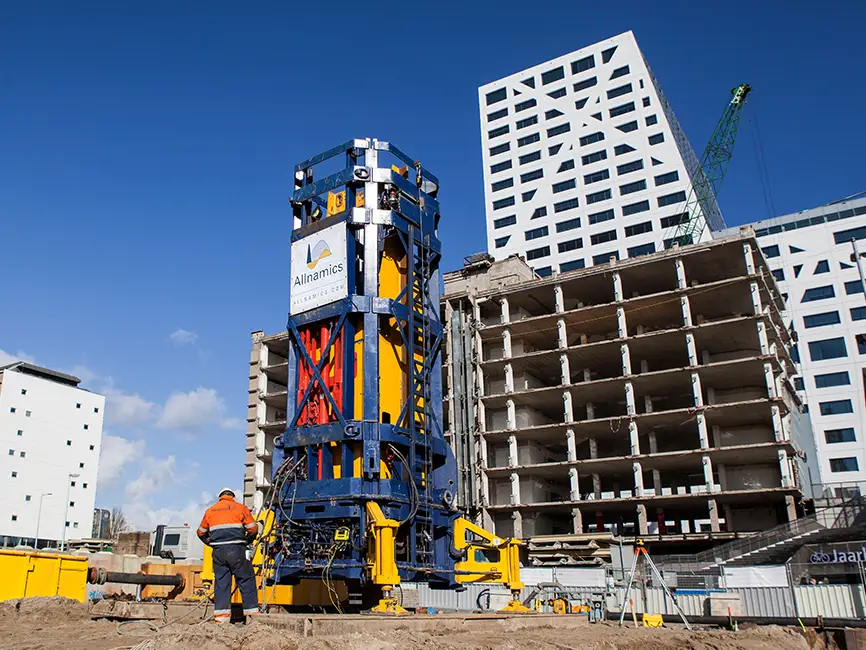



Rapid Load Testing (RLT) is not universally better than Dynamic Load Testing (DLT); each method suits different project conditions. RLT applies a longer-duration load that reduces stress wave interference in the pile, making it particularly useful when high test loads are needed without a large static reaction structure. DLT, by contrast, delivers a high-energy impact in milliseconds and is well-suited for monitoring pile installation and testing driven piles efficiently at scale. The sections below break down the key differences, how each method works, and how to choose the right approach for your project.
What are the key differences between rapid load testing and dynamic load testing?
The most important difference between rapid load testing and dynamic load testing is the duration of the applied load. In a rapid load test, the load is applied over a period long enough to significantly reduce stress wave propagation effects within the pile, allowing the pile to behave approximately as a single moving mass. In a dynamic load test, the impact from a hammer or drop weight lasts only milliseconds, generating stress waves that travel up and down the pile and must be explicitly accounted for in the analysis.
This difference in load duration has practical consequences for how each test is set up and interpreted:
- Load application: RLT uses a falling mass combined with a spring system (such as the StatRapid device) or a gas-propelled reaction mass (Statnamic) to generate a controlled, relatively gradual force. DLT uses a drop hammer or hydraulic hammer to deliver a sharp impact.
- Force measurement: In RLT, the force is measured directly at the pile head using a calibrated load cell, independent of the pile’s material properties. In DLT, force is typically derived from strain measurements at the pile head, which requires knowledge of the pile’s cross-sectional area and elastic modulus.
- Pile velocity during testing: During a rapid load test, different sections of the pile move in roughly the same direction and at comparable speeds. During a dynamic load test, different pile sections can simultaneously have very different velocities due to traveling stress waves.
- Applicable standards: RLT is governed by ISO 22477-10:2016, ASTM D7383, and, in the Netherlands, by NEN 7201:2025. DLT is covered by separate standards including ASTM D4945 and ISO 22477-4.
How does each method calculate pile bearing capacity?
Both rapid load testing and dynamic load testing derive pile bearing capacity from measured data, but neither delivers a direct static result; both require analytical processing to convert the measured dynamic or semi-dynamic response into an equivalent static capacity.
How rapid load testing calculates capacity
In a rapid load test, the measured force at the pile head includes contributions from three components: the static soil resistance, the rate-dependent (velocity-dependent) soil resistance, and the inertial force from the pile’s own mass. To obtain the static equivalent capacity, analysts subtract the pile inertia correction and apply a rate-effect correction for the soil. The most widely used approach is the Unloading Point Method (UPM), which identifies the point during unloading where pile velocity reaches zero and uses this to separate static from dynamic soil contributions. Importantly, the maximum measured force during an RLT cannot be used directly as the static bearing capacity; further processing is always required.
How dynamic load testing calculates capacity
In a dynamic load test, stress wave theory forms the basis of the analysis. Measurements of force and velocity at the pile head are recorded during impact. A simplified approach called the Case Method provides a rapid estimate of capacity in the field. For more detailed analysis, signal matching programs such as CAPWAP are used; these simulate the pile-soil system and iterate until the computed response matches the measured signals. DLT analysis must account for stress wave reflections from the pile tip, soil layers, and any changes in pile cross-section.
When is rapid load testing preferred over dynamic load testing?
Rapid load testing is the preferred choice when high test loads are needed and building a conventional static reaction structure would be costly, time-consuming, or physically impractical on site. Because RLT uses the inertia of a moving mass to generate the reaction force, it can produce very large forces without requiring anchor piles or a heavy ballast platform.
RLT also offers specific advantages for cast-in-place concrete piles. Because the force is measured directly with a load cell rather than derived from strain gauges and material properties, the result is less sensitive to uncertainties in pile cross-section or concrete stiffness. The longer load duration and the spring system used in devices like the StatRapid also reduce peak stresses in the pile, which matters when testing piles that might be sensitive to high compressive loads.
Additional situations where RLT is a strong candidate include:
- Projects where multiple piles need to be tested within a short timeframe
- Sites where access or space constraints make a static reaction frame impractical
- Projects where the pile type or installation method makes DLT instrumentation difficult
One important consideration: in cohesive soils, rate-dependent effects on soil resistance require careful correction. RLT can still be applied in these conditions, but the conversion to static equivalent capacity demands appropriate analysis and, depending on the applicable standard, may require project-specific correlation with a static load test.
When is dynamic load testing the better choice?
Dynamic load testing is the better choice when you need to monitor pile behavior during installation, verify driving stresses, or assess pile integrity as part of the driving process. Because DLT is performed using the same hammer that drives the pile, it integrates naturally into the installation workflow without requiring a separate test setup.
DLT is also well-suited for driven piles, steel pipe piles, precast concrete piles, and H-piles, where the pile material properties are well-defined and the strain gauge instrumentation can be reliably attached. For large programs involving many driven piles, DLT offers a cost-effective way to test a representative sample during or immediately after installation.
DLT is typically preferred when:
- You need to monitor driving stresses and assess pile integrity during installation
- The project involves a large number of driven piles and testing efficiency is a priority
- The pile type and material properties are well-defined and suitable for strain gauge instrumentation
- Restrike testing is needed to assess soil setup or relaxation after installation
- The required test load is within the range achievable with the available drop hammer
How do rapid load testing and dynamic load testing compare to static load testing?
Static load testing (SLT) is the reference method for pile bearing capacity. It applies load gradually in increments, holds each load step for a defined period, and measures displacement directly. The result is a genuine static load-settlement curve with no need for dynamic corrections. Both RLT and DLT aim to approximate this static result through different analytical routes.
The main practical limitation of SLT is the reaction structure. For high test loads, anchor piles or a large ballast platform are needed, which adds cost, preparation time, and logistical complexity. On sites with limited space or very high required test loads, SLT can become the most expensive option by a significant margin.
RLT sits between SLT and DLT in terms of load duration. It avoids the large reaction structure of SLT while also avoiding the strong stress wave effects of DLT. The trade-off is that the measured response still requires analytical processing; it is not a direct static measurement. DLT sits furthest from static conditions and requires the most complex interpretation, but it is also the fastest and most economical method for driven piles.
When choosing between the three methods, the relevant factors include the required test load, pile type, soil conditions, available space, applicable standards, and the level of confidence needed in the result. In some projects, a combination of methods, for example, RLT on selected piles with SLT as a reference, provides the most reliable outcome.
You can find a detailed overview of rapid load testing methodology and how it compares to other pile testing approaches in our technical resources.
Which pile testing method should you choose for your project?
The right pile testing method depends on your pile type, soil conditions, required test load, site constraints, and the specific information your project needs. There is no single method that outperforms the others in every situation; the decision requires a technical assessment of your specific conditions.
Use the comparison below as a starting point:
- Static Load Testing: Best when a direct, unambiguous static load-settlement curve is needed and the reaction structure is feasible. The reference standard for capacity verification.
- Rapid Load Testing: Best when high test loads are needed without a large reaction structure, or when testing cast-in-place concrete piles where direct force measurement is an advantage. Requires specialist interpretation, especially in cohesive soils.
- Dynamic Load Testing: Best for driven piles, installation monitoring, large testing programs, and restrike assessments. Fast and cost-effective, but requires well-defined pile material properties and careful signal matching analysis.
Key questions to guide your choice:
- What is the required test load, and is a static reaction structure feasible at your site?
- Is the pile driven or cast in place, and are the material properties well-defined?
- Do you need to monitor behavior during installation, or only verify capacity after installation?
- What are the soil conditions, granular or cohesive, and how does this affect rate-dependent corrections?
- What standard or specification governs the testing on your project?
For projects where the answer is not straightforward, a combination of methods often provides the most reliable and cost-effective outcome.
How We Help You Choose and Execute the Right Pile Testing Method
We work with project teams across infrastructure, offshore energy, marine, and construction to select and execute the pile testing approach that fits the actual conditions of your project, not just the most convenient or most familiar method.
Our team brings together decades of experience in rapid load testing, dynamic load testing, and static load testing, including direct involvement in the development of methods and equipment such as the StatRapid. Here is what we offer:
- Independent method selection advice: We assess your pile type, soil profile, required test load, site constraints, and applicable standards to recommend the most appropriate testing approach.
- Rapid Load Testing execution and interpretation: We perform RLT using the StatRapid and Statnamic systems, with full specialist analysis including inertia correction and rate-effect modeling, including in cohesive soils where standard corrections may not apply directly.
- Dynamic Load Testing with signal matching: We instrument driven piles, perform DLT during installation or restrike, and carry out detailed signal matching analysis to derive reliable capacity estimates.
- Static Load Testing: We design and execute SLT programs, including reaction system design, instrumentation, and interpretation, for projects where a direct static reference is needed.
- Combined testing programs: For projects where confidence in the result is especially important, we design programs that combine methods, for example, RLT on a larger sample with SLT as a reference on selected piles.
- Compliance with NEN 7201:2025, ISO 22477-10, and ASTM standards: All our testing and reporting meets the applicable international and national standards.
If you are planning a pile testing program and want to discuss which method fits your project, contact our team for a direct technical conversation.