


Dynamic Load Testing, Rapid Load Testing, and Static Load Testing are three distinct methods for measuring the load-bearing capacity of foundation piles. Static Load Testing applies a slow, sustained force and directly measures pile response under conditions close to real service loads. Dynamic Load Testing uses a short hammer impact and analyzes stress waves. Rapid Load Testing sits between the two, applying a controlled force over a duration long enough to reduce stress wave effects in the pile while remaining far shorter than a static test.
Choosing the right method depends on the required accuracy, available budget, site constraints, pile type, and soil conditions. The sections below answer the most common questions engineers and project teams ask when comparing these three approaches.
How accurate are dynamic and rapid load tests compared to static load testing?
Static Load Testing is the reference standard for pile capacity assessment because it directly measures load and displacement under quasi-static conditions, closely matching how a pile behaves in service. Dynamic Load Testing and Rapid Load Testing can both produce reliable results, but they require additional analysis steps to convert measured data into an equivalent static capacity, and their accuracy depends on the quality of that interpretation.
In Dynamic Load Testing, stress waves generated by a hammer impact travel through the pile and interact with the surrounding soil. Experienced analysts use signal matching software to derive capacity estimates, but the result is sensitive to assumptions about pile material properties and cross-section, particularly for cast-in-place concrete piles where these values carry some uncertainty.
Rapid Load Testing reduces the stress wave complexity in the pile by applying the load over a longer duration. When the load duration is sufficient relative to pile length and wave speed, the pile can be treated approximately as a single moving mass. However, the measured force still includes inertia effects and velocity-dependent soil resistance, both of which must be corrected before the result can be compared to a static capacity. In cohesive soils, rate-dependent soil behavior requires particular attention, and project-specific correlation with a static test may be needed depending on the applicable standard.
When performed correctly and interpreted by qualified specialists, both non-static methods can achieve results that correlate well with static tests. The key is recognizing that the raw measured force in a rapid or dynamic test is not directly equivalent to static pile capacity without further processing.
What are the main differences in how each test is performed?
The three methods differ fundamentally in how the load is applied, what equipment is used, and how long the loading event lasts.
Static Load Testing
In a Static Load Test, load is applied incrementally using hydraulic jacks reacting against kentledge, anchor piles, or a ground anchor system. The load is held at each increment while settlements are recorded. The process is slow and deliberate, often taking one to several days per pile. The reaction system can be large and costly, particularly for high test loads, but the result is a direct load-settlement curve under near-real service conditions.
Dynamic Load Testing
Dynamic Load Testing uses a drop hammer or pile driving hammer to strike the pile head. The impact lasts only a few milliseconds. Strain gauges and accelerometers mounted near the pile head record the stress wave signals generated by the impact. These signals are processed in real time and later analyzed in detail using signal matching software. The test is fast and can often use existing driving equipment, making it economical for testing multiple piles on a single project.
Rapid Load Testing
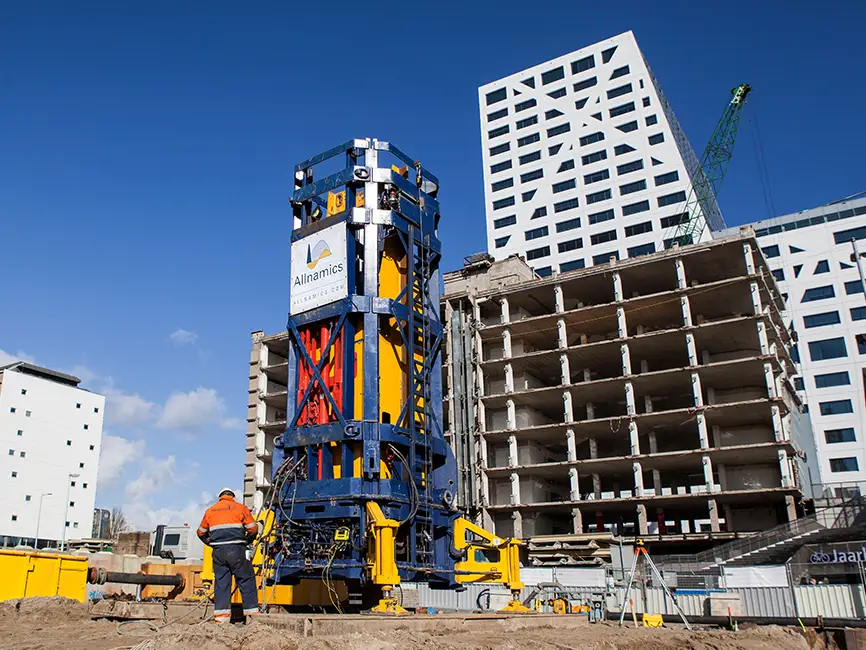
A rapid load test applies a controlled axial force over a duration typically in the range of 100 to 200 milliseconds, far longer than a dynamic impact but far shorter than a static test. The Statnamic method uses a propellant charge to accelerate a reaction mass upward from the pile head, generating a downward force on the pile. The StatRapid system achieves the same effect using a falling mass combined with a modular spring package, without a combustion process. In both cases, force is measured directly with a calibrated load cell at the pile head, which removes the dependence on pile material properties for force determination.
What does each testing method actually measure?
Each method measures different physical quantities, and understanding what is actually recorded helps clarify why interpretation steps are needed before comparing results across methods.
Static Load Testing measures applied load and pile head displacement directly. The load-settlement curve produced is a direct representation of pile behavior under the applied force, with no dynamic corrections required. This is why it serves as the reference against which other methods are calibrated.
Dynamic Load Testing measures strain and acceleration near the pile head during the hammer impact. Force is calculated from the measured strain combined with the pile’s elastic modulus and cross-sectional area. Velocity is derived by integrating the acceleration signal. These two signals together allow analysts to separate soil resistance from inertia effects using wave equation analysis and signal matching. The method does not measure force directly at the pile head.
Rapid Load Testing measures force directly at the pile head using a calibrated load cell, and measures pile head displacement and velocity using displacement transducers and accelerometers. The total measured force includes three components: the static soil resistance, the inertia of the pile mass, and velocity-dependent (rate-dependent) soil resistance. Analysis methods such as the Unloading Point Method separate these components to estimate the equivalent static capacity. Because force is measured directly rather than derived from pile material properties, the method has a measurement advantage for cast-in-place concrete piles.
When should dynamic, rapid, or static load testing be used?
The right method depends on the project’s accuracy requirements, budget, timeline, pile type, soil conditions, and the regulatory framework that applies.
- Static Load Testing is most appropriate when the highest level of certainty is required, when the project involves a new pile type or unusual soil conditions with limited local experience, or when standards require a static reference test. It is also the preferred method when load-settlement behavior under service loads needs to be characterized in detail.
- Dynamic Load Testing suits projects where speed and economy are priorities and where a large number of piles need to be tested within a short period. It works well for driven piles where material properties are well defined. It is also used during pile installation to monitor driving stresses and assess capacity in real time.
- Rapid Load Testing is particularly useful when high test loads are needed but constructing a large static reaction system would be costly, time-consuming, or spatially impractical. It offers advantages over Dynamic Load Testing for cast-in-place concrete piles because force is measured directly and peak stresses in the pile are lower due to the longer load duration and, in the StatRapid system, the spring package. In cohesive soils, rate effects require careful correction, and the applicable standard may require correlation with a static test.
In practice, methods are often combined. A small number of static tests may establish a reference, while dynamic or rapid tests verify a larger portion of the pile program more efficiently.
Which pile load testing method is most cost-effective?
Dynamic Load Testing is generally the least expensive option per pile when existing driving equipment can be used and when multiple piles are tested in a single mobilization. The method requires minimal additional setup and can be completed quickly. However, the total cost must include the analysis by a qualified specialist, which adds time and expertise requirements.
Rapid Load Testing involves more specialized equipment and mobilization costs than Dynamic Load Testing, but it becomes cost-effective when high test loads are required. Constructing a static reaction system for loads of several MN can be expensive and time-consuming. A rapid load test system can generate those loads without a large reaction structure, which often makes it the more practical and economical choice at the higher end of the load range.
Static Load Testing carries the highest direct cost per test due to the reaction system, the time required, and the equipment involved. However, when a static test reduces conservatism in pile design across a large pile program, the savings in pile quantities or dimensions can far outweigh the test cost. The most cost-effective approach for a given project depends on the number of piles, the required test loads, the soil profile, and how the test results will be used in design.
Are dynamic and rapid load tests accepted by international standards?
Yes. Both Dynamic Load Testing and Rapid Load Testing are recognized by major international and national standards, and both are accepted as valid methods for pile capacity assessment when applied and interpreted correctly.
Dynamic Load Testing is covered by standards including ISO 22477-4 and national equivalents in many countries. It is widely used across geotechnical practice globally and is accepted by most regulatory frameworks for pile verification.
Rapid Load Testing is defined in ISO 22477-10:2016, which sets out the criteria for load duration relative to pile length and stress wave speed, and specifies how results must be interpreted. The Dutch standard NEN 7201:2025 applies the same fundamental distinction. Earlier national standards include JGS 1815-2002 from Japan, which was the first formal standard for Rapid Load Testing, and ASTM D7383 in the United States. These standards make clear that the maximum measured force during a rapid load test cannot be used directly as static capacity without the appropriate analysis corrections.
The acceptance of both methods in design and verification depends on the applicable national annex, the project specification, and whether the method has been applied within the conditions and limitations defined by the relevant standard.
How We Help You Choose and Execute the Right Pile Load Test
We bring together decades of experience in all three pile load testing methods, including direct involvement in the development of Rapid Load Testing and the StatRapid system. When your project requires pile capacity verification, we help you select the method that fits your technical requirements, budget, and schedule, and we carry out the testing and analysis to the highest professional standards.
Here is what we offer across the three methods:
- Static Load Testing: Full service, including reaction system design, instrumentation, load application, and interpretation of load-settlement behavior
- Dynamic Load Testing: On-site measurement with strain gauges and accelerometers, real-time monitoring, and detailed signal matching analysis
- Rapid Load Testing: Testing with the StatRapid system or Statnamic equipment, direct force measurement via calibrated load cells, and analysis using validated interpretation methods including the Unloading Point Method
- Method selection advice: Independent technical guidance on which method or combination of methods best suits your pile type, soil conditions, load requirements, and applicable standards
- Reporting and compliance: Test reports aligned with ISO 22477, NEN 7201, ASTM, and other applicable standards, suitable for regulatory submission and design verification
If you are planning a pile testing program and want to discuss which approach fits your project, contact our team for a direct conversation with one of our specialists.