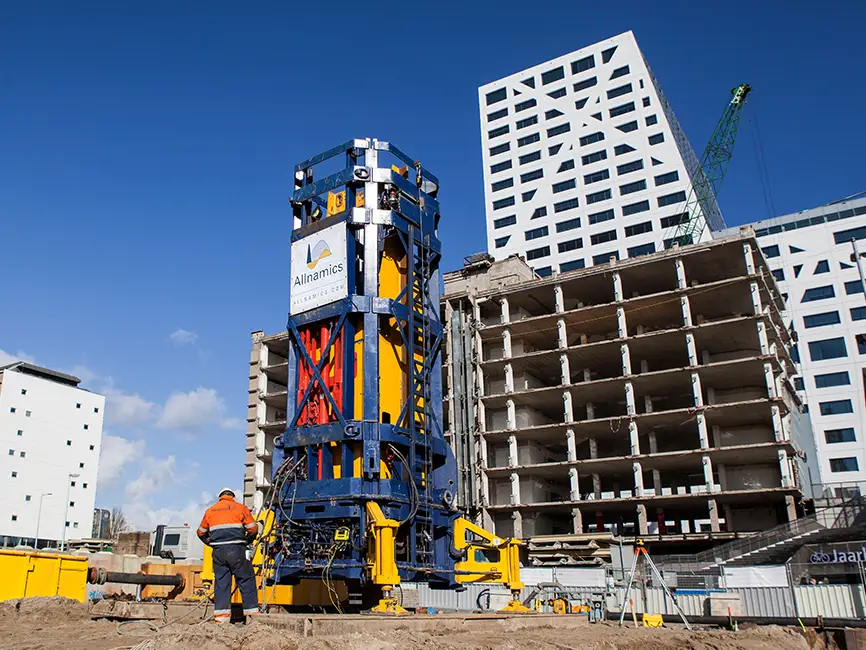



In a rapid load test, the maximum load is controlled by adjusting the drop mass and drop height of the falling weight system. The combination of these two variables determines how much force the pile head receives during the test. The buffer or spring package between the falling mass and the pile head further shapes the force pulse, allowing engineers to tune both the peak load and its duration to match the test requirements.
Because the measured peak force cannot be used directly as the static pile capacity, controlling the maximum load is only one part of the process. The sections below address each aspect of load control in detail, from the physical mechanism to measurement, interpretation, and when to revise your target during testing.
What factors determine the maximum load in Rapid Load Testing?
The maximum load in a rapid load test is determined by three interacting factors: drop mass, drop height, and the stiffness of the buffer or spring package. Together, these define the energy delivered to the pile and how that energy is converted into a force pulse. Soil conditions and pile stiffness also influence the actual peak force, because the pile-soil system resists and absorbs the applied energy.
Before a test is carried out, engineers predict the required configuration using one of three approaches: experience from previous tests on comparable piles and soils, simplified theoretical models, or more detailed wave-equation analyses. This prediction must confirm not only that the target maximum load is achievable, but also that the resulting pulse duration meets the conditions required for a valid rapid load test under the applicable standard, such as ISO 22477-10 or NEN 7201:2025.
A useful practice is the learning loop: assumptions from earlier tests are used to plan the next one, and the measured results are then fed back to refine future predictions and expand the reference database. This iterative approach improves accuracy over time and reduces the risk of under- or overloading the pile during testing.
How do the drop mass and drop height control the applied force?
The applied force in a rapid load test is controlled by varying the drop mass and drop height, which together determine the kinetic energy at impact. A heavier mass or a greater drop height increases the energy delivered to the pile head, which raises the peak force. The buffer package then converts this kinetic energy into a controlled force pulse rather than a sharp impact.
This mechanism is fundamentally different from a conventional dynamic load test. In a dynamic test, the goal is a short, sharp blow. In a rapid load test, the buffer is specifically designed to extend the impact duration, producing a force pulse that lasts long enough to reduce stress wave reflections within the pile. The pile can then be treated approximately as a single moving mass during analysis, which simplifies the interpretation considerably.
By selecting different combinations of mass and drop height, the test team can step up the load incrementally across multiple drops. This allows the pile response to be observed at increasing load levels before reaching the target maximum, which is useful for identifying the onset of significant displacement or any unexpected pile behavior.
What instruments measure and verify the load during an RLT?
During a rapid load test, the applied force is measured directly using load cells positioned between the buffer package and the pile head. Pile head velocity and displacement are recorded simultaneously using accelerometers and displacement transducers. These measurements together provide the data needed to separate the inertial contribution of the pile mass from the soil resistance.
Direct force measurement is one of the practical advantages of rapid load testing over dynamic load testing for cast-in-place concrete piles. Because the force is measured at the pile head rather than derived from strain gauge readings, the measurement is more straightforward and less sensitive to the uncertainties associated with wave propagation analysis in variable cross-section piles.
All instrumentation is integrated into the test system and records data continuously throughout the drop event. The raw measurements are then used as input for the Unloading Point Method or other analysis procedures that convert the measured rapid load response into an equivalent static resistance. This conversion step is where soil type, rate dependency, and damping corrections become relevant.
How does pulse duration affect load control in Rapid Load Testing?
Pulse duration directly affects whether a test qualifies as a rapid load test and whether the measured force can be reliably interpreted. The force pulse must last long enough to reduce the influence of stress wave reflections within the pile, so that different parts of the pile move at approximately the same velocity during the loading event. If the pulse is too short, the test behaves more like a dynamic load test and requires a different analysis approach.
ISO 22477-10 defines the minimum pulse duration relative to pile length and the propagation velocity of stress waves through the pile material. NEN 7201:2025 applies the same fundamental criterion. Meeting this criterion is not just a procedural requirement; it is what makes the simplified mass-correction analysis physically valid.
The buffer or spring package is the primary tool for controlling pulse duration. A stiffer buffer produces a shorter, sharper pulse, while a softer or more compliant buffer extends the pulse. By selecting the appropriate buffer configuration alongside the drop mass and height, the test team controls both the peak force and the shape of the force-time curve. This dual control over magnitude and duration is what distinguishes rapid load testing from both static and dynamic alternatives.
What are the load limits for Rapid Load Testing compared to other pile test methods?
Rapid load testing can reach pile resistances in the range of 8 to 16 MN with modern equipment such as the StatRapid system, making it suitable for heavily loaded foundation piles where a conventional static load test would require a large and costly reaction structure. This range covers a wide variety of onshore and offshore pile applications.
Compared to static load testing, rapid load testing removes the need to construct a kentledge or reaction frame capable of carrying the full test load. This makes it faster to mobilize and more practical in locations where space is limited or where multiple piles need to be tested within a short programme. Compared to dynamic load testing, rapid load testing applies a longer force pulse, which reduces peak stresses in the pile and makes it more suitable for cast-in-place concrete piles that are sensitive to high-frequency impact.
The table below summarizes the key differences between the three main pile load test methods:
- Static Load Testing (SLT): Long loading duration, direct measurement of static resistance, requires reaction structure, high mobilization cost for large loads
- Dynamic Load Testing (DLT): Very short pulse, stress wave analysis required, suitable for driven piles, lower mobilization cost but more complex interpretation
- Rapid Load Testing (RLT): Intermediate pulse duration, direct force measurement, no reaction structure needed, applicable to a wide range of pile types with appropriate soil corrections
The applicable load range for any specific project depends on the pile type, soil profile, available equipment configuration, and the requirements of the governing standard. In cohesive soils, rate-dependent soil behavior requires additional correction, and a project-specific correlation with a static test may be needed depending on the normative situation.
When should the maximum load target be adjusted during a test?
The maximum load target should be adjusted during a rapid load test when the measured pile response indicates unexpected behavior, such as a significantly larger displacement than predicted, signs of structural distress in the pile, or a measured force that deviates substantially from the prediction. In these situations, continuing to the planned maximum load without review could damage the pile or produce results that are difficult to interpret.
Upward adjustment may also be appropriate if the pile shows a stiffer response than expected and the target load has not yet mobilized sufficient displacement to characterize the pile’s resistance. In that case, increasing the drop height or adding mass in subsequent drops allows the test to reach a more informative load level.
The learning loop principle applies here as well. Each drop in a multi-drop sequence provides new information about the pile-soil response. Your team should review the data between drops and use it to confirm or revise the plan for the next drop. This real-time feedback is one of the practical strengths of rapid load testing: the test can be adapted as it progresses, rather than committing to a fixed load in advance.
It is also worth noting that the maximum measured force during a rapid load test is not equivalent to the static pile capacity. The raw measurement includes the inertial contribution of the pile mass and rate-dependent soil effects. These must be corrected through the appropriate analysis method before the result can be compared to a static resistance value.
How Allnamics Supports Your Rapid Load Testing Programme
We combine decades of experience in pile testing with in-house-developed equipment and analysis tools to help you get reliable, interpretable results from every rapid load test. Our involvement covers the full process, from pre-test prediction to on-site execution and post-test analysis.
- Pre-test prediction: We assess the required drop mass, drop height, and buffer configuration to reach your target load while meeting the pulse duration criteria of the applicable standard
- Equipment: We deploy the StatRapid system, a modular rapid load testing installation capable of testing pile resistances up to 16 MN, transportable by road and set up efficiently on site
- On-site execution: Our engineers monitor each drop in real time, reviewing force, velocity, and displacement data between drops to confirm the test is progressing as planned and to adjust the configuration if needed
- Analysis and reporting: We apply the Unloading Point Method and other appropriate analysis procedures, including corrections for soil rate effects, to convert the measured rapid load response into a reliable equivalent static resistance
- Independent review: We also provide independent technical review of rapid load test data collected by others, including assessment of test validity, analysis method suitability, and comparison with static or dynamic test results
Whether you are planning a new testing programme or need expert support for a specific project challenge, we are ready to help. Contact our team to discuss your requirements, or explore our rapid load testing services to learn more about how we work.