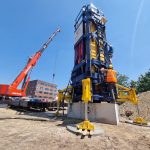



Groundwater level directly affects pile load test results by changing the effective stress in the soil surrounding the pile. Lower effective stress reduces both skin friction and end bearing capacity, which means a pile tested under different groundwater conditions than those assumed in design may appear to perform differently than expected. The sections below address the most common questions engineers and project teams face when groundwater and pile load testing intersect.
How does groundwater level change the effective stress on a pile?
Groundwater level changes effective stress by altering the balance between total stress and pore water pressure in the soil. As the water table rises, pore water pressure increases, which reduces effective stress. Since both skin friction and end bearing in piles are governed by effective stress rather than total stress, a higher water table directly lowers the soil resistance a pile can mobilize.
The relationship follows a straightforward principle from soil mechanics: effective stress equals total stress minus pore water pressure. When the water table sits at the ground surface, pore water pressure at any depth equals the full weight of the water column above that point. The result is a significantly lower effective stress profile compared to a site where the water table is deep.
For driven piles in granular soils, this effect is well understood and predictable. For piles in layered profiles or at sites with artesian conditions, the effective stress distribution becomes more complex and requires careful interpretation of piezometer data before any pile load test results can be meaningfully compared to design assumptions.
Does groundwater level affect pile skin friction and end bearing differently?
Yes, groundwater level affects skin friction and end bearing through the same effective stress mechanism, but the magnitude of impact differs depending on pile geometry and soil layering. Skin friction is distributed along the full embedded length of the pile, so it integrates the effective stress reduction across many soil layers. End bearing acts at a single point and reflects the effective stress at pile toe depth only.
For long friction piles, a rise in the water table affects a large portion of the shaft and can substantially reduce total skin friction capacity. For short end-bearing piles with their toe in dense granular material or rock, the reduction in end bearing may be more limited because the effective stress at depth changes less dramatically relative to the total stress at that level.
In cohesive soils, the relationship becomes more complicated. Pore water pressures in clay do not respond instantaneously to water table changes, and excess pore pressures generated during pile driving can persist for weeks or months. This means the effective stress acting on a pile in clay at the time of testing may differ significantly from both the long-term in-situ condition and the condition assumed in design. This is one reason why dynamic load testing should generally be avoided in cohesive soils, where time-dependent pore pressure behavior makes accurate capacity assessment particularly difficult.
What happens to pile load test results when the water table rises?
When the water table rises between pile installation and testing, or between testing and the design reference condition, pile load test results can underestimate the long-term capacity or misrepresent the conditions the pile will experience in service. A pile tested with a high water table will mobilize lower skin friction and potentially lower end bearing than the same pile would under a lower water table, all else being equal.
The practical consequence depends on which direction the discrepancy runs. If the water table during testing is higher than the long-term operational condition, the test result is conservative and the pile may have more capacity in service than the test suggests. If the water table during testing is lower than the long-term condition, the test result is unconservative and the pile may underperform relative to what the test indicated.
Seasonal fluctuations are a common source of this problem. A pile tested during a dry summer period may show higher capacity than the same pile would show after a wet winter raises the water table by several meters. Without recording and accounting for groundwater level at the time of testing, comparing results across a pile program or between test phases becomes unreliable.
Should pile load tests be conducted at a specific groundwater level?
Pile load tests should ideally be conducted at the groundwater level that represents the most critical design condition, which is typically the highest anticipated water table the pile will experience during its service life. Testing under this condition produces results that are directly comparable to the governing design case without requiring correction factors.
In practice, controlling the groundwater level at a test site is rarely straightforward. Dewatering to lower the water table is sometimes used during construction, but this changes the effective stress condition and may not reflect operational reality. Testing during periods of naturally low groundwater can produce results that look favorable but do not represent the worst-case scenario the foundation will face.
Where testing at the design groundwater condition is not possible, the next best approach is to measure the actual groundwater level precisely at the time of testing and apply appropriate corrections during interpretation. This requires piezometer readings taken immediately before and during the test, not estimates based on historical data or regional averages. The correction must account for the full effective stress profile along the pile shaft and at the toe, not just the water table depth at the surface.
How do dynamic and static load tests respond differently to groundwater changes?
Static load tests and dynamic load tests both respond to groundwater-driven changes in effective stress, but they capture those changes in fundamentally different ways. Static load testing measures pile response directly under sustained load, producing a load-settlement curve that reflects actual soil resistance at the time of the test. Dynamic load testing derives capacity indirectly through signal matching analysis, which introduces additional interpretation steps where groundwater effects can be obscured or misattributed.
Static and Rapid Load Testing
In a static load test, the applied load and resulting pile head displacement are measured directly using load cells and displacement gauges. The test captures the actual mobilized resistance under the groundwater conditions present at the time. If piezometer data is recorded alongside the test, the result can be confidently anchored to a specific effective stress condition and adjusted for comparison with other tests or design assumptions.
Rapid Load Testing works on a similar principle of direct measurement, applying a controlled impulse load over a duration long enough to eliminate stress wave effects. Like static load testing, it produces a direct load-settlement relationship that can be tied to measured groundwater conditions at the time of the test.
Dynamic Load Testing
Dynamic load testing measures strain and acceleration at the pile head during a hammer impact and derives capacity through signal matching analysis. The method is sensitive to the effective stress distribution along the pile at the moment of testing, but because capacity is derived rather than measured directly, groundwater-related changes in skin friction distribution can be difficult to separate from other sources of variability in the signal matching model.
Setup time adds another layer of complexity for driven piles. After driving, excess pore pressures generated by installation dissipate over time, and soil resistance recovers. If the water table also changes during this setup period, the effective stress at restrike reflects both the natural pore pressure recovery and the changed groundwater condition. Separating these two effects requires careful monitoring and experienced interpretation. For end-bearing steel piles in granular soils, dynamic testing can still achieve capacity estimates within a reasonable range of static results, but only when groundwater conditions are well documented and accounted for in the analysis.
How should groundwater data be recorded and reported alongside pile test results?
Groundwater data should be recorded using installed piezometers and reported as a complete dataset alongside every pile load test result, including readings taken immediately before, during, and after the test. A single water table depth measurement is not sufficient. The full piezometric profile at the test location, including any artesian conditions or perched water tables, must be documented to support meaningful interpretation.
The following groundwater data points should be captured and included in the test report:
- Piezometric readings at multiple depths along the pile shaft, not just at the surface, to define the effective stress profile accurately
- Timing of readings relative to pile installation, setup period, and test execution
- Seasonal context, noting whether the test was conducted during a wet or dry period relative to the annual range
- Comparison with design groundwater assumptions, clearly stating whether test conditions match, exceed, or fall below the design reference level
- Any dewatering or groundwater management activities on or near the test site that may have artificially altered the natural water table
Reporting groundwater data in isolation from the test results is a common gap in practice. The most useful approach integrates piezometric readings directly into the capacity interpretation, showing how the effective stress profile at the time of testing compares to the design condition and quantifying the adjustment needed to make the results comparable. This is particularly important when test results from different phases of a project, or from different seasons, need to be combined into a single dataset for design verification.
How We Help You Account for Groundwater in Pile Load Testing
Groundwater conditions are one of the most frequently overlooked variables in pile testing programs, and misinterpreting results because of unrecorded or poorly understood water table conditions can lead to costly errors in both directions. We work with your team to make sure groundwater is treated as a first-class variable throughout the testing program, not an afterthought in the report.
Here is what we bring to your project:
- Integrated piezometric monitoring during all pile load tests, providing real-time groundwater data that is recorded alongside force, displacement, and velocity measurements
- Static Load Testing and Rapid Load Testing using direct measurement methods that produce unambiguous load-settlement curves anchored to documented groundwater conditions
- Dynamic Load Testing with signal matching using our own AllWave-DLT software, performed by experienced engineers who account for effective stress conditions and setup time in the interpretation
- Capacity corrections and cross-test comparisons that adjust results to a common groundwater reference level, making it possible to compare tests conducted at different times or under different seasonal conditions
- Full test reporting that integrates groundwater data, effective stress profiles, and capacity interpretations into a single document your team and regulators can rely on
If your project involves variable groundwater conditions, seasonal fluctuations, or a testing program that spans multiple phases, we can help you design a testing and monitoring approach that produces results you can trust. Contact our team to discuss your project requirements.