

When a hammer strikes a pile, it transfers kinetic energy into the pile as a compressive stress wave that travels downward through the pile material. The amount of energy that actually reaches the pile depends on the hammer type, the cushion system, and the mechanical properties of the pile itself. Not all of the hammer’s rated energy makes it into the pile: losses occur at every stage of the impact chain. The sections below unpack each part of that process, from the moment of impact to how energy transfer is measured and what it means for your project.
What happens at the moment a hammer strikes a pile?
At the moment of impact, the hammer’s kinetic energy is converted into a compressive force pulse at the top of the pile. This force pulse is not instantaneous across the entire pile; it is a localized event that generates a longitudinal stress wave propagating downward from the pile head. The rated energy of the hammer and the energy that actually enters the pile are not the same value.
Between the hammer and the pile head, a helmet, cap, and cushion system mediate the impact. The cushion changes both the peak magnitude and the duration of the force pulse. A softer cushion spreads the impact over a longer time window, reducing peak stress but also altering how efficiently energy is delivered. A stiffer cushion concentrates the pulse, which can increase peak compressive stress in the pile. This means the cushion is an active dynamic component of the driving system, not a neutral buffer.
For diesel hammers specifically, the process is more complex. The combustion of gas in the cylinder contributes to the driving force, and the performance of the hammer depends on the stiffness of the pile-soil system. A stiffer system produces a different impact response than a softer one, which is why the hammer cannot be treated simply as a fixed energy source. The actual impact force-time history is what matters for the pile, and that history is shaped by the entire hammer-cushion-pile-soil interaction.
How does a stress wave travel through a pile?
A stress wave travels through a pile as a longitudinal compression wave, moving at a speed determined by the pile material’s elastic modulus and mass density. The wave propagates from the pile head downward, and different parts of the pile experience different stress states at the same moment in time. This is why a pile cannot be treated as a rigid body during dynamic loading.
The propagation speed is governed by the relationship between the material’s stiffness and its density. Steel piles transmit stress waves faster than concrete piles because of the difference in these material properties. As the wave travels, it interacts with the surrounding soil, which applies resistance along the shaft and at the pile toe.
A central concept in understanding wave travel is mechanical impedance, which links the force in the pile to the velocity of the pile particles at any given cross-section. When impedance changes (due to a change in cross-section, a splice, a connector, or a transition between pile segments), part of the wave is reflected back upward and part is transmitted further downward. These reflections carry information about what the wave encountered, which is the physical basis for pile integrity testing and dynamic load testing.
At the pile toe, the wave either reflects as a tension wave (if the toe is free or meets low resistance) or as a compression wave (if the toe meets high resistance). The pattern of upward-traveling reflected waves, recorded at the pile head, reveals the pile’s condition and the soil resistance distribution along its length.
What causes energy to be lost during pile driving?
Energy is lost during pile driving at multiple points in the impact chain: within the hammer mechanism itself, through heat and deformation in the cushion, through elastic rebound in the pile, and through soil damping along the shaft and at the toe. The cumulative effect of these losses means that only a fraction of the hammer’s rated energy produces useful permanent pile penetration.
The main sources of energy loss include:
- Hammer inefficiency: The rated energy of a hammer reflects its theoretical output. Mechanical friction, misalignment, and, in diesel hammers, incomplete combustion all reduce the energy actually delivered to the pile head.
- Cushion energy absorption: Cushion materials absorb energy through internal deformation. The restitution coefficient of the cushion material determines how much of that energy is returned to the system. A low restitution coefficient means more energy is lost as heat within the cushion.
- Elastic pile compression: The pile itself stores energy elastically during the stress wave passage. If the soil resistance is high enough to prevent permanent penetration, much of this energy is returned upward as a reflected wave rather than doing useful work.
- Soil damping: Dynamic soil resistance includes a velocity-dependent damping component. This damping absorbs energy during the wave’s interaction with the soil along the shaft and at the toe. It is distinct from the static soil resistance that governs long-term pile capacity.
- Wave reflections at impedance changes: Any discontinuity in the pile (a splice, a change in cross-section, or a damaged section) causes partial wave reflection, reducing the energy transmitted to the pile toe.
For wooden cushions in particular, the properties change as the cushion consolidates over the first blows. Using unconsolidated cushion properties in a prediction will overestimate energy losses in early blows and underestimate them later. Cushion wear and change during driving are therefore relevant factors in any accurate drivability analysis.
What is the energy transfer ratio and why does it matter?
The energy transfer ratio (ETR) is the proportion of the hammer’s rated energy that is actually delivered to the pile during a blow, expressed as a percentage. It matters because the blow count, pile stresses, and penetration per blow all depend on how much energy actually enters the pile, not on what the hammer’s nameplate says it produces.
A hammer rated at a certain energy level may deliver significantly less than that to the pile head, depending on the efficiency of the hammer mechanism, the cushion system, and the pile-soil stiffness. This is the core principle: rated hammer energy does not equal energy delivered to the pile. Treating them as equivalent leads to inaccurate predictions of blow count and pile stress.
The energy transfer ratio has direct consequences for project planning. If the ETR is lower than assumed in the design, the blow count required to reach target penetration increases. A higher blow count means more driving time, greater fatigue loading on the pile, and a higher risk of pile damage from accumulated stress cycles. Conversely, if the ETR is higher than expected, compressive stresses in the pile may exceed design limits, particularly in prestressed concrete piles.
Understanding the ETR also helps with hammer selection. The goal is to select a hammer that delivers sufficient energy to overcome soil resistance at the deepest and most resistant layers, while keeping stress levels within the pile’s structural limits at all penetration depths, not simply to select the largest available hammer.
How is hammer energy transfer measured in practice?
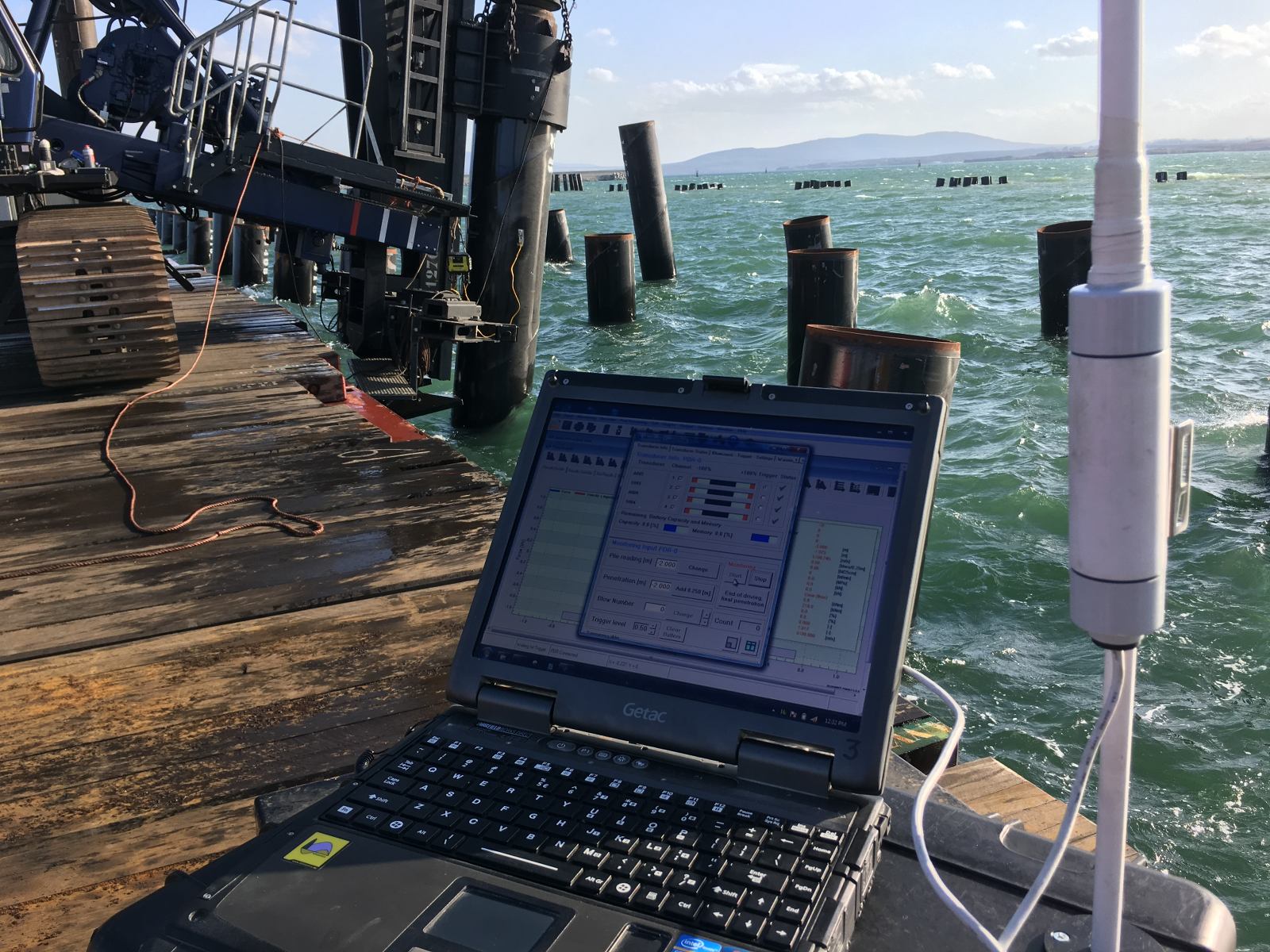
Hammer energy transfer is measured during pile driving using Dynamic Load Testing (DLT), which records force and velocity signals at the pile head during each hammer blow. From these measurements, the energy transmitted into the pile can be calculated directly from the stress wave data, giving a real-time picture of actual energy delivery rather than theoretical hammer output.
Sensors (typically strain gauges and accelerometers) are attached near the pile head. During each blow, the force signal is derived from the strain measurements and the velocity signal from the accelerometer data. The energy transmitted into the pile is calculated by integrating the product of force and velocity over time. This value, known as the transferred energy, is compared to the hammer’s rated energy to determine the ETR for each blow.
Dynamic load testing also captures the complete force-time and velocity-time histories, which can be used in signal matching analysis to determine soil resistance distribution, pile integrity, and bearing capacity. This makes DLT a powerful tool not only for measuring energy transfer but for validating the entire pile-soil interaction model used in the drivability prediction.
In practice, ETR values vary from blow to blow and can shift as the cushion consolidates, soil conditions change with depth, or hammer performance fluctuates. Monitoring these values continuously during installation gives your team early warning of unexpected changes in driving behavior before they become problems.
Does hammer type affect how energy is transferred into a pile?
Yes, hammer type significantly affects how energy is transferred into a pile. Impact hammers and vibratory hammers operate on fundamentally different physical principles, and even within the category of impact hammers, diesel and hydraulic hammers deliver energy differently. The type of hammer determines the shape, duration, and magnitude of the force applied to the pile.
Impact hammers: diesel versus hydraulic
Hydraulic impact hammers deliver a more controlled and consistent energy output per blow. The drop height is mechanically set, and the energy delivered is more predictable. Diesel hammers, by contrast, involve combustion of gas in the cylinder as part of the driving mechanism. Their performance depends on the stiffness of the pile-soil system; a stiffer system produces a different combustion response and therefore a different impact force-time history. This makes diesel hammer behavior more variable and more difficult to model accurately without accounting for the full hammer-pile-soil interaction.
Vibratory hammers: a different physical process
Vibratory hammers do not generate discrete impact waves. Instead, they impose continuous cyclic displacement on the pile at a set frequency. The energy transfer mechanism is fundamentally different: rather than a single compressive pulse, the pile experiences thousands of loading cycles. The relevant parameters for a vibratory hammer are the eccentric moment, operating frequency, and resulting displacement amplitude, not simply the centrifugal force.
Two vibratory hammers with similar centrifugal force ratings can produce very different penetration rates if their eccentric moments and frequencies differ. A hammer with a larger eccentric moment and lower frequency generates a greater displacement amplitude, which can be more effective in cohesive soils where sufficient toe displacement is needed to push soil beyond its elastic range. Selecting a vibratory hammer based on centrifugal force alone is therefore an oversimplification that can lead to poor installation performance.
The soil also responds differently to vibratory driving than to impact driving. Thousands of loading cycles cause soil fatigue, a progressive reduction in soil strength along the pile shaft. The degree of fatigue varies with depth: soil near the top of the pile has experienced far more cycles than soil near the current pile toe. Accurate vibratory drivability predictions must account for this depth-dependent loading history rather than applying a single uniform reduction factor to the entire pile.
How Allnamics Supports Hammer Energy Transfer Analysis
We help engineering teams move beyond theoretical hammer ratings and understand what is actually happening at the pile head and along the pile shaft during installation. Our approach combines advanced simulation, field measurement, and expert interpretation to give you a complete picture of energy transfer and driving performance.
Here is what we provide:
- Drivability predictions using AllWave-PDP and AllWave-VDP: Our AllWave software package simulates the full hammer-pile-soil system for both impact and vibratory driving. Outputs include blow count versus penetration, maximum compressive and tensile stresses, energy transfer, and refusal risk, giving your team the data needed to select the right hammer and anticipate installation challenges before they occur.
- Soil modelling for pile driving: We build soil resistance models from CPT, SPT, and laboratory data, including depth-dependent friction fatigue for vibratory driving simulations. This produces more realistic drivability predictions than simplified uniform soil models.
- Dynamic Load Testing during installation: We measure actual energy transfer at the pile head during driving using force and velocity sensors, providing real-time ETR values and early detection of unexpected driving behavior.
- Hammer selection support: We evaluate whether a proposed hammer operates within the right energy window: sufficient to overcome soil resistance at depth, but within the structural limits of the pile at all penetration stages.
- Fatigue analysis: For projects where pile integrity over the full installation process matters, we assess stress cycles and cumulative fatigue loading as part of the drivability study.
If your project involves complex soil conditions, sensitive pile types, or tight installation tolerances, accurate energy transfer analysis is not a formality; it is what keeps your installation on schedule and your piles undamaged. Contact us to discuss your project and find out how we can support your drivability and pile installation planning.