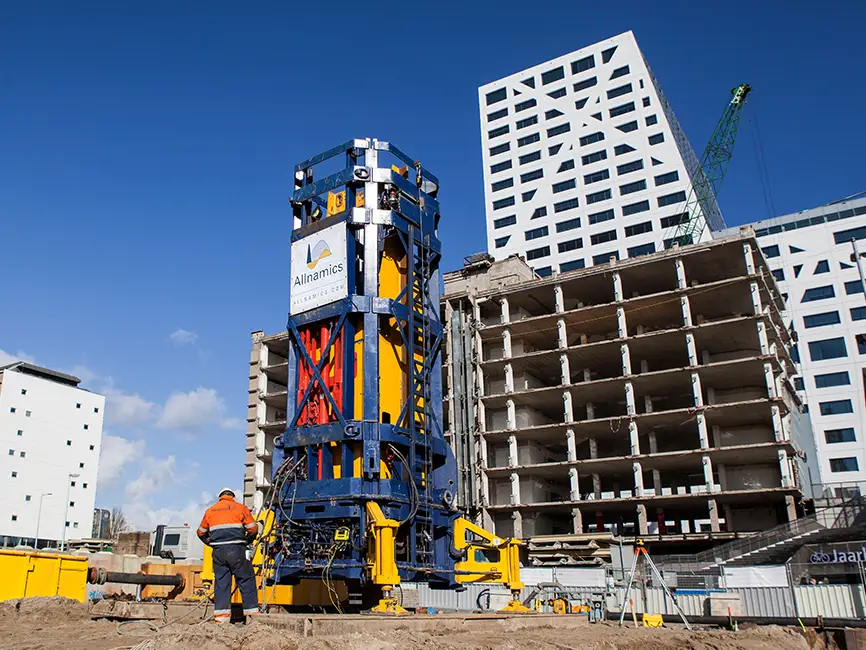



Statnamic and StatRapid are both forms of Rapid Load Testing (RLT), but they differ in how they generate the load. Statnamic uses gas pressure to accelerate a reaction mass upward from the pile head, while StatRapid uses a falling mass combined with a specially designed buffer system to produce the load pulse. Both methods sit between Static Load Testing and Dynamic Load Testing in terms of loading duration and interpretation complexity.
The distinction matters in practice because the loading mechanism influences how you mobilize the test load, how you adapt to site conditions, and what equipment you need on location. The sections below answer the most common questions about how each method works, how they compare, and which one fits your project.
How does Statnamic load testing actually work?
Statnamic generates a compressive load on a pile by accelerating a reaction mass upward from the pile head using gas pressure. The combustion of a special fuel inside a cylinder creates pressure that drives the reaction mass upward, and the equal and opposite reaction force pushes the pile downward. The load is measured directly at the pile head using a calibrated load cell, and pile head displacement is tracked with a laser system.
The name Statnamic combines the words static and dynamic, which directly reflects its position between the two conventional testing methods. Development began in 1988 through a collaboration between Berminghammer Corporation in Canada and TNO Building and Construction Research in the Netherlands. The method reached routine application in North America, Japan, Korea, and Singapore during the early 1990s.
One practical advantage of Statnamic is that the reaction mass required is only approximately 5 to 10% of the intended test load. For a 2 MN test load, you need roughly 10 to 20 tonnes of reaction mass. This is far less than the ballast required for a conventional Static Load Test at the same load level, which makes Statnamic particularly attractive for high-capacity pile tests.
The loading duration in a Statnamic test is much longer than a hammer blow in Dynamic Load Testing, but much shorter than a static load step. During a Statnamic test, typical pile head velocities range from approximately 0.1 to 2 metres per second. This intermediate loading rate reduces stress wave propagation effects within the pile, but it does not eliminate rate-dependent effects in the surrounding soil. Interpreting the static pile capacity from a Statnamic test therefore requires methods such as the Unloading Point Method to separate inertial and damping components from the measured force.
How does StatRapid differ from Statnamic in its loading mechanism?
StatRapid generates the load pulse mechanically rather than through combustion. A falling mass drops onto a specially designed buffer or spring package placed on the pile head, and the buffer controls the duration and shape of the force pulse. There is no fuel, no gas pressure, and no combustion process involved. This mechanical approach gives you direct control over the load level by adjusting drop height and mass, and control over pulse duration by selecting the buffer configuration.
Cape Holland and Allnamics developed StatRapid in response to growing demand for a practical, field-ready Rapid Load Testing system. The system introduced in 2013 included a hydraulically adjustable frame, a modular falling mass, a rubber buffer package, an internal hoisting system, a release mechanism, a catch mechanism, and integrated measurement and analysis software. The systems described at that time could test pile resistances in the range of 8 to 16 MN.
It is important to understand how StatRapid differs from a conventional Dynamic Load Test using a drop weight. In a Dynamic Load Test, the goal is a short, sharp impact that generates stress waves for wave equation analysis. In StatRapid, the buffer package is specifically designed to extend the impact duration, not shorten it. The objective is a load pulse that lasts long enough to satisfy the conditions for Rapid Load Testing, which means the pile moves more uniformly along its length and stress wave effects are significantly reduced.
StatRapid was introduced in 2012 as a modern alternative that avoids the logistical complexity of handling combustible fuel on site, making it easier to deploy across a wider range of project environments, including locations with strict site safety requirements.
Which method gives more accurate pile capacity results?
Neither Statnamic nor StatRapid is inherently more accurate than the other. Both methods produce results of comparable quality when correctly executed and interpreted, because both follow the same Rapid Load Testing principles and face the same fundamental challenge: separating the static pile resistance from inertial and rate-dependent soil effects during a transient loading event.
The accuracy of either method depends on three main factors:
- Loading duration relative to pile length: The load pulse must last long enough for the pile to move as a near-rigid body. A useful indicator is the wave number, which relates pulse duration to the time a stress wave takes to travel the pile length. A higher wave number means less stress wave interference and a more reliable result.
- Soil type and drainage conditions: In fine-grained soils, rate-dependent effects and excess pore water pressure can influence the measured resistance. These effects require careful interpretation regardless of which RLT variant you use.
- Interpretation method: The Unloading Point Method is the most widely used approach for both Statnamic and StatRapid. Signal matching and advanced numerical methods can improve accuracy further, particularly for complex soil profiles.
A key advantage of Statnamic is that the force is measured directly at the pile head with a load cell, independent of the pile’s material properties. In Dynamic Load Testing, force is typically derived from strain measurements combined with material parameters. Statnamic and StatRapid both avoid this dependency, which simplifies force measurement and reduces one potential source of uncertainty.
What pile types and project conditions suit each method?
Both Statnamic and StatRapid apply to a wide range of pile types, including driven steel piles, bored concrete piles, cast-in-place piles, and precast concrete piles. The choice between the two methods depends more on site logistics, load requirements, and operational constraints than on pile type.
Statnamic is well suited to:
- Projects requiring very high test loads, since Statnamic systems have been developed with capacities reaching 16 MN and beyond
- Locations where a compact, self-contained system is preferred
- Offshore and marine environments where the system’s design allows deployment from a vessel or platform
- Projects where the pile head geometry accommodates the Statnamic cylinder and reaction mass assembly
StatRapid is well suited to:
- Sites with strict restrictions on combustible materials or fuel handling
- Projects where modular, mechanically simple equipment is preferred for ease of mobilization and maintenance
- Situations where the test load range of 8 to 16 MN covers the required capacity
- Onshore construction projects where a hydraulic frame system can be positioned efficiently
For rapid load testing in general, both methods are recognized under international standards including ASTM D7383 and ISO 22477-10, which means either can satisfy regulatory and contractual requirements on most projects.
How do Statnamic and StatRapid compare to static load testing?
The most important difference between Statnamic, StatRapid, and Static Load Testing is the duration over which the load is applied. In a Static Load Test, load is applied in increments and held for extended periods. Pile head velocities are effectively zero, and all sections of the pile respond simultaneously to load changes. In Statnamic and StatRapid, the load pulse lasts from milliseconds to tenths of a second, which is far shorter than a static test but far longer than a hammer blow in Dynamic Load Testing.
This difference in loading duration has direct consequences for how you interpret results and what resources you need on site:
- Reaction system: A Static Load Test requires a substantial reaction structure, such as kentledge ballast, anchor piles, or a reaction beam system. Statnamic and StatRapid require only a small reaction mass or a falling mass system, which significantly reduces mobilization time and cost.
- Result interpretation: A Static Load Test gives you a direct load-settlement curve. Statnamic and StatRapid require post-processing to extract the equivalent static resistance from the measured dynamic response.
- Soil rate effects: Static Load Testing loads the soil slowly enough that rate-dependent effects are negligible. Both Rapid Load Testing variants load the soil faster, which means the interpreted static capacity must account for damping and rate effects in the surrounding ground.
- Speed and cost: Statnamic and StatRapid are generally faster and more economical to execute than Static Load Tests at equivalent load levels, particularly for high-capacity piles where the reaction system for a static test would be very large.
In practice, Rapid Load Testing is often used as a cost-effective alternative to Static Load Testing when the ground conditions and pile type are suitable, or as a complement to a smaller number of static tests within a larger testing program.
How We Support Your Rapid Load Testing Program
We developed the StatRapid system and have been involved in Rapid Load Testing since the early stages of Statnamic’s development. This means we bring direct technical knowledge of both methods to every project, from test design through to final capacity interpretation.
When you work with us on a rapid load testing program, we provide:
- Method selection advice: We help you determine whether Statnamic or StatRapid is the right fit based on your pile type, required test load, site conditions, and contractual requirements
- Test execution: Our teams carry out both Statnamic and StatRapid tests onshore and offshore, with full measurement and data acquisition on site
- Signal analysis and interpretation: We apply the Unloading Point Method and advanced signal matching to extract reliable static capacity values from the measured data
- Compliance with international standards: We ensure your testing program meets the requirements of ISO 22477-10, ASTM D7383, and other applicable standards
- Integration with broader testing programs: We combine rapid load testing with Static Load Testing or Dynamic Load Testing where a more complete picture of pile performance is needed
If you are planning a pile testing program and want to discuss which method fits your project, contact our team directly. We will give you a straightforward assessment based on your specific conditions.