

To select the right vibratory hammer for pile installation, you need to match the hammer’s eccentric moment, operating frequency, and centrifugal force to the soil conditions, pile geometry, and required penetration depth. The goal is to stay within an operational window: enough energy to overcome soil resistance, without exceeding the structural limits of the pile. The sections below walk through the specific factors, soil effects, frequency trade-offs, calculation approach, and monitoring requirements that shape this decision.
What factors determine which vibratory hammer fits a project?
The right vibratory hammer for a project sits within an operational window defined by three boundaries: it must generate enough force to overcome the highest relevant soil resistance, it must not transfer energy that exceeds the pile’s structural limits, and it must operate within its own mechanical constraints. No single performance number captures all three boundaries at once.
Several factors feed into this selection:
- Eccentric moment: Determines the displacement amplitude the hammer can produce. A larger eccentric moment at lower frequency generates greater pile movement per cycle, which matters especially in cohesive soils.
- Centrifugal force: The dynamic force the hammer delivers. Two hammers with similar centrifugal force can perform very differently if their eccentric moments and frequencies differ.
- Operating frequency: Affects how many loading cycles the soil experiences per minute and how the pile-soil system responds dynamically.
- Pile geometry: A closed-ended pile is significantly harder to install with a vibratory hammer than an open-ended tubular pile. For open pipe piles, internal shaft friction and plug formation also influence drivability.
- Target penetration depth: Deeper targets require sustained performance across varying soil layers, not just peak capacity in one stratum.
A common mistake is selecting the largest available hammer on the assumption that more power always helps. A heavier hammer may be needed to pass through a dense sand layer, but that same hammer can generate excessive compressive stresses at other penetration depths. Hammer selection is therefore a balancing exercise across the full installation profile, not a single-point decision.
How does soil type affect vibratory hammer performance?
Soil type is one of the strongest drivers of vibratory hammer performance. In granular soils such as sand, cyclic vibration disrupts grain-to-grain contact and temporarily reduces shear resistance. This reduction can be substantial, allowing the pile to advance largely under the combined static weight of the hammer and pile. In cohesive soils such as clay, a larger residual strength remains after each cycle, making penetration harder to achieve.
In cohesive ground, each cycle must produce enough toe displacement to push the soil past its elastic range and generate plastic deformation. If the displacement amplitude is too small, the soil response stays elastic and no permanent penetration occurs. This is why eccentric moment and the resulting amplitude matter more in clay than in sand: raw centrifugal force alone does not guarantee progress.
It is also worth noting that the resistance reduction in granular soils is not the same as liquefaction. Vibratory driving can be effective in unsaturated granular material as well. The resistance drop is more broadly attributed to cyclic disturbance and a temporary reduction in contact pressure and shear resistance. Liquefaction can further ease penetration when it occurs, but it is not a requirement for effective vibratory installation.
Soil fatigue adds another layer of complexity. During vibratory driving, the soil along the shaft experiences thousands of loading cycles. A hammer operating at 23 Hz produces roughly 10,000 cycles in about seven minutes. The soil near the top of the shaft accumulates far more cycles than the soil immediately around the pile tip. Using a single uniform residual strength value for the entire shaft therefore does not reflect physical reality. Advanced soil models treat fatigue as a function of local loading history rather than applying one constant reduction factor across the full pile length.
What is the difference between high-frequency and low-frequency vibratory hammers?
The main difference between high-frequency and low-frequency vibratory hammers lies in how they generate penetration. High-frequency hammers operate at greater cycle rates, which can reduce vibration transmission to surrounding structures and improve performance in certain granular soils. Low-frequency hammers typically run at higher eccentric moments, producing larger displacement amplitudes per cycle, which is more effective in cohesive or stiff soils.
Two hammers with similar centrifugal force can produce very different results depending on their frequency and eccentric moment combination. A hammer with a larger eccentric moment and lower frequency generates a greater displacement amplitude than a hammer with the same dynamic force but higher frequency and smaller eccentric moment. In practice, this means the lower-frequency configuration can achieve a higher penetration rate in cohesive ground, even though the raw force figures look comparable.
Frequency also affects soil fatigue accumulation. At higher frequencies, the soil accumulates more loading cycles in the same installation time. This can accelerate resistance reduction in granular soils but also means the fatigue history along the shaft builds up faster, which needs to be accounted for in the soil model.
For projects near sensitive structures, high-frequency hammers are often preferred because they reduce ground-borne vibration transmission. However, this benefit must be weighed against the amplitude limitations that come with higher frequency operation, particularly when the soil conditions demand significant displacement to achieve penetration.
How do you calculate the required eccentric moment and centrifugal force?
Calculating the required eccentric moment and centrifugal force starts with a drivability simulation that models the interaction between the hammer, the pile, and the soil resistance profile. The centrifugal force is a function of the eccentric moment and the square of the operating frequency. Changing frequency therefore has a non-linear effect on the force the hammer delivers.
The starting point for any calculation is a soil resistance model derived from ground investigation data, typically CPT or SPT results combined with laboratory data where available. From this model, you can estimate the Soil Resistance to Driving (SRD) at each penetration depth, accounting for friction fatigue along the shaft and toe resistance at the pile tip.
The simulation then checks whether the selected hammer can overcome the peak SRD values encountered along the installation path while keeping pile stresses within acceptable limits. Key outputs include:
- Penetration rate versus depth
- Maximum and minimum displacement amplitudes
- Compression and tension stresses in the pile
- Risk of early refusal at specific depth intervals
- Energy transfer efficiency
Rated hammer energy is not the same as energy delivered to the pile. The simulation must model the actual energy transfer through the hammer-pile-soil system, including any cushion effects if present. A cushion changes both the peak stress and the duration of the load pulse, so it functions as an active component of the system rather than a neutral interface.
The AllWave software package supports this type of vibratory driving prediction through AllWave-VDP, which models the continuous cyclic loading of vibratory installation and generates results that can be compared against actual monitoring data during and after installation.
When should a vibratory hammer be replaced by an impact hammer?
A vibratory hammer should be replaced by an impact hammer when the pile reaches a depth where vibratory-induced displacement amplitudes are no longer sufficient to overcome soil resistance, and further penetration stops or becomes impractical. This condition is called early refusal and signals that the cyclic loading mechanism can no longer generate the plastic soil deformation needed for advancement.
Early refusal is more likely when the pile encounters dense sand layers, stiff clay, or cemented strata that require higher peak forces than the vibratory hammer can deliver. In these situations, an impact hammer generates a discrete stress wave that travels down the pile and mobilizes soil resistance differently, often achieving penetration that vibratory driving cannot.
A documented example involves a monopile with a diameter of 4.5 m and a total length of 40.5 m. A vibratory hammer drove the pile to approximately 25 m penetration before early refusal occurred. An impact hammer then completed the installation to the target depth of around 31.5 m. This sequence also provided valuable data: the vibratory phase and the subsequent impact phase together allowed comparison between the CPT-based soil model, signal matching results from vibratory monitoring, and capacity assessments from restrike testing.
Beyond refusal, there are other situations where switching to impact driving makes sense:
- When pile integrity requirements demand precise stress control that vibratory driving cannot provide
- When the project specification requires dynamic load testing during installation, which is more straightforward with impact driving
- When the soil profile includes layers where vibratory driving is known to cause excessive soil disturbance that affects long-term capacity
Planning for a potential switch from vibratory to impact driving before installation begins is good practice. A combined drivability study that models both methods gives your team a clearer picture of where the transition point is likely to occur and what hammer specifications are needed for each phase.
What monitoring is needed during vibratory pile installation?
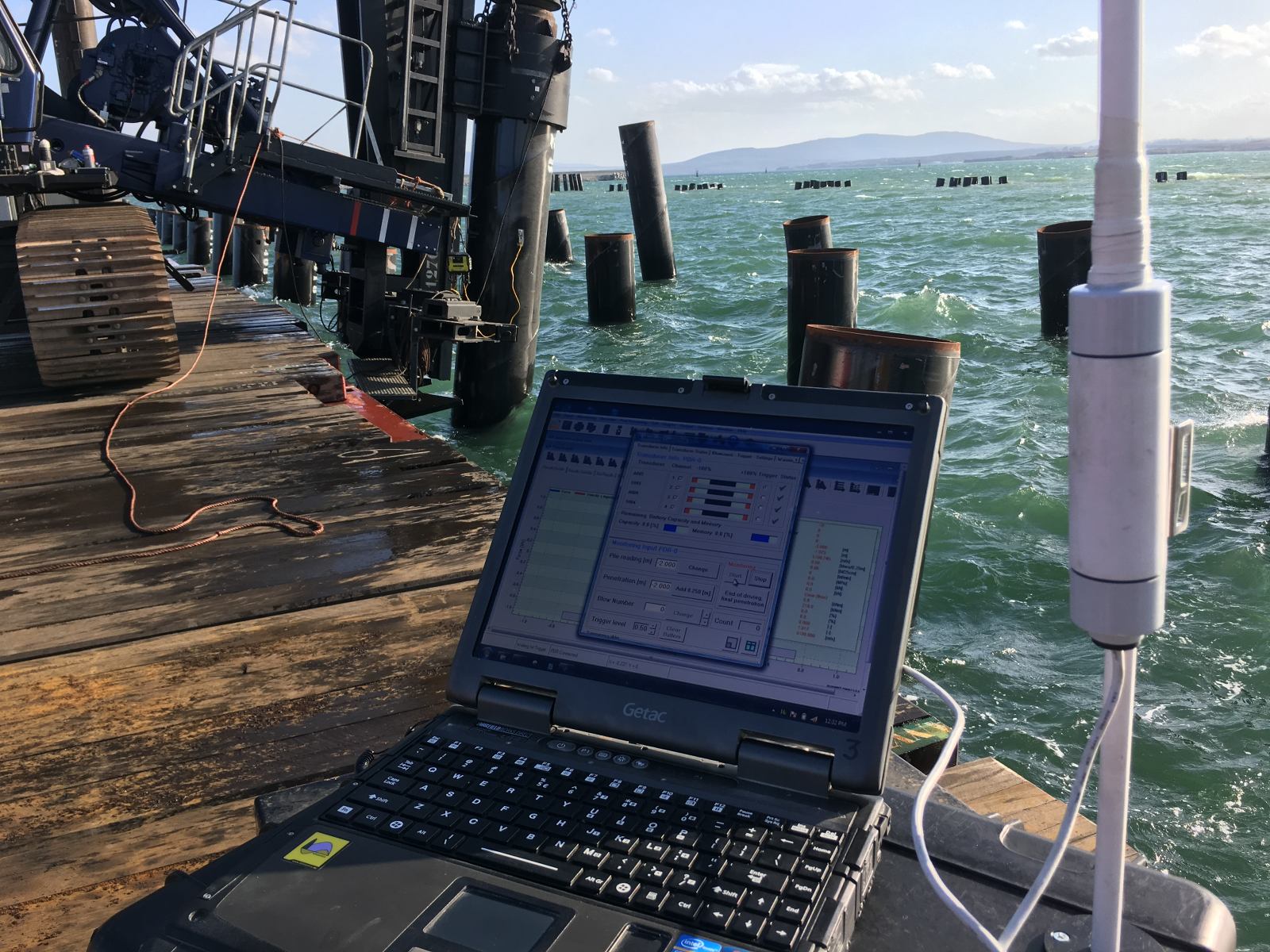
During vibratory pile installation, you need to monitor displacement amplitude, penetration rate, and the forces acting on the pile in real time. This data allows you to detect early refusal before it becomes a problem, verify that the hammer is operating within its design limits, and build a record that supports post-installation analysis and capacity assessment.
The most useful monitoring parameters during vibratory driving include:
- Pile head displacement: Confirms that the amplitude generated by the hammer is sufficient to drive penetration in the actual soil conditions encountered
- Penetration rate: A declining rate at constant hammer settings signals increasing soil resistance and potential early refusal
- Vibration frequency: Verifies that the hammer is operating at its intended frequency throughout the installation
- Strain and acceleration at the pile head: Provides data for signal matching and back-analysis of soil resistance during and after installation
- Power consumption: Sudden changes in power draw can indicate changes in soil resistance or mechanical issues with the hammer
Monitoring data is most valuable when it feeds into a post-analysis workflow. The prediction made before installation, the measurements taken during installation, and the back-analysis performed afterward form a learning loop. Deviations between the predicted penetration rate and the actual rate are not just anomalies to explain: they are information that improves the soil model for future predictions on the same project or similar ground conditions.
For open-ended pipe piles, monitoring should also account for plug behavior. A pile that is unplugged during vibratory installation may behave differently under static load, because plug formation changes the effective toe resistance and the distribution of shaft friction. Understanding this distinction matters for interpreting both the installation record and any subsequent load testing results.
How Allnamics Supports Vibratory Hammer Selection and Drivability Prediction
We combine advanced simulation tools, field monitoring expertise, and decades of installation experience to help you select the right vibratory hammer and manage the risks of pile installation from the earliest planning stage through to final verification.
Our support covers the full workflow:
- Drivability studies using AllWave-VDP: We model the vibratory driving process using CPT-based soil models, accounting for friction fatigue, displacement amplitude, and soil resistance at each penetration depth. This gives you a realistic prediction of penetration rate, refusal risk, and pile stresses before a single pile is driven.
- Combined vibratory and impact drivability analysis: Where your installation plan involves both methods, we simulate both phases and identify the likely transition point, helping you plan equipment mobilization and reduce the risk of unexpected refusal.
- Installation monitoring and signal matching: We instrument piles during installation and use the recorded data for back-analysis. This closes the loop between prediction and reality, updates the soil model, and provides a defensible record for capacity assessment.
- Post-installation capacity verification: Where dynamic or static load testing is required after vibratory installation, we carry out and interpret those tests in the context of the full installation history, including plug behavior and soil disturbance effects.
- Independent technical review: If your team has already selected a hammer or developed a drivability model, we can provide an independent review to check assumptions, identify gaps, and confirm that the approach is fit for the ground conditions and pile specifications involved.
If you are planning a project that involves vibratory pile installation and want to make sure your hammer selection and drivability analysis are grounded in accurate soil modeling, contact our team to discuss your project requirements.