

AllWave-VDP predicts penetration speed during vibratory pile driving by simulating the interaction between the vibratory hammer, the pile, and the surrounding soil using one-dimensional stress-wave analysis. The simulation calculates how much permanent penetration the pile achieves per unit of time based on the balance between the driving force generated by the hammer and the soil resistance acting on the pile. The sections below unpack the key questions engineers ask when using AllWave-VDP for vibratory drivability predictions.
What factors determine penetration speed in vibratory pile driving?
Penetration speed in vibratory pile driving is determined by the balance between the dynamic force generated by the vibratory hammer and the total soil resistance acting on the pile at any given depth. When the driving force exceeds the resistance, the pile advances. When resistance approaches or exceeds the available force, penetration slows or stops entirely.
Several interacting factors govern this balance throughout the installation process:
- Hammer characteristics: The eccentric moment, operating frequency, static weight, and power of the vibratory hammer directly control the amplitude and frequency of the oscillating force applied to the pile head.
- Pile geometry and stiffness: Cross-sectional area, wall thickness, length, and material properties influence how stress waves travel through the pile and how the pile responds to cyclic loading.
- Shaft resistance: Friction along the pile shaft is the dominant resistance component during vibratory driving. As penetration increases, the contact area grows and shaft resistance accumulates.
- Toe resistance: Resistance at the pile tip depends on the strength and stiffness of the soil layer at the current penetration depth.
- Friction fatigue: Repeated cyclic loading during vibratory driving progressively reduces the unit shaft friction along the upper portions of the pile. This reduction in friction is a defining feature of vibratory driving and distinguishes it fundamentally from impact driving.
- Soil layering: As the pile passes through different soil layers, resistance changes continuously. Stiff or dense layers can cause a sharp reduction in penetration speed or lead to early refusal.
These factors do not act independently. The frequency of the hammer interacts with the dynamic stiffness of the soil, and the degree of friction fatigue depends on both the number of loading cycles and the soil type. A reliable vibratory driving prediction must account for all of these interactions simultaneously.
How does AllWave-VDP calculate penetration speed during simulation?
AllWave-VDP calculates penetration speed by applying the Method of Characteristics (MoC) to simulate one-dimensional stress-wave propagation through the pile under cyclic vibratory loading. At each time step, the program computes the forces, velocities, and displacements at every node along the pile, then determines how much net permanent downward movement the pile achieves over a given period.
The calculation process works through the following sequence:
- Hammer model: The vibratory hammer is modelled as an oscillating force source, defined by its eccentric moment, frequency, static bias weight, and mechanical efficiency. This generates a time-varying force at the pile head.
- Stress-wave propagation: The MoC propagates the resulting stress waves down the pile, accounting for changes in pile cross-section, material properties, and impedance at each node.
- Soil resistance model: At each node along the shaft and at the toe, the program applies a soil resistance model that includes both static and dynamic components. The dynamic component accounts for velocity-dependent damping, which is particularly important under the high-frequency cyclic loading of vibratory driving.
- Penetration calculation: The net permanent displacement per cycle is computed from the difference between downward and upward pile movement. Dividing this by the cycle duration gives the instantaneous penetration speed.
- Depth-by-depth progression: The simulation repeats this process across a series of penetration depths, building a complete penetration speed profile from the start of driving to the target depth.
The output is therefore not a single number but a penetration speed profile versus depth, showing how installation rate changes as the pile encounters different soil conditions. This profile allows engineers to identify zones where driving will be slow, where refusal risk is elevated, and where the hammer may reach its operational limits.
What soil models does AllWave-VDP use for resistance prediction?
AllWave-VDP uses CPT-based soil models to derive the Soil Resistance to Driving (SRD) profile that feeds the simulation. The cone resistance and sleeve friction data from a CPT are interpreted to estimate unit shaft friction and unit toe resistance at successive depths, forming the input soil model for the stress-wave calculation.
Two aspects of the soil model are particularly important for vibratory driving predictions:
Static resistance and SRD derivation
The static component of soil resistance is derived from CPT data using established correlations that translate cone resistance into unit shaft and toe resistance values. Because vibratory driving generates different stress conditions than static loading, the SRD used in the simulation is not the same as the long-term axial pile capacity. The SRD reflects the resistance the pile encounters during dynamic installation, which is typically lower than the static capacity due to the cyclic nature of the loading and the effects of pore pressure changes in fine-grained soils.
Friction fatigue and dynamic damping
The soil model in AllWave-VDP incorporates friction fatigue, the progressive reduction of unit shaft friction as the pile is subjected to repeated loading cycles. This is modelled as a depth-dependent reduction in shaft resistance along the upper portion of the pile, reflecting the fact that soil near the surface has experienced more loading cycles than soil near the current pile tip. In addition, the model includes velocity-dependent dynamic damping at both the shaft and the toe, which captures the rate-dependent behaviour of soil under the high-frequency excitation of a vibratory hammer. SPT data and laboratory test results can supplement CPT-based inputs where available, improving the accuracy of the resistance profile in variable ground conditions.
How accurate is AllWave-VDP’s penetration speed prediction?
AllWave-VDP’s penetration speed predictions are most accurate when the soil model is well-calibrated and the hammer parameters are correctly defined. Like all predictive tools in geotechnical engineering, the reliability of the output depends directly on the quality of the input data and the engineering judgement applied in interpreting the results.
Several factors affect prediction accuracy in practice:
- CPT data quality: A high-resolution CPT close to the pile location gives a more representative resistance profile than a distant or interpolated investigation.
- Friction fatigue modelling: The degree of friction fatigue during vibratory driving is soil-dependent and not always well-constrained by CPT data alone. Uncertainty in this parameter can lead to over- or under-prediction of penetration speed.
- Hammer performance: Real hammers do not always operate at their rated specifications. Mechanical losses, hydraulic pressure variations, and soil-hammer interaction can reduce effective energy output below the modelled value.
- Soil variability: Lateral variability in soil conditions between the CPT location and the pile position introduces uncertainty that no simulation can fully eliminate.
The most effective way to improve prediction accuracy is to treat the initial simulation as the starting point of a learning loop. When actual installation data is collected during driving, signal matching and back-analysis allow the soil model to be updated. The updated model then produces a more accurate post-analysis and informs improved predictions for subsequent piles. The 2022 NAM L13-F1-1 case illustrates this approach: a 4.5 m diameter monopile was driven with a vibratory hammer until early refusal at approximately 25 m, then completed with an impact hammer to 31.5 m. Comparing the original CPT-based prediction with the signal-matching results from both vibratory and impact driving phases allowed the soil model to be refined and validated against measured behaviour.
When should AllWave-VDP penetration predictions be used in a drivability study?
AllWave-VDP penetration predictions should be used whenever vibratory driving is part of the planned installation method and the project requires a quantitative assessment of installation performance before driving begins. This applies to both the planning phase, where hammer selection and installation feasibility are evaluated, and the execution phase, where predictions are compared against measured data to verify or update the soil model.
Specific situations where AllWave-VDP predictions add clear value include:
- Hammer selection: Comparing the predicted penetration speed and refusal depth for different vibratory hammers helps identify the most suitable equipment for the ground conditions.
- Refusal risk assessment: The penetration speed profile identifies depths where resistance may exceed the hammer’s capacity, allowing the project team to plan contingency measures such as switching to an impact hammer.
- Installation time estimation: Predicted penetration rates across the full depth range allow realistic scheduling of pile installation, which is particularly important for offshore projects where vessel time is expensive.
- Combined vibratory and impact driving sequences: When the installation plan involves starting with a vibratory hammer and completing with an impact hammer, AllWave-VDP and AllWave-PDP can be used together to simulate the full installation sequence.
- Post-installation back-analysis: After driving, measured penetration rates are compared with predictions to validate the soil model and build an experience database for future projects in similar ground conditions.
A vibratory drivability prediction is not a one-time calculation. It is most useful when it is treated as a living document that is updated as installation data becomes available, turning each pile installation into a source of calibration data for the next.
How We Support Vibratory Drivability Predictions
We provide complete drivability studies for vibratory and impact pile driving, combining advanced simulation with hands-on installation monitoring and back-analysis. Our approach covers the full workflow from initial soil model development to post-installation validation, giving your team a reliable technical basis for hammer selection, risk assessment, and installation planning.
When you work with us on a vibratory drivability study, we deliver:
- CPT-based soil model development tailored to the specific pile geometry, hammer type, and ground conditions at your project location
- AllWave-VDP simulations producing penetration speed profiles, refusal risk assessments, and operational limit checks across the full installation depth
- Combined vibratory and impact driving analyses using AllWave-VDP and AllWave-PDP together when the installation sequence involves both methods
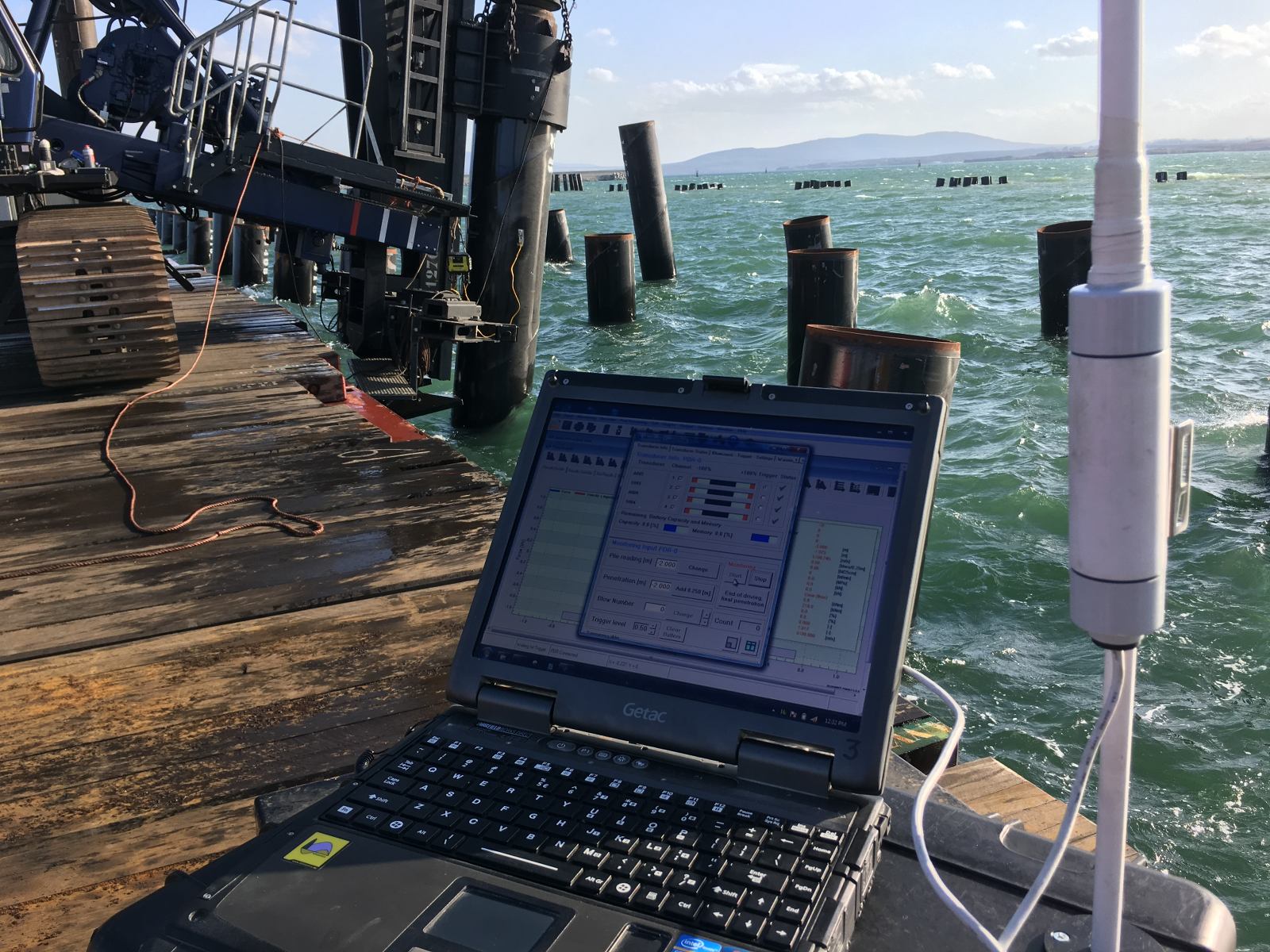
- Installation monitoring and signal matching during actual driving, enabling real-time comparison between predicted and measured performance
- Back-analysis and model updating after installation, turning measured data into improved predictions for subsequent piles or future projects
- Independent technical review of existing drivability studies, hammer selection decisions, or refusal risk assessments prepared by others
Our work is grounded in more than 50 years of experience with foundation piles and a direct line to the development of the stress-wave methods that underpin modern drivability prediction. If your project involves vibratory driving in complex or variable ground conditions, contact us to discuss how we can support your drivability study.