

Vibratory pile driving is more difficult in cohesive soils because clay does not respond to cyclic vibration the way sand does. In granular soils, vibration temporarily reduces friction by rearranging particles. In cohesive soils, the clay matrix resists that rearrangement, maintains higher friction throughout installation, and rebuilds strength rapidly once vibration stops. The sections below unpack the mechanics behind this behavior and what it means for your installation planning.
What makes cohesive soils behave differently during pile installation?
Cohesive soils behave differently during pile installation because their strength comes from electrochemical bonds between fine clay particles rather than from grain-to-grain contact and friction. This means that the mechanisms governing soil resistance in clay are fundamentally different from those in sand, and they do not respond to the same installation forces in the same way.
In sand, soil particles are relatively free to move. Vibration disrupts the contact between grains, temporarily reducing effective stress and allowing a pile to advance with less resistance. In clay, the particles are bound together by cohesive forces that vibration cannot easily overcome. The soil deforms plastically rather than rearranging, and the pile must displace material rather than slide through a temporarily loosened matrix.
Permeability also plays a role. Clay drains very slowly, so excess pore water pressure generated during installation dissipates over hours or days rather than seconds. This delayed drainage affects how quickly the soil regains strength after disturbance, which has direct consequences for both installation performance and post-installation capacity.
How does a vibratory hammer actually drive a pile into the ground?
A vibratory hammer drives a pile by generating continuous cyclic vertical motion through counter-rotating eccentric masses. Unlike an impact hammer, which delivers discrete blows, a vibratory hammer imposes a sustained oscillation that causes the pile to move up and down at a set frequency, progressively working it into the ground through repeated displacement cycles.
The key parameters governing vibratory hammer performance are eccentric moment, operating frequency, and the resulting displacement amplitude. Two hammers with similar centrifugal force ratings can perform very differently in the field. A hammer with a larger eccentric moment and lower frequency typically produces a greater displacement amplitude per cycle. In cohesive soils, this matters significantly because the pile tip must move far enough to push the soil beyond its elastic range and achieve permanent penetration.
Pile geometry also affects how the hammer interacts with the ground. A closed-ended pile is considerably harder to install with a vibratory hammer than an open-ended tubular pile, because the closed end must displace a full column of soil rather than allowing material to enter the pile. For open tubular piles, the interaction between internal shaft friction, external shaft friction, and plug formation adds further complexity to predicting and managing installation behavior.
This is why hammer selection for vibratory driving cannot be reduced to a single centrifugal force value. The combination of eccentric moment, frequency, and pile geometry must be evaluated together against the specific soil conditions at your site.
Why doesn’t vibratory energy reduce friction in clay the same way it does in sand?
Vibratory energy does not reduce friction in clay the same way it does in sand because clay particles do not rearrange under cyclic loading. In sand, vibration temporarily disrupts grain contact and lowers effective stress, creating a lubrication effect. In clay, the cohesive bonds between particles resist rearrangement, so the soil continues to exert significant shaft friction throughout the vibratory installation process.
The physical model for soil reaction during vibratory driving involves displacement, velocity, and acceleration components acting simultaneously. Research by Bielefeld, Moscoso, and Verbeek describes the general soil reaction as a function of these three variables, incorporating spring stiffness, damping, and added mass. In cohesive soils, the damping component remains high throughout the installation cycle, meaning the pile continuously works against a resistant medium rather than a temporarily softened one.
This also explains why simple adaptations of traditional impact driving soil models are insufficient for vibratory driving in clay. The Smith model, commonly used for impact driving analysis, couples static and dynamic resistance in a way that does not accurately represent the physical behavior of cohesive soil under continuous cyclic loading. Applying it without modification to vibratory driving scenarios in clay can produce unreliable predictions.
Accurate soil modeling for pile driving in cohesive conditions requires a model that accounts for the specific loading mechanism of vibratory hammers and the distinct way clay responds to sustained oscillation rather than discrete impacts.
What is soil setup and why does it worsen in cohesive soils?
Soil setup is the increase in pile resistance that occurs after installation stops, as disturbed soil around the pile regains strength over time. In cohesive soils, setup is more pronounced and faster-acting than in granular soils because clay rebuilds its cohesive bonds relatively quickly once cyclic disturbance ends, and excess pore pressures dissipate to restore effective stress.
During vibratory driving, the soil immediately surrounding the pile is disturbed and weakened. The moment the hammer stops, the recovery process begins. In clay, this recovery can be substantial within minutes or hours, which creates a practical problem: if driving is interrupted and then resumed, the pile may encounter significantly higher resistance than it faced during the initial installation phase.
A related concept is soil fatigue, which describes the progressive change in soil strength along the pile shaft as the number of loading cycles accumulates. At a vibratory hammer frequency of around 23 Hz, approximately 10,000 cycles are generated in roughly seven minutes. The soil at the top of the shaft experiences the full history of those cycles, while soil near the current pile tip has experienced far fewer. This means that a uniform residual strength assumption along the full pile length is physically unrealistic.
An advanced soil model must treat fatigue as a function of local loading history rather than applying a single reduction factor to the entire shaft. The Beta Factor, originally proposed by Jonker, describes the ratio between residual and initial soil strength, but applying a constant Beta value across the full pile ignores the depth-dependent cycle count that each soil layer has actually experienced. In cohesive soils, where setup is strong and recovery is rapid, this distinction has a direct impact on prediction accuracy.
When should vibratory driving be avoided in cohesive soil conditions?
Vibratory driving should be avoided in cohesive soils when the clay is stiff or heavily overconsolidated, when the required pile tip displacement per cycle is insufficient to overcome the soil’s plastic resistance, or when early refusal is a significant risk and no contingency impact driving plan is in place. In these conditions, vibratory driving may consume time and energy without achieving meaningful penetration.
Soft to medium clays can sometimes be penetrated with a vibratory hammer, particularly when the hammer has a large eccentric moment and produces sufficient displacement amplitude at the pile tip. However, as clay stiffness increases, the energy required to push the soil beyond its elastic range grows, and the vibratory hammer’s continuous low-energy input becomes less effective compared to the high-energy discrete blows of an impact hammer.
Early refusal is a documented risk in vibratory driving through cohesive profiles. A pile can advance steadily through softer layers and then encounter a stiffer clay horizon where penetration effectively stops. Without a reliable vibratory driving prediction based on site-specific soil data, this risk is difficult to anticipate and manage before mobilization.
Pile geometry also influences the decision. Closed-ended piles in stiff clay present the highest refusal risk. Open-ended tubular piles offer more flexibility, but plug formation during installation can shift the effective resistance profile in ways that are not always predictable from standard soil investigation data alone.
What methods help improve vibratory pile driving performance in clay?
Several methods can improve vibratory pile driving performance in cohesive soils: selecting a hammer with a large eccentric moment and appropriate frequency to maximize tip displacement, using open-ended pile geometries where feasible, minimizing installation interruptions to limit soil setup, and grounding the installation plan in a site-specific drivability prediction that accounts for cohesive soil behavior.
Hammer configuration and pile selection
Hammer selection should prioritize displacement amplitude over raw centrifugal force. A hammer with a larger eccentric moment and lower operating frequency can generate greater pile tip movement per cycle, which is what matters most in cohesive soil where the pile must overcome plastic resistance. Comparing hammers purely on centrifugal force rating can lead to selecting a configuration that is technically powerful but practically ineffective in clay.
Open-ended pile geometries reduce the volume of soil that must be displaced at the tip, lowering the resistance the hammer must overcome. Where project requirements allow, this choice alone can significantly improve penetration rates in cohesive profiles.
Installation planning and monitoring
Minimizing planned interruptions during installation limits the opportunity for soil setup to increase resistance between driving phases. Where interruptions are unavoidable, your team should anticipate higher resistance at restart and plan accordingly, including having contingency impact driving capacity available if vibratory driving reaches refusal.
Systematic installation monitoring during vibratory driving generates data that can be used for back-analysis and post-processing. Comparing measured penetration rates and resistance profiles against pre-installation predictions allows the soil model to be updated in real time and improves the accuracy of future predictions on similar projects. This learning loop transforms each installation into a calibration exercise rather than a one-off event.
How Allnamics Supports Vibratory Pile Driving in Cohesive Soils
We work with contractors, foundation engineers, and project developers who face the specific challenges of vibratory pile installation in cohesive soil conditions. Our support covers the full cycle from pre-installation prediction through to post-installation analysis, giving your team a technically grounded basis for decision-making at every stage.
Here is what we provide:
- Site-specific drivability predictions using the AllWave software package, including AllWave-VDP for vibratory driving scenarios and AllWave-PDP for impact driving, both capable of modeling cohesive soil behavior with depth-dependent fatigue and realistic soil reaction models
- Soil modeling for pile driving based on CPT and laboratory data, with explicit treatment of friction fatigue, soil setup, and the distinct loading mechanisms of vibratory hammers in clay
- Hammer selection advice that evaluates eccentric moment, frequency, and displacement amplitude against your specific soil profile and pile geometry, rather than relying on centrifugal force ratings alone
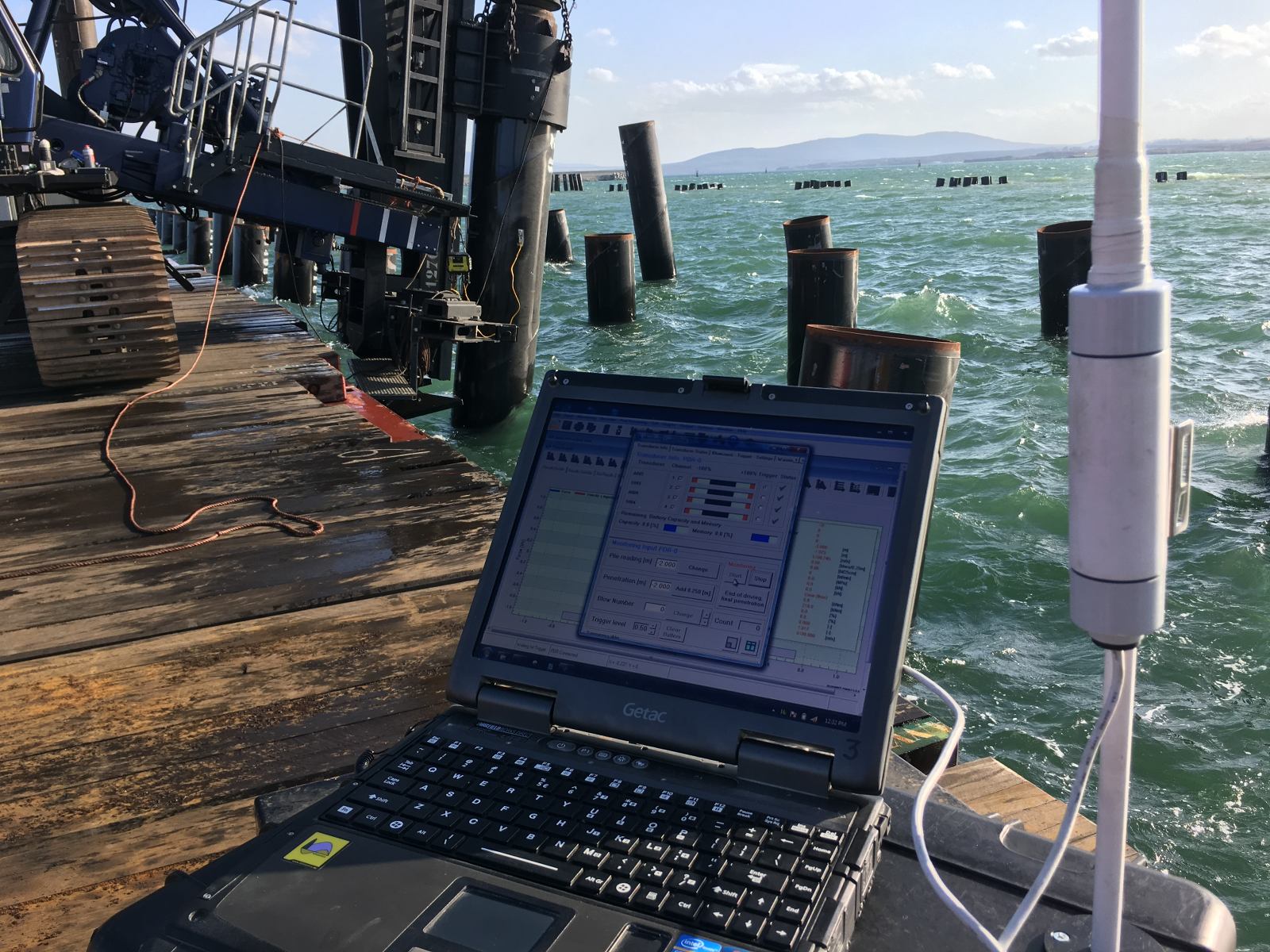
- Installation monitoring and signal matching during vibratory and impact driving phases, providing real-time data that can be used to update soil models and validate predictions
- Post-installation back-analysis that compares predicted and measured performance, building an experience database that improves future predictions on similar cohesive soil projects
- Contingency planning support for projects where early refusal risk in stiff clay requires a combined vibratory and impact driving strategy
If your project involves vibratory pile installation in cohesive soils and you want a prediction grounded in realistic soil modeling rather than simplified assumptions, contact us to discuss your site conditions and project requirements.
Gerelateerde artikelen
- How do sand and clay behave differently during pile driving?
- What is the difference between static and dynamic soil resistance during pile driving?
- How does shaft resistance influence pile drivability?
- Why is AllWave-VDP the most used prediction program for offshore installation predictions?
- How do soil conditions affect pile load test outcomes?