

Sand and clay behave very differently during pile driving because their fundamental soil mechanics differ. Sand is granular and responds quickly to stress changes, while clay is cohesive and reacts more slowly due to its low permeability and time-dependent strength behaviour. Understanding these differences is important for selecting the right installation method, predicting drivability, and avoiding costly problems on site. The sections below walk through the specific behaviour of each soil type, the set-up effect, mixed profiles, and testing approaches.
Why does soil type change how a pile is driven?
Soil type determines how resistance builds up around a pile during installation. Sand and clay generate resistance through different mechanisms, respond differently to dynamic loading, and recover strength at very different rates after driving. These differences directly affect blow count, penetration rate, pile stresses, and the risk of refusal or damage.
When a hammer strikes a pile, a stress wave travels down the shaft and interacts with the surrounding soil. The soil’s response to that wave depends on its stiffness, permeability, and shear strength characteristics. In granular soils, the response is fast and largely governed by effective stress. In cohesive soils, pore pressure changes and viscous behaviour slow the response and alter how resistance is distributed between shaft friction and toe resistance.
This is why soil modelling for pile driving cannot rely on a single set of parameters. Accurate drivability predictions require soil-specific input, including cone penetration test (CPT) data, undrained shear strength for clay layers, and friction angle estimates for sand. Without this, predictions of blow count, maximum pile stresses, and achievable penetration depth carry significant uncertainty.
How does sand respond to impact during pile driving?
Sand responds to pile driving with relatively high initial resistance that reduces quickly under repeated loading. The granular structure means that shaft friction and toe resistance are governed by effective stress and the friction angle between the pile surface and the soil. As driving progresses, friction fatigue causes the shaft friction in sand to decrease with depth, meaning the resistance per unit length of pile shaft drops as the pile penetrates further.
This friction fatigue effect is well documented in offshore driving records and forms a core part of established soil resistance to driving (SRD) models. In the Alm and Hamre framework, for example, the transition from initial to residual shaft friction in sand follows an exponential relationship, typically reaching residual values after roughly 20 to 30 metres of additional penetration. Toe resistance in sand is modelled as a fraction of the CPT cone resistance, with a best-fit value of approximately 0.4 times the cone resistance over the full pile tip area.
For vibratory installation in sand, the behaviour is even more pronounced. The cyclic motion of a vibratory hammer disrupts the grain contacts around the pile, temporarily reducing shear resistance. This can allow the pile to advance significantly under the combined static weight of the hammer and pile alone. This resistance reduction is driven by cyclic disturbance and a temporary drop in contact pressure, not necessarily by liquefaction, which is a separate and more specific phenomenon.
Sand also responds well to impact driving because energy transfer is efficient when soil stiffness is high. However, very dense sand layers can cause refusal if the blow count rises beyond practical limits before the target penetration depth is reached.
How does clay behave differently when a pile is driven through it?
Clay resists pile driving through undrained shear strength and cohesion rather than friction angle. During impact driving, pore water pressures build up around the pile because clay’s low permeability prevents rapid drainage. This means the soil cannot quickly redistribute stress, and the pile must overcome a resistance that is partly governed by the rate of loading rather than just the static strength of the soil.
Shaft friction in clay during driving is linked to the undrained shear strength and the overconsolidation ratio (OCR). Residual friction values in normally consolidated clay are typically around 0.35 times the undrained shear strength, while in heavily overconsolidated clay this can drop toward 0.2 times the undrained shear strength. Importantly, overconsolidated clay reaches its residual friction over a shorter penetration distance than normally consolidated clay, sometimes within 10 metres compared to around 30 metres for normally consolidated conditions.
Toe resistance in clay is modelled differently from sand. A bearing capacity factor of around 11.5 times the undrained shear strength is commonly used, though variations in this factor tend to have limited influence on total SRD because shaft friction typically dominates in clay profiles.
For vibratory driving in clay, the behaviour is notably more difficult. Each cycle must generate enough displacement to push the soil past its elastic range and into plastic deformation. If the displacement amplitude of the hammer is too small relative to the soil stiffness, the clay responds elastically and the pile makes little or no permanent penetration. This is why hammer selection for clay requires careful attention to eccentric moment and displacement amplitude, not just centrifugal force.
What is the set-up effect and why does it matter in clay?
The set-up effect is the increase in pile capacity that occurs after driving stops, caused by the dissipation of excess pore water pressure and the recovery of soil strength around the pile. In clay, this effect is significant and can cause the pile’s static capacity after installation to be substantially higher than the resistance measured during driving.
During impact driving, the stress wave and pile displacement disturb the clay structure and generate excess pore pressures. Once driving stops, those pressures dissipate over time as water migrates away from the pile shaft. As effective stress recovers, shaft friction increases. In some clay profiles, the long-term static capacity can be several times higher than the SRD measured at the end of driving.
This distinction between dynamic resistance during installation and static capacity after set-up is important for foundation design and for interpreting pile test results. The resistance during driving is what governs drivability analysis. The capacity after set-up is what governs the foundation’s ability to carry load in service. These are related but not interchangeable quantities, and treating them as equivalent leads to errors in both directions.
Set-up also affects the timing of pile load testing. Testing too soon after installation in clay may underestimate long-term capacity. Dynamic load testing performed at the end of driving captures the driving resistance, while a restrike test performed days or weeks later can reveal how much strength has recovered, giving a better picture of the pile’s actual bearing capacity.
How do mixed soil profiles affect pile driving predictions?
Mixed soil profiles, where sand and clay layers alternate with depth, create the most complex conditions for drivability prediction. Each layer transition changes the resistance profile, and the interaction between layers affects how stress waves travel and reflect along the pile shaft.
In a layered profile, the pile may drive easily through a soft clay layer, encounter high resistance in a dense sand layer, and then experience a sudden drop in resistance when entering softer material again. This variation in blow count with depth must be predicted accurately to avoid hammer damage, pile overstress, or unexpected refusal.
Friction fatigue adds another layer of complexity in mixed profiles. Sand layers that the pile passed through earlier continue to contribute residual shaft friction as the pile penetrates deeper. Clay layers that were disturbed during driving may have reduced resistance initially but will recover strength over time. Capturing this behaviour requires a soil model that tracks the loading history at each point along the pile shaft, rather than applying a uniform residual strength across the full pile length.
Chalk deserves specific mention as a material that does not behave like standard sand or clay. Low-to-medium density chalk shows highly variable field behaviour, with reported cases of both easy penetration and sudden refusal. Conventional SRD methods often fail to predict chalk behaviour reliably, and dedicated approaches that account for the relationship between cone resistance and chalk resistance to driving, the degradation of local stresses during driving, and interface shear characteristics are needed for accurate predictions.
Which pile testing methods are best suited for sand versus clay?
The choice of pile testing method depends on what you need to measure and when you can test relative to installation. Both sand and clay can be assessed using dynamic and static methods, but the timing and interpretation differ between soil types.
Testing in sand
Dynamic load testing (DLT) during driving or at restrike works well in sand because set-up times are short. Excess pore pressures dissipate quickly in granular soils, so the capacity measured shortly after driving is close to the long-term static capacity. Signal matching analysis of the dynamic test data allows you to separate shaft friction from toe resistance and assess the quality of energy transfer from hammer to pile.
Static load testing (SLT) in sand provides a direct measurement of pile capacity and is particularly useful for calibrating dynamic test results or verifying design assumptions in dense or variable sand profiles where drivability predictions carry higher uncertainty.
Testing in clay
In clay, the timing of testing is more important. Dynamic load testing at the end of driving captures the SRD, which is useful for drivability verification but does not reflect the long-term capacity. A restrike test after sufficient set-up time, typically days to weeks depending on the clay type, gives a much better estimate of static capacity. The difference between end-of-driving and restrike results quantifies the set-up effect directly.
Rapid load testing and static load testing are both applicable in clay and provide direct capacity measurements that account for the fully set-up condition. Pile integrity testing is relevant in both soil types to detect damage that may have occurred during installation, particularly in clay where high driving resistance in stiff layers can generate tension stresses that risk pile cracking.
How We Help with Drivability Predictions in Sand and Clay
At Allnamics, we support your team through every stage of drivability analysis, from initial soil modelling to full installation monitoring. Our approach combines decades of experience in pile driving mechanics with our own software tools and field testing capabilities.
- Soil modelling for pile driving: We build soil resistance models from CPT, SPT, and laboratory data, applying soil-specific parameters for sand, clay, and complex layered profiles, including chalk where standard methods fall short.
- Impact drivability predictions with AllWave-PDP: Our AllWave software package simulates hammer, pile, and soil interaction for impact driving, generating blow count versus penetration curves, maximum pile stresses, energy transfer, and refusal risk assessments.
- Vibratory drivability predictions with AllWave-VDP: For vibratory installation, we model the cyclic soil response in both granular and cohesive soils, accounting for friction fatigue, displacement amplitude, and hammer configuration to predict penetration rate and achievable depth.
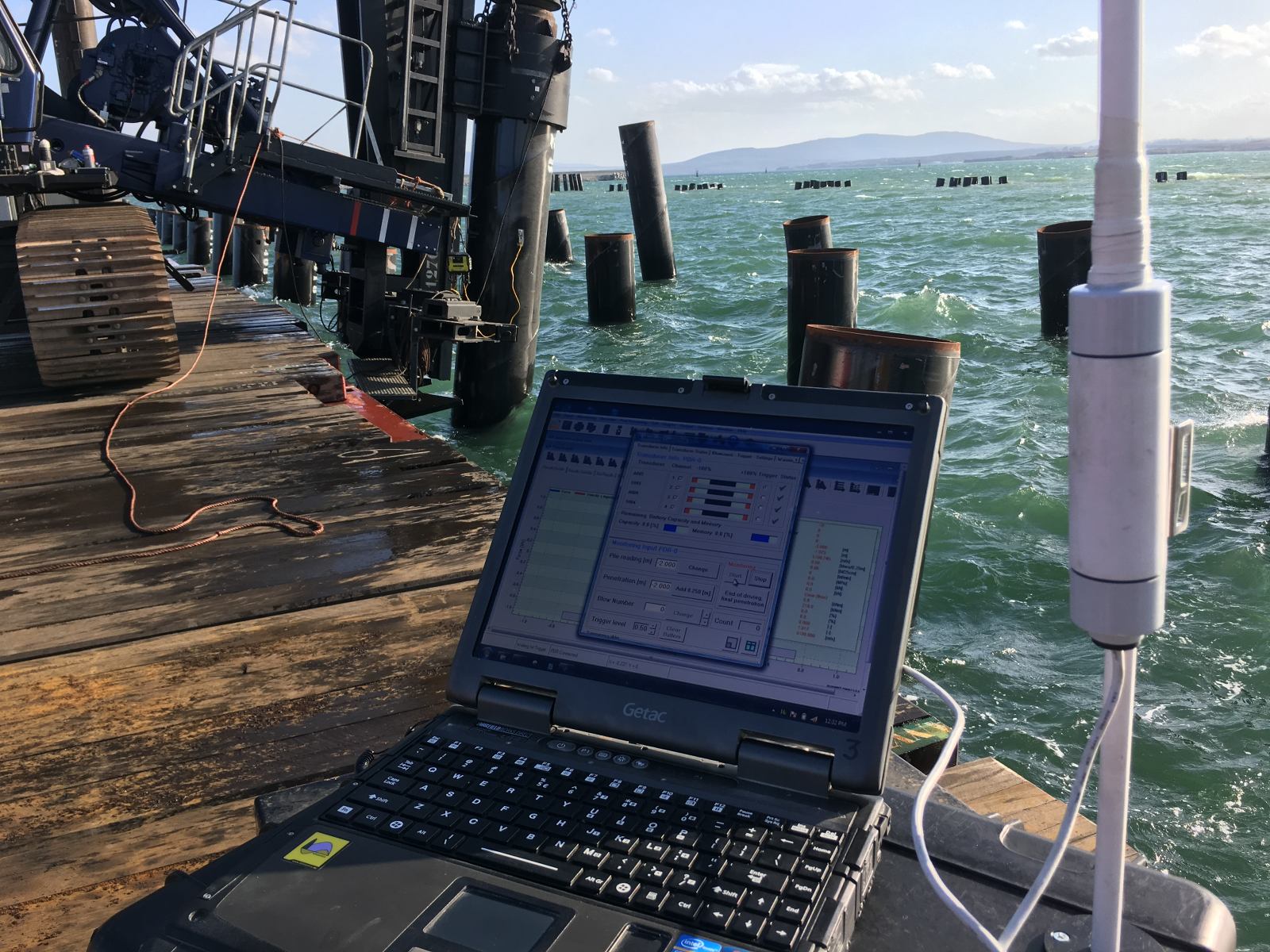
- Dynamic load testing and signal matching: We perform DLT during driving and at restrike to capture both SRD and set-up effects in clay, with full signal matching analysis to separate shaft and toe contributions.
- Independent technical review: We review existing drivability studies, flag assumptions that may not hold for your specific soil profile, and provide a second opinion before installation begins.
If your project involves challenging soil conditions, mixed profiles, or tight tolerances on pile performance, contact our team to discuss how we can support your drivability analysis. Reach out to us directly and we will respond with a concrete proposal tailored to your project.