

Initial soil resistance is the resistance a pile encounters at a specific depth the first time it reaches that point during driving, while residual soil resistance is the locked-in stress state that remains in the pile-soil system after driving stops. The difference matters because residual stresses alter the apparent load distribution measured during pile testing, which means ignoring them can lead to misinterpretation of a pile’s actual bearing capacity. The sections below walk through how this resistance builds up, how it affects measurements, and how engineers account for it in practice.
How does soil resistance build up around a driven pile?
Soil resistance builds up around a driven pile through two mechanisms acting simultaneously: shaft friction along the pile’s side surface and toe resistance at the pile tip. As the pile penetrates deeper, both components mobilize progressively, and their combined magnitude defines the Static Resistance to Driving (SRD) at any given depth.
During impact driving, the total resistance the pile experiences is not purely static. A dynamic component also develops, driven by the velocity and acceleration of pile movement rather than displacement alone. This dynamic resistance disappears once the pile stops moving, which is why the resistance during driving and the static bearing capacity after installation are related but not identical quantities.
Shaft friction does not build up uniformly along the pile length. As the pile advances, soil near the top of the pile has experienced far more loading cycles than soil near the current pile tip. In clay, the transition from initial to residual shaft friction depends on the undrained shear strength and the overconsolidation ratio (OCR). In normally consolidated clay, residual friction levels are typically reached after roughly 30 meters of additional penetration, while in heavily overconsolidated clay that distance can shrink to around 10 meters. In sand, a similar exponential transition from initial to residual shaft friction occurs, generally stabilizing after 20 to 30 meters of further penetration.
Toe resistance follows its own mobilization pattern. The pile tip must displace enough soil to fully engage bearing resistance, and the displacement required to reach that point is captured by the quake parameter in dynamic pile models. When the actual displacement during a hammer blow is smaller than the quake, the full toe resistance is not mobilized, which is an important checkpoint in signal matching analyses.
What is residual soil resistance in pile testing?
Residual soil resistance is the stress locked into the pile-soil system after driving is complete. When a pile is driven into the ground, the hammer compresses the pile and pushes it downward. As the pile rebounds elastically after each blow, the surrounding soil partially restrains that rebound, leaving the pile in a state of internal stress even when no external load is applied.
In practical terms, this means the pile carries a pre-existing compressive load at the toe and a corresponding tensile load along part of the shaft before any test load is applied. These locked-in stresses are not visible from the pile head unless strain gauges are installed along the pile length before driving begins.
The magnitude of residual stress depends on several factors:
- Soil stiffness and strength: Stiffer, stronger soils generate larger residual stresses because they resist the pile’s elastic rebound more effectively.
- Pile stiffness: More flexible piles tend to accumulate higher residual stresses relative to their cross-section.
- Number of hammer blows: Residual stresses accumulate with repeated impacts, so long driven piles in dense profiles are particularly susceptible.
- Time after driving: Excess pore pressures generated during driving dissipate over time, changing the effective stress state around the pile and altering the residual stress distribution.
Residual soil resistance is a real physical phenomenon, not a measurement artifact. It reflects the mechanical equilibrium the pile reaches with the surrounding soil after installation.
How does residual stress affect pile capacity measurements?
Residual stress distorts pile capacity measurements by shifting the apparent distribution of shaft friction and toe resistance without changing the pile’s true total capacity. Because the pile already carries compressive load at the toe before testing begins, a static load test will appear to show less toe resistance and more shaft friction than actually exists under working conditions.
This misinterpretation has direct consequences for pile design. If an engineer reads a load test result and concludes that shaft friction dominates when in reality toe resistance is significant, the design assumptions for similar piles on the same project may be wrong. The total capacity number may still be correct, but the load transfer mechanism is misrepresented.
Dynamic Load Testing (DLT) is also affected. Signal matching analyses that do not account for residual stresses can produce soil model parameters that fit the measured signal but misrepresent the true static resistance components. A high residual toe load, for example, can mask the true shaft friction distribution in the signal match output.
The timing of a Dynamic Load Test relative to pile installation adds another layer of complexity. A test performed immediately at End of Driving (EOD) captures a resistance state that includes elevated pore pressures and reduced effective stresses. A restrike test performed 24 to 48 hours later, after pore pressure dissipation and soil set-up, will typically show a higher ultimate resistance. Both measurements are valid, but they answer different questions, and comparing them without noting the time difference leads to incorrect conclusions.
How do engineers detect and correct for residual soil resistance?
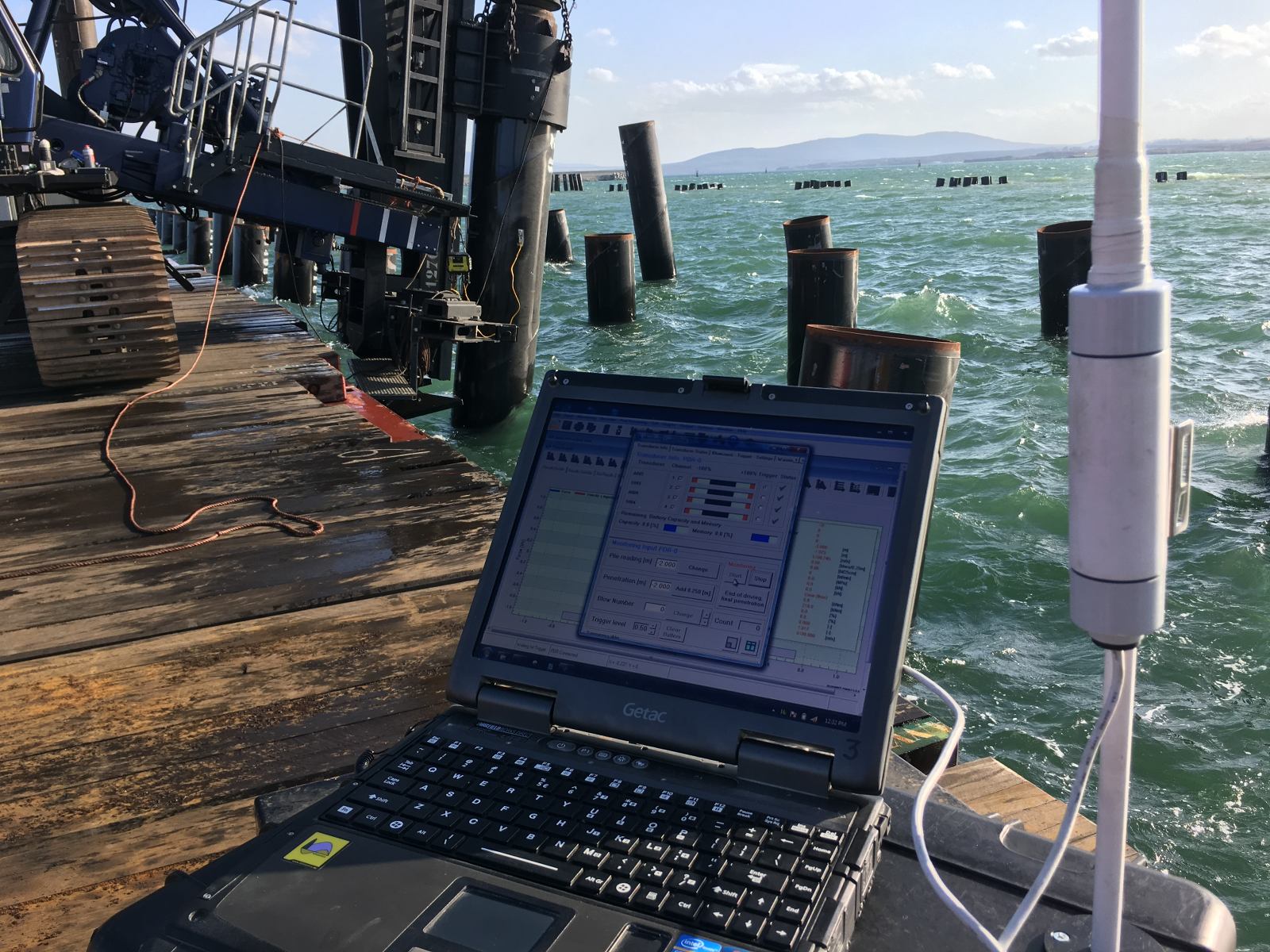
Engineers detect residual soil resistance primarily by installing strain gauges along the pile shaft before driving. These gauges record the stress distribution in the pile at any point in time, including before any test load is applied. The zero reading after driving but before testing directly reveals the residual stress profile.
When instrumentation is not installed before driving, engineers use analytical and numerical methods to estimate residual stresses. Signal matching of dynamic test data, using software such as the AllWave Software Package, allows engineers to model the pile-soil interaction and back-calculate soil parameters that are consistent with the measured force and velocity signals. By comparing EOD and restrike results within the same signal matching framework, the analyst can identify how resistance has changed and infer the likely residual stress state.
Correction methods in static load testing include:
- Telltale rods: Installed inside hollow piles to measure tip displacement independently of head displacement, allowing the actual toe load-displacement response to be separated from shaft friction.
- Residual load analysis: Using the strain gauge data from a fully instrumented pile to subtract the pre-existing stress state from the measured test response, producing a corrected load transfer curve.
- Calibration against Static Load Testing: Performing a signal match on dynamic test data and then computing the predicted static load-displacement response, comparing it against an actual static test to refine soil model parameters within the bounds the dynamic match allows.
Each method has its own accuracy limitations, and the best approach depends on the project’s risk level, the available instrumentation, and whether a static reference test is feasible.
When does residual soil resistance matter most for a project?
Residual soil resistance matters most when the pile’s load transfer mechanism is important to the design, not just its total capacity. Projects where toe resistance is expected to carry a significant share of the load are most sensitive, because residual stresses systematically understate toe contribution in test results.
Specific situations where residual resistance deserves close attention include:
- Long, heavily driven piles in dense sand or stiff clay: These accumulate the largest residual stresses and show the greatest distortion in load test interpretation.
- Offshore foundations: Large-diameter offshore piles driven through layered profiles often develop significant residual toe loads, and misinterpreting their load transfer can affect the design of the entire foundation system.
- Vibratory driving: During vibratory installation, the soil experiences thousands of loading cycles. Soil near the top of the pile undergoes far more cycles than soil near the current pile tip, making a uniform residual strength assumption physically unrealistic. Advanced models treat soil fatigue as a function of local loading history rather than applying a single reduction factor to the entire shaft.
- Projects using Dynamic Load Testing as the primary capacity verification method: When no static load test is available for calibration, the signal matching result carries more weight, and unaccounted residual stresses introduce greater uncertainty into the interpreted capacity.
- Reuse of existing foundations: When assessing whether an existing pile foundation can support a new or modified structure, the current residual stress state reflects the pile’s entire loading history and must be understood before any capacity assessment is reliable.
In all these situations, the gap between the resistance during installation and the static capacity after installation is not a minor correction. It is a fundamental aspect of how the pile interacts with the surrounding soil, and treating it carefully is what separates a reliable foundation assessment from one that carries hidden risk.
How Allnamics Helps with Soil Resistance Analysis and Drivability Predictions
We combine decades of experience in pile testing, signal matching, and soil modelling for pile driving to help your team understand and correctly interpret soil resistance at every stage of a project. Whether you are planning installation, verifying capacity, or assessing an existing foundation, we provide the analysis and tools to give you a reliable picture of what the soil is actually doing.
Our support in this area includes:
- Drivability studies using AllWave-PDP and AllWave-VDP: We run impact and Vibratory Driving Prediction analyses that account for the transition from initial to residual soil resistance, soil fatigue under cyclic loading, and the difference between static and dynamic resistance components. Lower, best-estimate, and upper-bound SRD profiles are used to give your team a full picture of installation risk rather than a single nominal result.
- Dynamic Load Testing and signal matching: We perform DLT at End of Driving and during restrike, and we use signal matching within the AllWave framework to separate static and dynamic resistance components, identify residual stress effects, and produce calibrated soil model parameters.
- Instrumented static load testing: Where the project warrants it, we design and execute fully instrumented static load tests that reveal the true load transfer profile, including corrections for residual stress, giving you a reference that can calibrate dynamic test results on the same site.
- Independent technical review: If your team has existing test data or a drivability prediction that needs a second opinion, we review the soil modelling assumptions, the signal matching quality, and the interpretation of residual resistance effects.
- Foundation reuse assessments: For existing piles, we assess the current residual stress state and its implications for revised loading scenarios, supporting sustainable reuse decisions with technically sound analysis.
If your project involves driven piles and you want to make sure soil resistance is being interpreted correctly, get in touch with our team to discuss how we can support your foundation engineering work.