


Europe’s first experiences with rapid load testing began in the early 1990s, when the Statnamic method was introduced to the continent shortly after its development in North America. The Netherlands played a particularly active role from the outset, drawing on decades of existing expertise in stress wave research and pile foundation engineering. The sections below trace how the method arrived, where it was first applied, how it was validated, what early challenges arose, and how European standardization eventually followed.
How did Rapid Load Testing reach Europe?
Rapid load testing reached Europe through the Statnamic method, which was developed in the mid-1980s as an alternative positioned between static and dynamic load testing. The Netherlands was among the first countries to engage with the technique, building on a strong domestic tradition of stress wave research that dated back to the 1950s and accelerated through the work of organizations such as TNO, Heerema, and Hollandsche Beton Groep in the 1970s.
That existing knowledge base made Dutch geotechnical engineers well placed to evaluate and adopt the new method. The wave-equation analysis methods developed in the Netherlands, including TNOWAVE-related approaches, had already established a framework for understanding how piles respond to rapid loading events. When Statnamic emerged internationally, European researchers recognized its conceptual connection to this earlier work and began investigating it seriously.
The method’s core appeal was practical: it offered a way to apply high test loads without the heavy reaction structures that static load testing requires, while avoiding some of the stress wave complications associated with high-strain dynamic testing. For European contractors and consultants working on large-diameter piles and complex urban sites, this combination of attributes made the technique worth pursuing.
What were the first European projects to use Rapid Load Testing?
The first European rapid load tests were conducted in the Netherlands during the early 1990s, with projects in Rotterdam and Arnhem among the documented early applications. These tests focused on validating the Statnamic method under Dutch soil conditions and pile types, and they produced some of the earliest European datasets comparing rapid load test results with reference measurements.
A landmark publication from this period is the 1992 paper by Middendorp, Bermingham, and Kuiper, Statnamic Load Testing of Foundation Piles, which drew on early field experience and laid out the theoretical and practical framework that would guide subsequent European work. This paper established the conceptual separation between dynamic pile behavior and rate-dependent soil behavior, a distinction that remains central to how rapid load testing is interpreted today.
Later, projects in other European countries extended the geographic reach of the method. A well-documented case from Barcelona involved large-diameter in-situ concrete piles with working loads of approximately 6 to 8 MN. In that project, a bi-directional static test had been used first but did not fully mobilize the available resistance because the embedded loading system was not positioned optimally. Rapid load testing with the StatRapid device was selected for supplementary verification, partly because dynamic load testing was considered less suitable for large cast-in-place concrete piles where high-impact stresses could risk pile damage.
How was Rapid Load Testing validated against static load testing in Europe?
European validation of rapid load testing relied on comparative test programs in which rapid load tests and static load tests were performed on the same or equivalent piles. The Waddinxveen research, documented by Kristof Verstraeten, is one of the most referenced Dutch validation studies, providing a controlled comparison that helped establish confidence in the Unloading Point Method as an interpretation tool.
These comparison programs addressed two separate questions that researchers recognized as distinct. The first question was whether the load duration was long enough to limit stress wave effects within the pile. The second was whether the measured soil resistance at high loading rates could be reliably converted to the resistance that a static test would mobilize. Answering both questions required careful attention to pile length, wave speed, soil type, and damping behavior.
Research by Van Foeken, Middendorp, and Courage on automatic signal matching contributed further analytical tools that improved the reliability of the conversion from measured rapid load response to static-equivalent capacity. Across these studies, the consistent finding was that rapid load testing can serve as a valid alternative to static load testing when the load duration is appropriate, the instrumentation is correct, and the interpretation method suits the specific pile-soil combination.
For cohesive soils, the validation picture was more nuanced. Several European studies found that loading-rate effects in clay required soil-specific correction factors, and no single universal correction emerged from the available data. This finding shaped how European practitioners approached the method in clay-dominated ground profiles.
What challenges did early adopters face with Rapid Load Testing?
Early adopters of rapid load testing in Europe faced three main categories of challenge: interpreting the test results correctly, selecting appropriate loading parameters in advance, and building confidence among clients and regulators unfamiliar with the method.
Interpretation and rate-dependent soil behavior
The most technically demanding challenge was converting the measured rapid load response into a reliable static-equivalent capacity. The Unloading Point Method provided a practical starting point, but researchers quickly recognized that it rested on assumptions about soil damping that did not hold equally well across all ground conditions. In cohesive soils, rate dependency, pore water pressure effects, and dilatancy all influenced the measured resistance in ways that a simple inertia correction could not fully account for. Early practitioners had to develop project-specific approaches and, in some cases, run parallel static tests to calibrate their interpretation.
Predicting test parameters before execution
A second challenge was predicting, before the test, what drop mass, spring configuration, and drop height would be needed to achieve the required load level and load duration. Middendorp, Bielefeld, and Bakker described three approaches to this prediction: using experience from previous tests, applying simplified theoretical models, and running full wave-equation analyses. Each approach carried uncertainty, and early practitioners often needed to adjust parameters on site. The recommendation that emerged from this experience was a learning loop in which results from each test were used to refine predictions for future work.
How did European standards for Rapid Load Testing develop?
European standardization of rapid load testing developed gradually, following the lead of Japan, which published the world’s first formal standard for the method in 2002 through the Japanese Geotechnical Society (JGS 1815-2002). European efforts built on this foundation and on the growing body of comparative test data accumulated through the 1990s and 2000s.
At the international level, ISO 22477-10 established a framework for rapid load testing that European countries could adopt or reference within their national systems. In parallel, ASTM D7383 provided a North American standard that influenced European practice through shared research networks and multinational projects.
In the Netherlands, NEN 7201:2025 represents the current national standard governing pile load testing, including rapid load testing. This standard sets explicit requirements for load duration, instrumentation, interpretation methods, and the conditions under which a failure load may or may not be extrapolated from a test that did not reach full mobilization. The standard treats both execution and analysis as specialist activities, reflecting the consensus across ISO 22477-10, ASTM D7383, and the research literature that rapid load test interpretation requires geotechnical expertise rather than a direct reading of the maximum measured load.
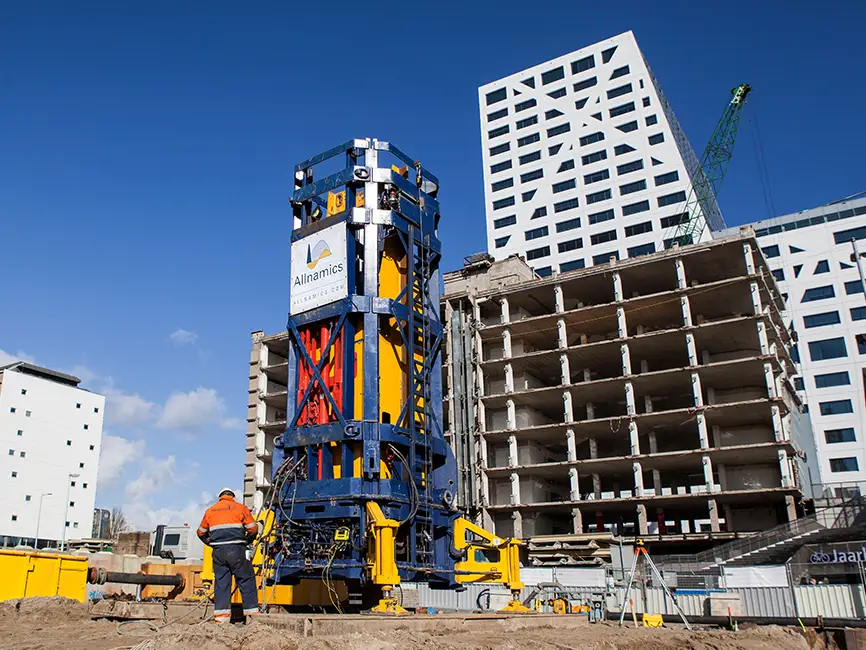
The introduction of the StatRapid in 2012 also contributed to the maturation of European practice. As a modular rapid load test device that generates force through a falling mass and a spring package rather than a combustion process, StatRapid offered more controlled load application and reduced peak stresses at the pile head. This made it particularly relevant for large in-situ concrete piles, and its adoption on projects such as the Barcelona case helped demonstrate the method’s practical range under European site conditions.
How Allnamics Supports Rapid Load Testing Projects
We have been involved in rapid load testing since its earliest European applications, and our team includes engineers who contributed directly to the development of the method and its interpretation frameworks. When your project requires high-capacity pile testing without the cost and complexity of a conventional static reaction system, we can help you determine whether rapid load testing is the right approach and execute it to the highest technical standard.
Here is what we bring to your rapid load testing program:
- Test design and parameter prediction: We assess your pile type, soil profile, required load level, and applicable standard to define the correct drop mass, spring configuration, and drop height before mobilizing to site.
- StatRapid equipment and operation: We own and operate the StatRapid device, a modular rapid load test installation that we developed in-house and that is particularly well suited to large-diameter in-situ concrete piles.
- Specialist interpretation: We apply the Unloading Point Method and, where soil conditions require it, more advanced non-linear damping approaches to convert measured rapid load response into reliable static-equivalent capacity.
- Compliance with current standards: We work in accordance with ISO 22477-10, NEN 7201:2025, and ASTM D7383, and we document our work to meet the requirements of your project’s regulatory framework.
- Comparison with other test methods: Where your project involves both rapid load tests and static or dynamic load tests, we provide integrated analysis that draws on all available data.
If you are planning a pile testing program and want to understand whether rapid load testing fits your project, contact our team to discuss your specific requirements.