


Yes, a rapid load test can load a pile to soil failure, provided the applied force is large enough to mobilize the full resistance of the surrounding soil. The test generates a controlled force pulse that pushes the pile downward, and if that pulse is sufficiently strong, the pile will reach its ultimate bearing capacity. However, reaching soil failure in a rapid load test requires careful planning, the right equipment, and specialist interpretation to translate the measured response into a reliable static equivalent capacity. The sections below address the most common questions engineers ask about this process.
How does Rapid Load Testing apply force to a pile?
Rapid Load Testing applies a controlled axial compressive force to a pile by accelerating a reaction mass and transferring the resulting impulse to the pile head over a relatively short but sustained period, typically between 50 and 200 milliseconds. This duration is long enough to suppress the stress wave propagation effects that dominate Dynamic Load Testing, but far shorter than the sustained load applied in a Static Load Test.
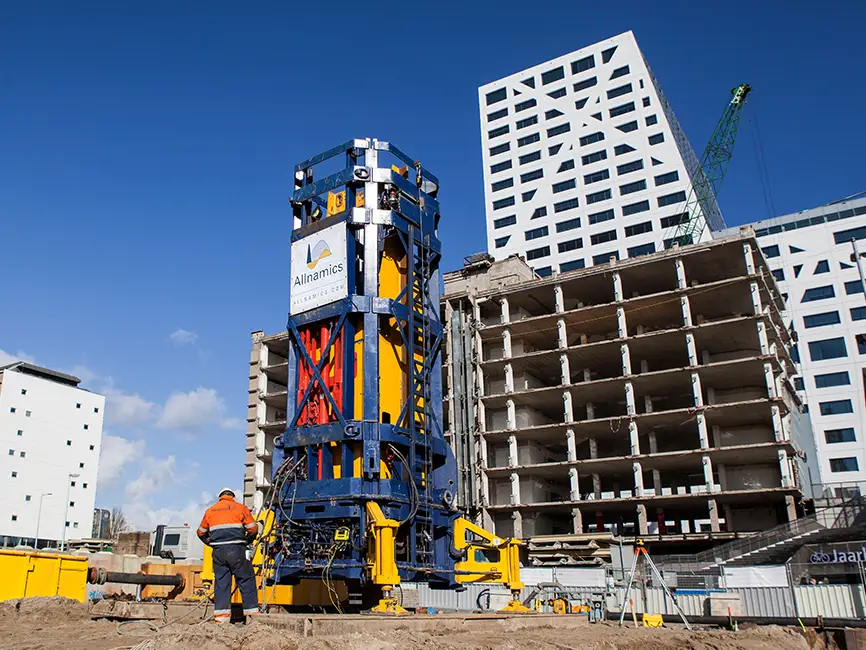
Two main execution approaches exist. The first, associated with the Statnamic method, uses gas pressure to propel a reaction mass upward, generating a downward force on the pile. The second uses a drop mass combined with a cushion or spring system to extend and shape the force pulse. Allnamics’ own StatRapid system uses a spring package that both prolongs the load duration and reduces peak stresses at the pile head, a particularly relevant advantage when testing large-diameter cast-in-situ concrete piles where high impact stresses could cause damage.
Because the load duration is long relative to the pile’s stress wave travel time, the pile can be treated approximately as a single moving mass during the relevant portion of the test. This simplifies the analysis considerably compared to Dynamic Load Testing, though the inertia of the pile mass must still be corrected for during interpretation.
What does ‘loading a pile to soil failure’ actually mean?
Loading a pile to soil failure means applying enough force to fully mobilize the available soil resistance, shaft friction along the pile length and end bearing at the pile tip, so that the pile undergoes a clearly defined settlement at or beyond the point where resistance no longer increases with displacement. This condition is commonly referred to as reaching the ultimate bearing capacity or the failure load.
In practice, soil failure does not always mean a sudden collapse. For many pile-soil combinations, resistance increases gradually with displacement and then levels off into a plateau. A test is considered to have reached failure when the load-displacement curve shows this plateau or when a defined settlement criterion is met according to the applicable standard.
This distinction matters for rapid load test interpretation. If the test does not drive the pile far enough into the soil to mobilize full resistance, the measured peak force does not represent the ultimate capacity. Standards including NEN 7201:2025 explicitly restrict extrapolating an unmeasured failure load from a load-displacement curve when the test has not reached a clear failure point. The pile must actually be pushed to the point of soil failure for the result to be used as a direct capacity measurement.
Can Rapid Load Testing reach ultimate pile capacity?
Yes, a rapid load test can reach ultimate pile capacity when the applied force pulse is large enough to overcome the combined shaft friction, end bearing, and pile inertia simultaneously. The test is not inherently limited to partial mobilization, it is a question of whether the equipment used can generate sufficient force for the specific pile and soil conditions.
The maximum force achievable depends on the reaction mass, the drop height or gas pressure used, and the stiffness of any spring or cushion system. For large-diameter piles carrying working loads of several meganewtons, the required test force can be substantial. The Barcelona case documented in technical literature illustrates this: large cast-in-situ piles with diameters of approximately 1.5 metres and working loads between roughly 6 and 8 MN were tested using the StatRapid system after a bi-directional static test failed to fully mobilize resistance due to suboptimal load cell placement.
Reaching ultimate capacity in the test is necessary but not sufficient on its own. The measured peak force during a rapid load test is not the static capacity. The raw measurement includes the inertial resistance of the pile mass and rate-dependent soil behaviour. These components must be removed through analysis, typically using the Unloading Point Method or a more advanced model, before a static equivalent capacity can be stated.
How does RLT compare to Static Load Testing for capacity assessment?
Static Load Testing remains the most direct method for measuring pile capacity because it applies load slowly enough that inertia and rate effects are negligible, what you measure is essentially the static soil resistance. Rapid Load Testing derives a static equivalent capacity from a short-duration dynamic event, which introduces additional interpretation steps and associated uncertainty.
That said, the two methods are often comparable in outcome when RLT is executed and interpreted correctly. The key differences are practical rather than purely technical:
- Reaction system: Static Load Testing requires a kentledge or anchor pile system capable of providing the full test load as a reaction. For high test loads, this can be expensive, time-consuming, and spatially demanding. RLT generates its own reaction through the accelerated mass, removing the need for a large external reaction structure.
- Speed: Multiple piles can be tested within a short period using RLT, which is difficult to achieve with static testing.
- Stress levels in the pile: For cast-in-situ concrete piles, RLT with a spring system produces lower peak stresses than Dynamic Load Testing, making it safer for piles with lower concrete strength.
- Interpretation complexity: Static test results are more straightforward to interpret. RLT results require specialist analysis to account for inertia and rate-dependent effects.
Both ISO 22477-10:2016 and NEN 7201:2025 recognize RLT as a valid alternative to static testing under defined conditions, including requirements related to the soil type around the pile tip and the test class applied.
What factors affect whether RLT can mobilize full soil resistance?
Several factors determine whether a rapid load test successfully mobilizes the full soil resistance of a pile. Understanding these factors helps your team plan the test correctly and avoid situations where the result cannot be used as a capacity measurement.
Equipment capacity and pile geometry
The reaction mass and drop energy must be large enough to generate a force that exceeds the combined pile inertia and soil resistance. For long, heavy, or large-diameter piles, this requires substantial equipment. The spring or cushion system also affects how the force is distributed over time, a stiffer system produces a shorter, sharper pulse, while a softer system spreads the load over a longer duration, which can be more appropriate for certain pile-soil combinations.
Soil type and loading-rate effects
Cohesive soils such as clay introduce a significant complication: soil resistance measured under rapid loading is higher than under slow static loading. This is known as the loading-rate effect. Research has shown that failure load in clay can increase measurably per logarithmic increase in loading rate, meaning the raw RLT result in cohesive soil will overestimate static capacity unless an appropriate correction is applied. The correction factor is not universal, it depends on soil plasticity, structure, overconsolidation ratio, and other site-specific properties. NEN 7201:2025 and ISO 22477-10:2016 both require that this rate dependency be addressed in the analysis, and in some cases a project-specific correlation with a static test may be needed.
Load duration relative to pile and soil wave characteristics
The force pulse must be long enough relative to the pile’s stress wave travel time for the pile to behave approximately as a single moving mass. However, wave and relaxation phenomena also occur in the surrounding soil, particularly around friction piles, meaning the required load duration is not determined solely by pile length and wave speed, but can also depend on pile diameter and the shear wave velocity of the surrounding ground.
When should engineers choose Rapid Load Testing over other methods?
Rapid Load Testing is most appropriate when high test loads are needed and a conventional static reaction system would be costly, slow, or physically impractical at the site. It is also a strong choice when multiple piles need to be tested within a short programme, or when Dynamic Load Testing is considered unsuitable due to the risk of high impact stresses in large cast-in-situ concrete piles.
Specific situations where RLT offers a practical advantage include:
- Sites with limited space for kentledge or anchor pile systems
- Projects requiring test loads of several meganewtons that would demand very large static reaction structures
- Large-diameter bored or CFA piles where the direct force measurement of RLT is preferable to the stress wave analysis required in Dynamic Load Testing
- Programmes where multiple piles must be tested efficiently within a defined time window
RLT is less straightforward in highly cohesive soils where loading-rate corrections are significant and where a project-specific correlation with a static test may be required by the applicable standard. In those cases, the choice between methods should be made in consultation with a specialist who can assess whether the rate correction can be reliably applied for the specific soil profile and pile type.
The applicable standard also matters. NEN 7201:2025, ISO 22477-10:2016, and ASTM D7383-19 each set conditions under which RLT results can be used as an alternative to static testing, and each places explicit limits on what can be concluded when full soil failure has not been reached in the test.
How We Support Rapid Load Testing Projects
We carry out rapid load tests for foundation projects across a wide range of sectors, from infrastructure and offshore energy to urban construction and port development. Our team combines decades of experience in pile testing with in-house-developed equipment and software, giving you both the technical execution and the specialist interpretation that RLT requires.
When you work with us on a rapid load test programme, we provide:
- Test design and planning: We assess your pile type, soil conditions, required test load, and applicable standard to determine whether RLT is the right method and what equipment configuration is needed to reach soil failure.
- StatRapid execution: Our StatRapid system uses a spring package that reduces peak stresses at the pile head, making it particularly suitable for large-diameter cast-in-situ concrete piles where impact-based methods carry a higher risk of damage.
- Specialist interpretation: We apply appropriate analysis methods, including inertia correction and loading-rate assessment for cohesive soils, to derive a reliable static equivalent capacity from the measured rapid load test response.
- Reporting aligned with standards: Our reports meet the requirements of NEN 7201:2025, ISO 22477-10:2016, and ASTM D7383-19, supporting regulatory compliance and independent technical review.
- Independent advice: Where site conditions or soil type make the interpretation uncertain, we advise on whether a correlation with a static test is needed and how to structure the testing programme to give you defensible results.
If you are planning a pile testing programme and want to assess whether rapid load testing is the right approach for your project, contact our team to discuss your specific conditions and requirements.
Gerelateerde artikelen
- Is there a Rapid Load Testing code for the United Kingdom?
- What causes discrepancies between static and dynamic test results?
- How does pile driving prediction prevent installation problems?
- How does stand-alone measurement work without a data connection?
- How does groundwater level affect pile load test results?