


Rapid Load Testing cannot fully replace Dynamic Load Testing, but it can serve as a valid and often superior alternative in many project situations. The two methods differ fundamentally in load duration, measurement approach, and the type of pile behavior they capture. Whether one can substitute for the other depends on pile type, soil conditions, and what your project actually needs to verify. The sections below break down the key differences, practical trade-offs, and decision criteria.
What are the key differences between Rapid Load Testing and Dynamic Load Testing?
The most important difference between a rapid load test and Dynamic Load Testing is the duration of the applied load. In Dynamic Load Testing, a hammer or drop weight delivers an impact lasting only a few milliseconds. In Rapid Load Testing, the load is applied over a period that is significantly longer, long enough to suppress the influence of stress wave propagation through the pile, but still much shorter than a conventional static test.
This distinction has direct consequences for how the pile behaves during the test and how the results must be interpreted:
- Stress wave behavior: In DLT, stress waves travel up and down the pile multiple times during a single blow, and wave equation analysis is required to interpret the data. In a rapid load test, the load duration is long enough that different sections of the pile move at roughly similar velocities, allowing the pile to be modeled as a concentrated mass under suitable conditions.
- Force measurement: DLT typically derives force from strain measurements combined with the pile’s elastic properties and cross-section. This introduces uncertainty, particularly for cast-in-situ concrete piles where material properties and geometry may vary. In Rapid Load Testing using Statnamic or StatRapid equipment, force is measured directly through a calibrated load cell, independent of pile material parameters.
- Load magnitude: RLT can generate very large forces without requiring a proportionally large permanent reaction structure, because the inertia of a moving mass provides the reaction. DLT relies on the energy delivered by the hammer, which limits the achievable force in some configurations.
- Data interpretation: Both methods require correction for dynamic effects. DLT uses signal matching and wave equation methods. RLT applies corrections for pile inertia and rate-dependent soil behavior, particularly relevant in cohesive soils.
Both methods sit between Static Load Testing and purely theoretical analysis, but they occupy different positions on the load-duration spectrum. Understanding where each method sits physically is the starting point for deciding which one fits your project.
When is Rapid Load Testing a valid alternative to Dynamic Load Testing?
A rapid load test is a valid alternative to Dynamic Load Testing when the pile type, soil conditions, and required load level make DLT technically difficult, risky, or less reliable. In practice, RLT tends to be the stronger choice in several specific situations.
Large-diameter cast-in-situ piles
For large bored or auger piles, the high-energy impacts required for DLT can generate stress levels that risk damaging the pile head or the pile body. A practical example from a project in Barcelona illustrates this: large in-situ concrete piles with a diameter of approximately 1.5 meters were tested using StatRapid Rapid Load Testing after a bi-directional static test failed to fully mobilize resistance. DLT was considered less suitable because the required impacts could have caused unacceptably high stresses in piles with lower concrete strength. The spring package in the StatRapid system not only extends the load duration but also reduces peak stresses at the pile head, making it particularly relevant for this pile type.
High required test loads
When the required test load is very high, assembling a DLT setup capable of delivering sufficient energy becomes challenging. RLT generates large forces through the inertia of a falling mass, which means you can reach high load levels without proportionally scaling up the equipment in the same way.
Situations where direct force measurement adds confidence
When pile material properties are uncertain, the indirect force derivation used in DLT introduces additional uncertainty. If your project involves piles where concrete quality or cross-section geometry is variable, the direct load cell measurement used in RLT provides a more reliable force record.
What are the limitations of Rapid Load Testing compared to Dynamic Load Testing?
Rapid Load Testing has real limitations that prevent it from being a universal replacement for Dynamic Load Testing. The most important is that the measured peak force during an RLT cannot be used directly as the static bearing capacity. The measured response includes pile inertia effects and rate-dependent soil resistance, both of which require correction before a static equivalent can be derived.
In cohesive soils, this correction is particularly demanding. The mobilized soil resistance during a rapid load test can differ significantly from the resistance that would be measured in a slow static test, because fine-grained soils exhibit rate-dependent behavior. Applying the correction methods correctly requires experienced interpretation, and the uncertainty in the result is generally higher than for a well-executed static test.
DLT also has a practical advantage in certain installation monitoring contexts. Because DLT uses existing driving equipment, it can be performed during or immediately after pile installation without additional mobilization. This makes it efficient for checking pile integrity and capacity on a large number of piles during a driving program. RLT requires dedicated equipment to be set up at each test location, which affects how it fits into a construction program.
Additionally, the standards governing RLT, including ISO 22477-10:2016 and NEN 7201:2025, define specific criteria that must be satisfied for the test to be interpreted as a rapid load test rather than a dynamic impact test. If the load duration is insufficient relative to pile length and wave speed, the test falls outside the RLT framework and the simplified analysis no longer applies.
How do the cost and mobilization of RLT compare to DLT?
Dynamic Load Testing is generally faster and less expensive to mobilize than Rapid Load Testing, particularly when existing pile driving equipment is already on site. DLT can often be performed using the same hammer used for installation, which reduces additional equipment costs significantly. For large programs testing many piles, this efficiency advantage is meaningful.
Rapid Load Testing requires dedicated equipment, including a drop mass, spring system, and load cell assembly. Mobilizing this equipment adds cost and time compared to a DLT performed with on-site machinery. However, this comparison shifts when you consider the alternative: if the project would otherwise require a Static Load Test, RLT is typically faster and less expensive than assembling a full static reaction system, particularly at high load levels where the reaction structure becomes large and costly.
The cost comparison therefore depends on what RLT is being compared against. Relative to DLT with existing equipment, RLT costs more to mobilize. Relative to Static Load Testing at high loads, RLT is often the more economical option. Your project’s baseline, the required test load, and the number of piles to be tested all influence which method delivers the best value.
Which pile testing method gives more accurate bearing capacity results?
Static Load Testing provides the most direct measurement of bearing capacity because the load is applied slowly, the pile and soil respond under genuinely static conditions, and no dynamic corrections are needed. Both DLT and RLT require post-processing to derive a static equivalent, which introduces additional uncertainty compared to a direct static measurement.
Between DLT and RLT, neither method is universally more accurate. The accuracy of each depends on how well the analysis model matches the actual pile-soil behavior in the specific conditions tested:
- DLT accuracy depends on the quality of signal matching, the accuracy of assumed pile properties, and whether the full geotechnical capacity was mobilized during the blow. If the pile is not driven to sufficient set, or if material properties are uncertain, the result carries higher uncertainty.
- RLT accuracy depends on the quality of the inertia and rate-effect corrections. In granular soils, rate effects are generally smaller and the correction is more straightforward. In cohesive soils, rate-dependent behavior is more pronounced and the correction requires more careful analysis.
Research and comparative studies consistently show that when RLT is performed on suitable pile types in appropriate soil conditions and interpreted using validated methods, the results correlate well with static load test outcomes. The same is true for DLT when conditions are favorable. The method that gives the most reliable result for your project is the one best matched to your pile type, soil profile, and the questions you need to answer.
How Allnamics Helps You Choose and Execute the Right Pile Testing Method
Choosing between a rapid load test and Dynamic Load Testing is not a purely theoretical decision. It depends on your pile geometry, soil conditions, required test loads, program schedule, and what your client or regulator needs to see. We help you make that decision on a technical basis and then execute the chosen method to the highest standard.
Here is what we offer:
- Independent method selection advice: We assess your project conditions and recommend the testing approach that gives the most reliable result for your specific situation, without defaulting to a single method.
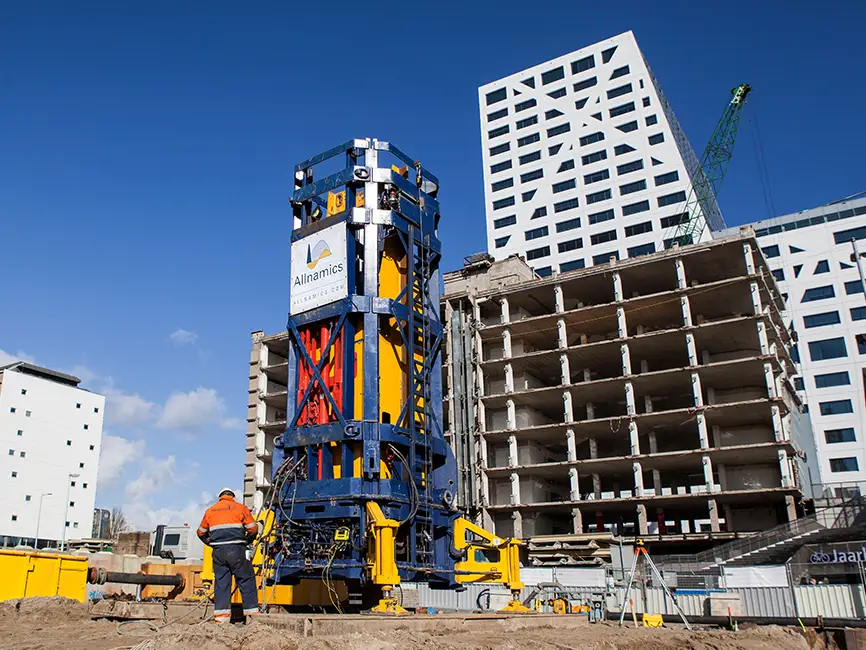
- StatRapid Rapid Load Testing: We developed and operate the StatRapid system, which generates the test load using a drop mass and modular spring package. This allows direct force measurement via a calibrated load cell and reduces peak stresses at the pile head, making it suitable for large-diameter cast-in-situ piles.
- Dynamic Load Testing and PDA: We perform DLT and Pile Driving Analysis for installation monitoring, capacity verification, and integrity assessment across a wide range of pile types and project scales.
- Expert data interpretation: Both RLT and DLT require experienced analysis. Our team interprets the results in the context of your soil profile, pile properties, and project requirements, and delivers conclusions you can act on.
- Compliance with current standards: We work in accordance with ISO 22477-10:2016, NEN 7201:2025, and other applicable standards, so your test results meet regulatory and contractual requirements.
If you are deciding which pile testing method fits your project, or if you need an independent technical review of your current approach, contact our team to discuss your specific situation.