


Rapid Load Testing (RLT) and Static Load Testing (SLT) both measure the axial capacity of a foundation pile, but they apply that load in fundamentally different ways. In a static test, load is applied slowly and held in increments; in a rapid load test, a controlled impulse lasting roughly 100 to 200 milliseconds generates the test force. The key practical difference is that SLT gives you a direct load-settlement curve, while RLT requires an interpretation step to convert the measured response into equivalent static behavior. The sections below unpack how each method works, what the results mean, and when one approach makes more sense than the other.
How does each test method actually load a pile?
Static Load Testing applies force to a pile head gradually, in defined load increments, using a reaction system such as anchor piles, kentledge ballast, or a reaction frame. The load is held at each increment while settlement is recorded, producing a direct measurement of how the pile moves under sustained force. The process is slow by design: each load step may be held for minutes or hours, so the pile and surrounding soil have time to respond as they would under real service conditions.
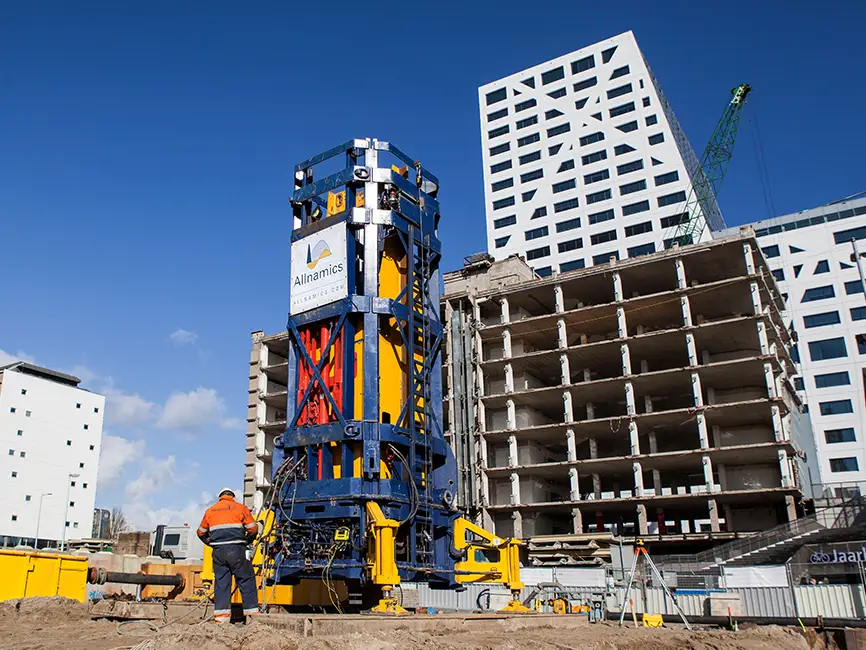
A rapid load test works differently. In the Statnamic variant, a propellant charge accelerates a reaction mass upward from the pile head, and the equal and opposite downward force loads the pile. In the StatRapid variant, a falling mass compresses a modular spring pack that transmits the impulse to the pile. Both approaches generate a load pulse lasting roughly 100 to 200 milliseconds, long enough to limit stress wave propagation along the pile shaft, but far shorter than any static increment. The force is measured directly at the pile head using calibrated load cells, which means the measurement does not depend on assumptions about the pile’s material properties or cross-section.
This distinction in load duration is not just a technical detail. It defines which physical phenomena dominate during the test and, therefore, how the results must be interpreted.
What do the test results tell you, and how are they interpreted?
Static Load Testing gives you a direct load-settlement curve. You can read the pile’s resistance at any load level without additional calculation. Rapid Load Testing gives you a force-time and velocity-time record that must be processed to separate the pile’s static resistance from inertial and damping components before you can draw conclusions about bearing capacity.
For SLT, interpretation is straightforward: the measured settlement at each load step is plotted against the applied load, and failure criteria defined in the applicable standard are applied directly to that curve. No signal processing is needed.
For RLT, the raw measurement includes three components acting simultaneously: the static soil resistance you want to quantify, an inertial force proportional to the pile’s acceleration, and a velocity-dependent damping force generated by the soil. The most widely used interpretation approach is the Unloading Point Method (UPM), which uses the point in the test where pile velocity reaches zero to isolate the static component. More advanced signal-matching methods are also available for complex soil profiles.
An important consideration in cohesive soils is the loading-rate effect. Clay and other cohesive materials can exhibit higher resistance under rapid loading than under slow static loading. This means the interpreted static capacity from an RLT in clay requires a rate correction, and in some regulatory contexts, a project-specific correlation with a static test may be needed to validate the correction factor applied.
Which method is more accurate for determining pile capacity?
Static Load Testing is generally considered the reference method for pile capacity because it directly measures load and settlement without requiring a conversion model. Rapid Load Testing can produce results that closely match SLT outcomes, but its accuracy depends on the quality of the interpretation method, the soil type, and whether loading-rate effects have been properly accounted for.
In granular soils and rock, the correlation between RLT and SLT results is well established, and the method performs reliably when applied correctly. In cohesive soils, the loading-rate effect introduces additional uncertainty that must be addressed through appropriate correction procedures.
It is also worth noting that RLT has one accuracy advantage over Dynamic Load Testing (DLT) for certain pile types. Because the force in RLT is measured directly via load cells rather than derived from strain measurements combined with assumed material properties, the force measurement is less sensitive to uncertainties in concrete quality or cross-sectional variation. This makes RLT particularly relevant for large-diameter bored or cast-in-situ concrete piles, where material variability is a realistic concern.
When is Rapid Load Testing preferred over Static Load Testing?
Rapid Load Testing is preferred when high test loads are needed but building a conventional static reaction system would be too costly, too time-consuming, or physically impractical on site. It is also attractive when multiple piles need to be tested within a short program.
Several specific situations favor RLT:
- High required test loads: Assembling kentledge or installing anchor piles for loads above 10 to 20 MN can be expensive and logistically complex. RLT can reach comparable load levels with a much smaller equipment footprint.
- Restricted access or limited headroom: Sites with space constraints, low overhead clearance, or difficult access make large reaction frames impractical. RLT equipment is more compact.
- Large-diameter cast-in-situ piles: As demonstrated in a Barcelona project involving piles of approximately 1.5 m diameter and working loads of 6 to 8 MN, RLT with StatRapid was selected because the spring pack reduces peak stresses at the pile head, lowering the risk of damage to concrete with moderate strength.
- Multiple piles in a short timeframe: RLT can be mobilized and completed faster per pile than SLT, making it efficient for acceptance testing programs covering several piles.
The suitability of RLT always depends on pile type, soil profile, the load level required, and the standard governing the project. In cohesive ground, the method remains applicable, but the interpretation requires careful attention to rate effects.
How do cost and logistics compare between the two methods?
Static Load Testing typically involves higher direct costs for reaction system construction, longer setup times, and more site space. Rapid Load Testing requires less infrastructure, mobilizes faster, and generally costs less per test, but the total cost difference depends heavily on the required test load and site conditions.
For SLT, the main cost drivers are the reaction system (anchor piles, kentledge, or a reaction frame), the time needed to install and dismantle it, and the duration of the test itself. At high load levels, these costs scale significantly.
For RLT, the equipment is self-contained and the test itself takes a fraction of the time. Setup is faster, and no permanent reaction infrastructure is left behind. However, the interpretation of RLT results requires specialist expertise, and in some project contexts, a reference static test may still be required alongside RLT to validate the rate correction applied in cohesive soils.
When testing multiple piles, the efficiency advantage of RLT compounds: the same equipment can move between pile locations quickly, whereas each SLT requires its own reaction setup.
Can Rapid Load Testing replace Static Load Testing on a project?
In many projects, yes: Rapid Load Testing can replace Static Load Testing as the primary acceptance or verification method, provided the applicable standard permits it, the soil conditions are suitable, and the interpretation is carried out correctly. In some cases, a combination of both methods delivers the most reliable outcome.
Standards such as ISO 22477-10 and ASTM D7383 provide formal frameworks for RLT, and national standards in several countries recognize the method for design verification. Whether RLT can fully replace SLT on a specific project depends on:
- The governing standard or contract specification
- Soil type: granular soils allow more straightforward substitution than cohesive soils
- The level of confidence required in the interpreted static capacity
- Whether the project involves pile types where direct force measurement is an advantage
In practice, RLT is sometimes used alongside a limited number of static tests: the static tests anchor the interpretation, and RLT extends the testing program to more piles at lower overall cost. This hybrid approach is common on large infrastructure projects where both statistical coverage and regulatory compliance are important.
How We Help with Pile Load Testing
We carry out both Rapid Load Testing and Static Load Testing for foundation projects across the full range of soil conditions, pile types, and load levels, onshore and offshore. Our team combines decades of experience in pile testing with in-house developed equipment, including the StatRapid system, which generates the test load through a falling mass and modular spring pack without combustion.
When you work with us, we help you:
- Select the right test method based on your pile type, soil profile, required load level, site constraints, and the standard governing your project
- Plan and execute the test program efficiently, including mobilization, instrumentation, and data acquisition
- Interpret results correctly, applying appropriate methods for rate effects in cohesive soils and providing clear, defensible conclusions for your design or acceptance process
- Combine methods where needed, for example using a reference static test to anchor an RLT program covering multiple piles
- Provide independent technical review if you need a second opinion on test results or interpretation from another party
If you are deciding between rapid load testing and static load testing for an upcoming project, or if you need specialist support for a complex foundation verification program, contact our team to discuss your specific situation.