


The set-up effect is the increase in pile bearing capacity that occurs after driving stops. When a pile is driven into the ground, the soil around it is disturbed and temporarily loses strength. Over time, that strength recovers and often exceeds the capacity measured immediately after installation. Understanding set-up matters for every project where driven piles are used, because it directly shapes how you design, test, and schedule your foundation program.
Why does pile capacity increase after driving stops?
Pile capacity increases after driving stops because driving disturbs the surrounding soil and generates excess pore water pressure. As that pressure dissipates and the soil reconsolidates around the pile shaft, skin friction recovers and grows beyond its pre-disturbance level. This recovery process is what geotechnical engineers call the set-up effect.
During driving, the pile forces its way through the soil, compressing and shearing the material around it. In fine-grained soils such as clay and silt, this generates high pore water pressures that temporarily reduce effective stress and, with it, the soil’s ability to grip the pile. The pile meets less resistance than it will in service, which means end-of-drive measurements significantly underestimate long-term capacity.
Once driving stops, two processes work together to restore and increase capacity. First, excess pore pressures dissipate as water migrates away from the disturbed zone. Second, the soil particles rearrange and consolidate against the pile surface, increasing contact stress and friction. In some soil types, additional aging effects such as thixotropic hardening and chemical bonding between soil particles and pile material contribute further gains on top of the consolidation-driven recovery.
The practical consequence is important: a pile tested immediately after installation will appear weaker than the same pile tested days or weeks later. Relying on end-of-drive resistance alone leads to conservative designs that waste material and cost, or to incorrect conclusions about pile performance.
Which soil types produce the most significant set-up?
The most significant set-up occurs in fine-grained cohesive soils, particularly soft to medium clays and silts. These soils generate the highest excess pore pressures during driving and take the longest to dissipate, which means the gap between end-of-drive capacity and long-term capacity is at its widest. In some clay profiles, long-term capacity can be several times higher than the capacity measured immediately after installation.
The degree of set-up depends on several soil characteristics:
- Permeability: Low-permeability soils such as clay retain excess pore pressure longer, extending the set-up period but also producing larger total capacity gains once dissipation is complete.
- Plasticity: High-plasticity clays tend to show more pronounced set-up than low-plasticity silts, partly because of stronger thixotropic effects and greater sensitivity to disturbance.
- Sensitivity: Sensitive clays that lose significant strength when remolded show the largest contrast between disturbed and recovered states, and therefore the greatest set-up potential.
- Organic content: Organic soils can exhibit complex time-dependent behavior that amplifies capacity gains beyond what consolidation alone would predict.
In granular soils such as sand and gravel, set-up also occurs but through different mechanisms. Pore pressure dissipation happens almost immediately because of high permeability, so the time-dependent gain is smaller and faster. However, aging effects, including stress relaxation, particle interlocking, and cementation at grain contacts, still produce measurable capacity increases over days to weeks. For driven piles in sand, set-up is real and worth accounting for, but it is rarely as dramatic as in clay.
Mixed soil profiles with alternating layers of sand and clay produce intermediate behavior. The overall set-up rate and magnitude depend on which layers contribute most to shaft friction and how quickly pore pressures in the finer-grained layers can drain through adjacent granular material.
How long does set-up take to reach full capacity?
The time required for set-up to reach full capacity ranges from hours in permeable granular soils to weeks or months in low-permeability clays. There is no single universal timeline because the rate depends on soil type, pile diameter, drainage conditions, and the magnitude of pore pressures generated during driving.
In sands and gravels, excess pore pressures dissipate within minutes to hours of driving stopping. Measurable set-up in these soils is largely complete within one to a few days, and restrike testing after 24 to 48 hours typically captures most of the available capacity gain.
In soft to medium clays, the timeline extends considerably. Pore pressure dissipation in low-permeability soils is governed by the drainage path length, which scales with pile diameter and the distance to permeable layers. For a typical offshore or onshore driven pile in soft clay, meaningful set-up continues for days to weeks, and full capacity may not be reached for several months. Waiting periods of 14 to 30 days before restrike testing are common in clay-dominated profiles, though the optimal waiting period should be determined based on site-specific soil data and pore pressure monitoring where possible.
Larger-diameter piles generate more disturbance and longer drainage paths, which extends the set-up period compared to smaller piles in the same soil. This is particularly relevant for large offshore monopiles and open-ended tubular piles, where the volume of disturbed soil around the shaft is substantial.
From a practical scheduling perspective, the waiting period between installation and testing is one of the three factors most strongly affecting the accuracy of dynamic load testing results for driven piles. Testing too early means the soil has not recovered its static resistance, and the measured capacity will underestimate long-term performance. Testing after an appropriate waiting period allows pore pressures to dissipate and soil resistance to reach a value representative of in-service conditions.
How is set-up measured and verified in practice?
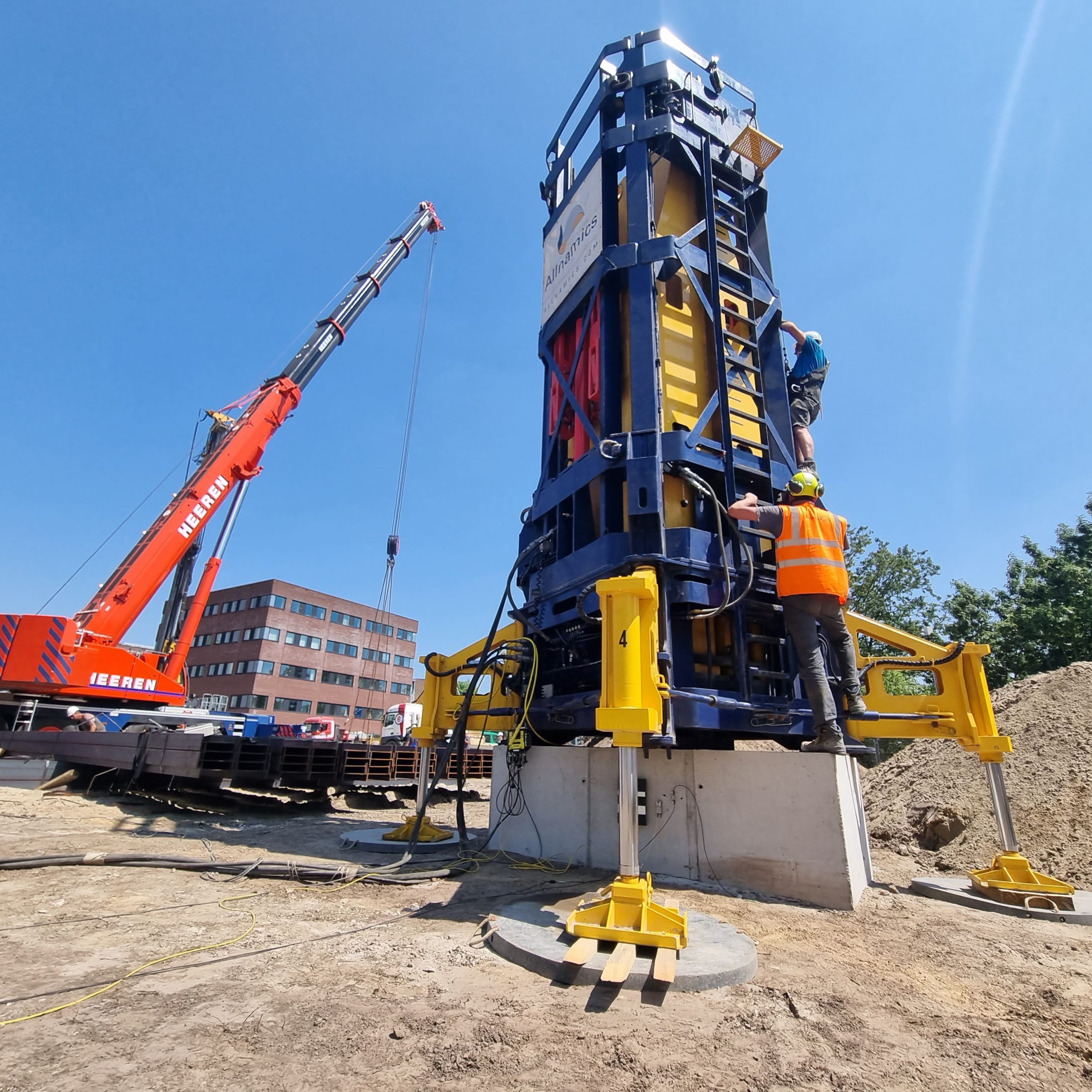
Set-up is measured and verified primarily through restrike testing, where a pile is re-struck with a hammer after a defined waiting period and the resulting force and velocity signals are analyzed to determine the recovered bearing capacity. Dynamic Load Testing (DLT) during restrike is the most widely used method for quantifying set-up on driven pile programs.
Restrike testing with dynamic load testing
During a restrike, sensors attached to the pile head measure strain and acceleration as the hammer delivers its blow. These measurements feed into signal matching analysis, which models how stress waves travel through the pile and interact with soil resistance along the shaft and at the toe. The result is a calibrated estimate of mobilized static capacity at the time of testing.
By comparing end-of-drive measurements with restrike results at one or more time intervals, your team can quantify how much capacity has been gained and whether the set-up process is still ongoing. Multiple restrikes at different waiting periods allow you to build a set-up curve for the site, which is useful for refining design assumptions and optimizing the installation and testing schedule for the rest of the pile program.
Pore pressure monitoring
Pore pressure dissipation can be tracked directly using piezometers installed in the soil adjacent to the pile. Monitoring pore pressure over time gives a direct indication of how quickly the soil is recovering and when capacity is likely to have stabilized. This approach is particularly useful on projects where waiting periods are constrained by schedule, because it provides evidence-based guidance on when restrike testing will yield representative results rather than relying on assumed timelines.
In practice, pore pressure monitoring and restrike testing are often used together. Pore pressure data tells you when to test; restrike data tells you what capacity has been achieved. Together they give a complete picture of the set-up process at your specific site.
How does set-up affect pile design and installation decisions?
Set-up affects pile design and installation decisions by allowing engineers to account for post-installation capacity gains when determining required pile length, cross-section, and installation criteria. Designs that incorporate set-up can be more efficient, using shorter or fewer piles to achieve the same load-bearing performance compared to designs based solely on end-of-drive resistance.
In design, set-up is typically incorporated through soil-specific set-up factors derived from local experience, comparative testing data, or site-specific restrike programs. These factors express how much capacity is expected to develop over time relative to the end-of-drive value. Applying appropriate set-up factors reduces conservatism in pile length calculations and can meaningfully reduce material quantities, installation time, and cost.
Installation decisions are also shaped by set-up. The end-of-drive criterion, which defines the blow count or set per blow at which driving stops, must account for the fact that the pile will gain capacity after installation. A pile that appears to have just reached the required resistance at end of drive may comfortably exceed design requirements once set-up is complete. Conversely, driving a pile to a higher end-of-drive resistance than necessary to compensate for uncertainty about set-up wastes energy and increases the risk of pile damage.
Set-up also influences the timing and scope of the pile load testing program. Testing too early produces results that underrepresent long-term capacity, which can trigger unnecessary remedial action or lead to overly conservative design revisions. Scheduling restrike tests after an appropriate waiting period, informed by soil conditions and pore pressure data, ensures that test results reflect the capacity the pile will deliver in service.
For projects in clay-dominated profiles, where set-up is large and slow, the interaction between installation schedule, waiting periods, and testing windows requires careful planning. Driving piles in a sequence that allows early-installed piles to set up before testing begins is a practical way to manage this without delaying the overall program.
How Allnamics Supports Set-Up Assessment and Pile Capacity Verification
We help you quantify set-up, plan your testing program, and verify that your piles achieve their required capacity after the soil has recovered. Our approach combines field measurement, signal matching analysis, and engineering judgment built on decades of experience with driven piles in a wide range of soil conditions.
Here is what we provide:
- Dynamic Load Testing during restrike: We perform DLT at carefully timed intervals after installation, using our own PDR measurement system and AllWave-DLT signal matching software to derive accurate estimates of mobilized static capacity at each stage of set-up.
- Set-up curve development: By testing at multiple waiting periods, we build a site-specific set-up curve that quantifies capacity gain over time and supports more informed design and installation decisions for the remainder of your pile program.
- Pore pressure monitoring: Where schedule or soil conditions make timing critical, we integrate pore pressure monitoring to track dissipation directly and determine when restrike testing will yield representative results.
- Rapid Load Testing and Static Load Testing: Where set-up is large and dynamic testing accuracy is limited by cohesive soil conditions, we recommend and perform Rapid Load Testing or Static Load Testing to provide a more direct and reliable measure of long-term pile capacity.
- Offshore and onshore capability: We carry out set-up assessment programs both onshore and offshore, including for large-diameter driven piles on wind farm and marine infrastructure projects where set-up is a significant factor in foundation performance.
- Independent technical review: If you need an independent assessment of set-up assumptions in an existing design or testing program, our engineers provide expert review and recommendations grounded in current best practice.
If set-up is a factor on your project and you want to make sure your testing program captures the right capacity at the right time, contact us to discuss your project requirements.
Gerelateerde artikelen
- What is the difference between Pile Driving Prediction (PDA) and a Vibratory Driving Prediction (VDP)?
- How is the maximum load controlled with Rapid Load Testing?
- How does ISO 22477 define pile testing procedures?
- How does stand-alone data logging work during monopile installation?
- How is a reference pile selected for a load test programme?