


A proof load test verifies that a pile can safely carry a defined working load without excessive settlement, while an ultimate load test pushes the pile to failure or near-failure to determine its maximum bearing capacity. The distinction matters because each test answers a different engineering question, and choosing the wrong one can leave your project with incomplete or misleading data. The sections below unpack what each test measures, when to use each approach, and what conclusions you can legitimately draw from the results.
What does each test actually measure?
A pile load testing program measures whether a pile performs acceptably under a specified load, typically expressed as a multiple of the design working load. It confirms that settlement remains within acceptable limits at that load level but does not reveal what happens beyond it. An ultimate load test measures the pile’s full load-displacement response up to failure or a defined failure criterion, exposing both shaft resistance and toe resistance.
In a proof load test, the applied load is held at a target level, often 1.5 to 2 times the working load, and displacement is monitored over time. The test ends once the pile demonstrates stable behavior at that load. You learn whether the pile passes or fails a performance threshold, but the actual reserve capacity above that threshold remains unknown.
In an ultimate load test, the load increases incrementally until the pile reaches geotechnical failure, structural failure, or a displacement criterion that defines failure for the project. The resulting load-settlement curve reveals the full picture: how shaft friction mobilizes at lower loads, how toe resistance activates at greater penetration, and where the pile transitions from elastic to plastic behavior. This data is far more valuable for calibrating design models and setting installation criteria for the rest of a pile program.
When should a proof load test be used instead of an ultimate load test?
A proof load test is appropriate when the primary goal is acceptance verification rather than capacity determination. If the pile design is already established and you simply need to confirm that installed piles meet a contractual or regulatory performance standard, a proof test is sufficient. It is also the practical choice when mobilizing enough load to reach failure is logistically or economically prohibitive.
Proof tests are common in urban construction projects where piles have relatively modest capacities and the reaction system can be sized to deliver 1.5 to 2 times the working load without excessive cost. They are also used for acceptance testing on production piles after an ultimate test has already been performed on a representative test pile earlier in the program.
An ultimate load test becomes necessary when you need to determine actual bearing capacity, validate design assumptions, or establish the relationship between load and settlement across the full range of pile behavior. This applies when entering unfamiliar ground conditions, when optimizing pile length or cross-section to reduce cost, when regulatory requirements demand capacity verification rather than acceptance verification, or when the consequences of foundation underperformance are severe. For offshore foundations, high-capacity piles, or projects where design optimization can generate significant savings, the additional investment in an ultimate test typically pays for itself.
How do the load levels and test procedures differ?
Proof load tests apply load to a defined target, typically 150% to 200% of the working load, hold it for a specified duration, and then unload. Ultimate load tests apply load incrementally beyond that point, continuing until failure or a defined displacement limit is reached. The procedural difference reflects the different questions each test is designed to answer.
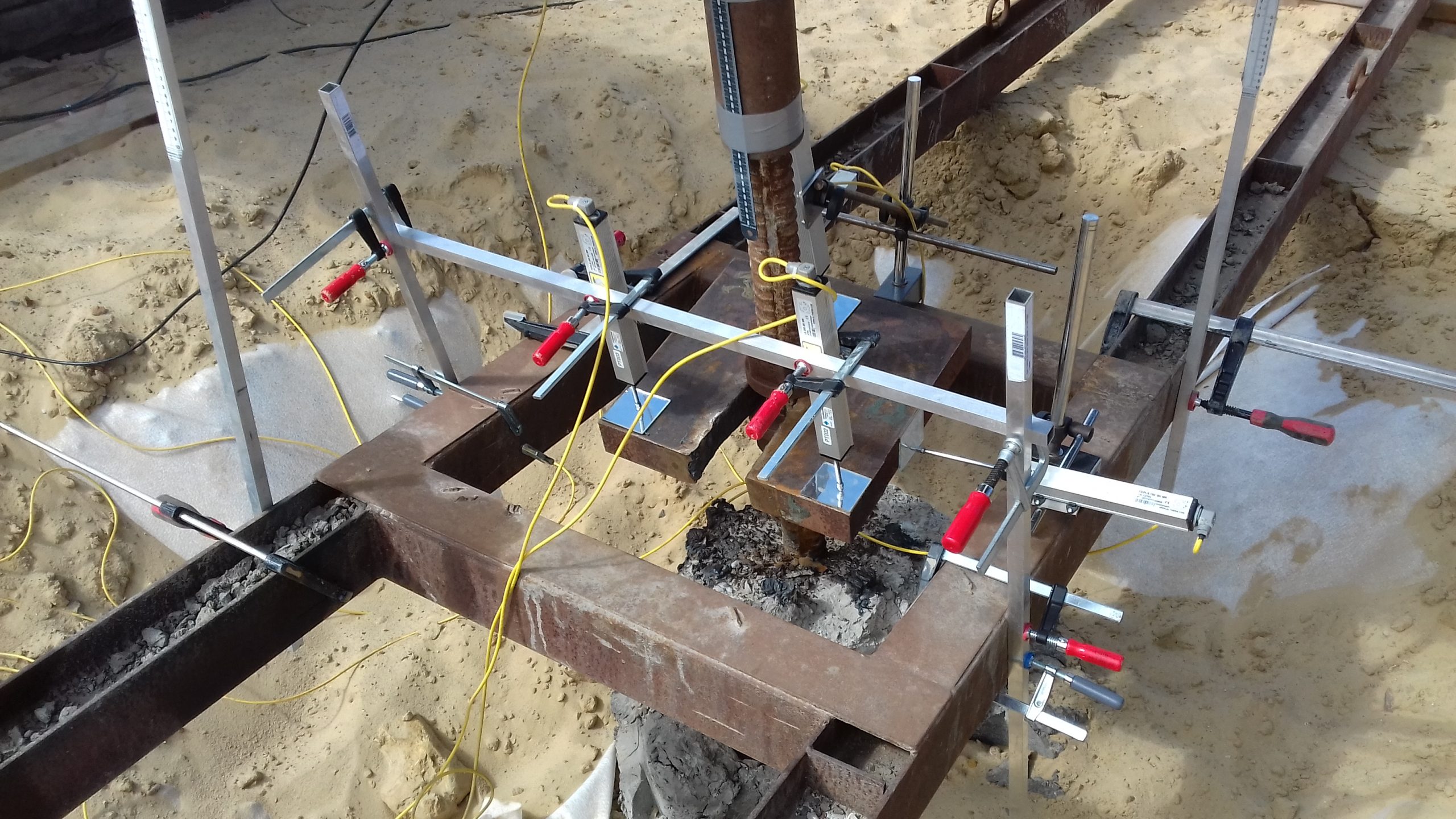
In a static proof load test, load is applied in increments using a hydraulic jack reacting against kentledge, anchor piles, or a reaction frame. Displacement is measured at each increment. Once the target load is reached and held, the pile must demonstrate that settlement stabilizes within the specified limit. If it does, the pile passes. The test is then unloaded, and elastic rebound is recorded.
A static ultimate load test follows a similar setup but continues loading beyond the proof load level. Load increments become smaller as the pile approaches failure to capture the transition accurately. The test ends when the pile reaches a failure criterion, such as a defined settlement at maximum load, a specified ratio of plastic to elastic settlement, or a load at which displacement accelerates without further load increase. The full load-settlement curve, including the post-peak response where it can be measured safely, is the primary output.
Both test types require a reaction system capable of delivering the target load, but an ultimate test demands a larger and more robust setup because the maximum applied load is higher and less predictable in advance. This is one reason why Rapid Load Testing has become a practical alternative for ultimate capacity determination: it eliminates the need for a large reaction frame by using the inertia of the pile and surrounding soil as the reaction, making high-load ultimate tests more accessible on constrained sites.
What can — and cannot — be concluded from each test result?
A proof load test tells you whether a pile meets a defined performance standard at a specific load level. It cannot tell you the pile’s actual bearing capacity, how much reserve exists above the tested load, or how the pile will behave if loads increase beyond the proof load in service. An ultimate load test provides all of that information but requires more load, more time, and a larger reaction system.
From a proof load test result, you can conclude:
- Whether the pile passed or failed the acceptance criterion
- The settlement at the proof load level and whether it falls within the specified limit
- The elastic rebound upon unloading, which gives a rough indication of load transfer behavior
You cannot conclude the ultimate bearing capacity, the distribution of load between shaft and toe, or the shape of the load-settlement curve beyond the tested load level. If the pile passes comfortably, you have no way of knowing whether the actual capacity is 10% or 100% above the proof load.
From an ultimate load test result, you can conclude:
- The ultimate bearing capacity or the load at a defined failure criterion
- The full load-settlement relationship, including the transition from elastic to plastic behavior
- The relative contribution of shaft friction and toe resistance, particularly if instrumentation is installed along the pile shaft
- Whether the pile design is conservative, accurate, or insufficient, enabling design optimization for the remaining program
Neither test type captures time-dependent behavior unless the load is held for extended periods at each increment. In cohesive soils, long-term creep and pore water pressure dissipation affect pile performance in ways that short-duration tests do not fully reveal. This is a limitation of both proof and ultimate static load tests unless the test protocol specifically includes extended hold periods at critical load levels.
Can dynamic or rapid load testing replace a static proof or ultimate test?
Dynamic Load Testing and Rapid Load Testing can replace a static proof or ultimate test in many situations, but not all. The suitability depends on pile type, soil conditions, the level of certainty required, and what the test result will be used for. For driven steel piles in granular soils, dynamic testing can estimate bearing capacity within 10 to 20% of static results. For bored cast-in-situ concrete piles in cohesive soils, that accuracy drops considerably.
Dynamic Load Testing (DLT) measures strain and acceleration at the pile head during hammer impact and derives bearing capacity through signal matching analysis. It is fast, cost-effective, and well-suited to large programs where testing many piles within schedule and budget is a priority. However, the results are inherently user-dependent because signal matching involves a large number of model parameters with no unique solution. Different engineers can produce equally plausible matches with different outcomes, creating a bandwidth of results. For cast-in-situ concrete piles, variable cross-section properties and uncertain material stiffness make this bandwidth significantly wider.
Rapid Load Testing (RLT) applies a controlled impulse load over a duration long enough to eliminate stress wave effects, producing a direct load-settlement measurement rather than a derived one. This makes it considerably more accurate than dynamic testing for a wider range of pile types, including bored piles and piles in cohesive soils. Rapid Load Testing can reach very high load levels, making it a practical alternative to static ultimate testing where mobilizing a large reaction system is difficult or expensive.
Static load testing remains the most direct and interpretively straightforward method. Forces and displacements are measured independently using load cells and displacement gauges, producing an unambiguous load-settlement curve that requires no signal matching model. For projects with strict regulatory requirements, mandatory independent verification, or high-consequence foundations where interpretive uncertainty is unacceptable, static testing provides the clearest evidentiary record. Dynamic or rapid testing is best used as a complement to static testing, or as a replacement where the pile type, soil conditions, and required accuracy level make it technically justified.
How Allnamics Helps You Choose and Execute the Right Pile Load Test
We work with your team from the earliest planning stages to identify whether a proof load test, an ultimate load test, or a combination of methods is the right approach for your project. Our advice is grounded in the specific pile types, soil conditions, load levels, and regulatory requirements your project involves, not a one-size-fits-all recommendation.
Here is what we bring to your pile load testing program:
- Test program design: We define the appropriate load levels, test sequence, instrumentation requirements, and acceptance criteria based on your design assumptions and project objectives.
- Static Load Testing: We design and execute static proof and ultimate load tests in compression, tension, and lateral loading, using dedicated equipment built for high-quality load and settlement measurement.
- Rapid Load Testing: For high-capacity piles or sites where a large reaction system is impractical, we perform Rapid Load Tests using the StatRapid and Statnamic methods, reaching test loads up to 65 MN and beyond.
- Dynamic Load Testing: We perform DLT using our own PDA system and interpret results using AllWave-DLT, with signal matching carried out by experienced engineers who understand the limitations and conditions that affect accuracy.
- Independent analysis and reporting: We deliver clear, well-documented results that your team, your client, and regulators can rely on, with transparent interpretation of what the data does and does not show.
- Offshore and onshore capability: We operate globally, with experience across offshore wind, oil and gas, marine infrastructure, and civil construction projects.
If you are deciding between a proof and ultimate load test, or evaluating whether dynamic or rapid testing can meet your project’s requirements, contact our team to discuss the specifics of your project and get a clear recommendation.
Gerelateerde artikelen
- Why is load duration important with Rapid Load Testing?
- What challenges does saltwater exposure create for testing equipment?
- How do you choose the right pile load testing method in 2026?
- How is pile driving behaviour predicted before construction starts?
- What is the difference between the PDR and Quad PDR?