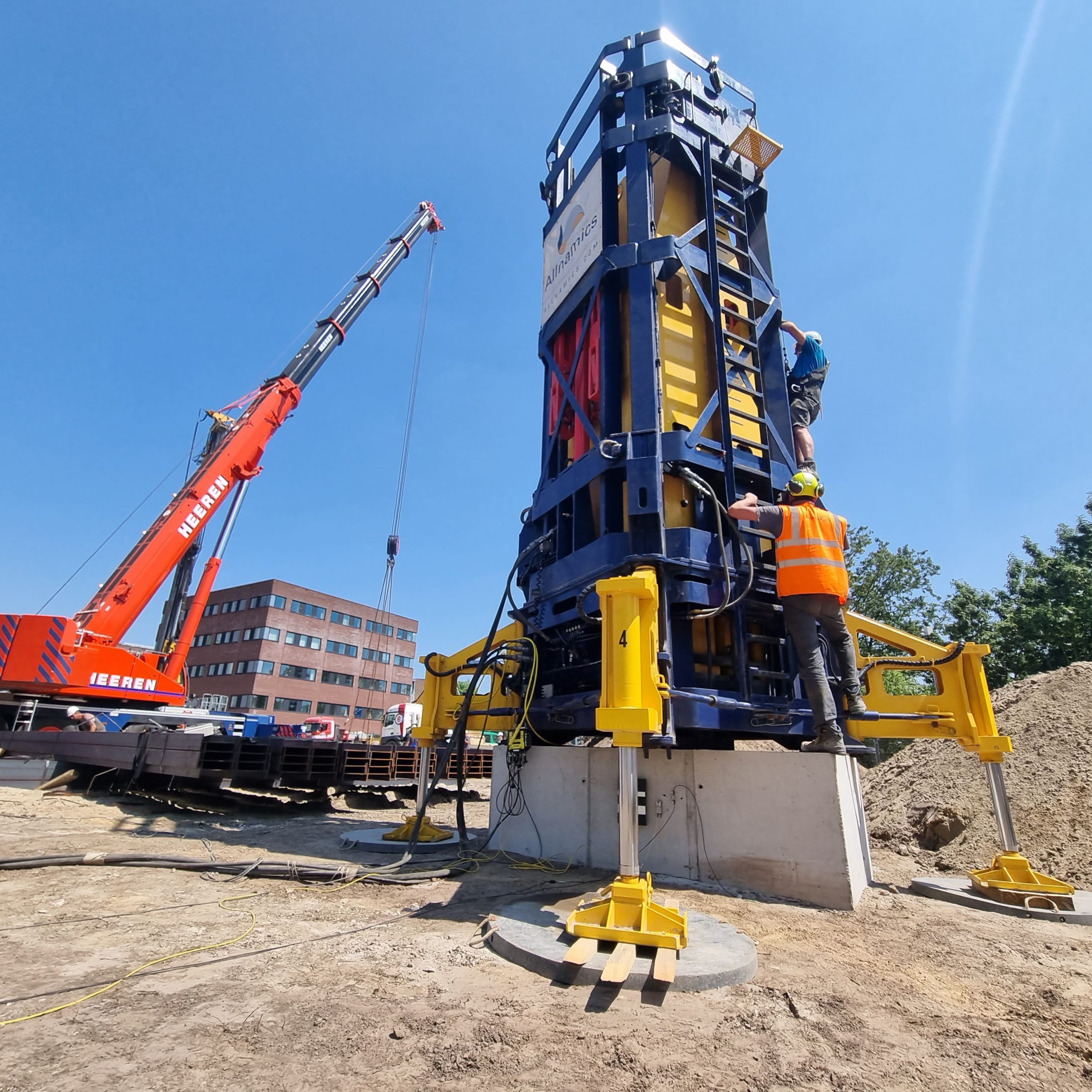



A maintained load test is a type of static pile load test where a load is applied to a pile in defined increments and held at each level for a set period before the next increment is added. It is the most direct method available for measuring how a pile responds to sustained loading, producing a clear load-settlement curve that reflects real-world foundation behavior. The sections below unpack how the procedure works, when to use it, and how it compares to alternative pile load testing methods.
How does a maintained load test actually work?
A maintained load test works by applying a vertical load to the pile head in controlled increments, holding each load level for a fixed duration while measuring pile head settlement, and then adding the next increment. The process continues until the target test load is reached, after which the load is released in stages and elastic rebound is recorded. This step-by-step approach captures the pile’s full load-displacement behavior under sustained conditions.
The load is typically applied using hydraulic jacks reacting against a kentledge (dead weight platform) or a system of anchor piles. A calibrated load cell measures the applied force directly, while displacement gauges or linear variable differential transformers (LVDTs) record settlement at the pile head with high precision. Because both force and displacement are measured independently and directly, the results require no interpretation model to produce a usable load-settlement curve.
During each load hold, engineers monitor whether settlement is still occurring or has stabilized. Most procedures define a settlement rate criterion, for example, less than 0.1 mm per hour, that must be met before the next load increment is applied. This waiting period is what distinguishes a maintained load test from faster loading approaches and is precisely what allows it to capture time-dependent soil behavior such as creep and consolidation.
What are the different maintained load test procedures?
Several standardized maintained load test procedures exist, each differing in how load increments are sized, how long each level is held, and what the acceptance criterion is for moving to the next stage. The three most widely used are the Standard Maintained Load Test, the Quick Maintained Load Test, and the Cyclic Loading procedure.
Standard Maintained Load Test
The standard procedure applies load in increments of roughly 25% of the design working load. Each increment is held until settlement stabilizes, which can take anywhere from one to several hours per stage depending on soil type. The total test duration often runs from one to several days. This approach is well suited to projects where long-term settlement behavior and creep characteristics are important design inputs, particularly in fine-grained or cohesive soils.
Quick Maintained Load Test
The quick maintained load test uses smaller increments, typically 10 to 15% of the working load, held for a fixed, shorter duration regardless of whether settlement has fully stabilized. Each hold period might be as brief as 5 to 15 minutes. The total test can be completed in a single working day. This procedure trades some time-dependent data for efficiency and is appropriate when the primary objective is confirming bearing capacity rather than characterizing long-term settlement.
Cyclic Loading
Some specifications require cyclic loading, where the pile is loaded to an intermediate level, unloaded, and then reloaded to a higher level. This approach provides additional data on elastic and plastic deformation, pile stiffness, and the behavior of the pile-soil interface under repeated loading. It is particularly relevant for piles subject to variable or repeated operational loads in service.
When is a maintained load test required or preferred?
A maintained load test is required or preferred when the project demands a direct, unambiguous measurement of pile capacity and load-settlement behavior under sustained loading. Regulatory frameworks, client specifications, or geotechnical design standards often mandate static load testing for high-consequence structures, piles in unfamiliar soil conditions, or projects where design assumptions carry significant uncertainty.
Specific situations where a maintained load test is the preferred approach include:
- Piles with relatively small capacities where mobilizing the full failure load with a static reaction system is practical and cost-effective
- Cast-in-situ concrete piles, bored piles, and continuous flight auger (CFA) piles where dynamic testing is less accurate due to variable cross-sections and material properties
- Fine-grained or cohesive soils where time-dependent behavior, creep, and pore water pressure dissipation significantly influence pile performance
- Projects with strict regulatory requirements where an independent, directly interpretable evidentiary record is needed
- Design calibration when the objective is to determine shaft and toe resistance factors separately, or to validate design models for a specific site
- Troubleshooting when an existing pile or foundation system is underperforming and the cause needs to be identified through direct load-displacement data
For piles with very high bearing capacities, particularly offshore driven steel piles, mobilizing enough static force to load the pile to failure becomes logistically difficult and expensive. In those cases, dynamic load testing or rapid load testing is often more practical, with static testing used selectively for calibration or verification.
What’s the difference between a maintained load test and other pile load tests?
The maintained load test differs from other pile load test methods primarily in how the load is applied, how long it acts, and what data it produces. Static load testing with maintained loading is the most direct method; dynamic and rapid load tests apply loads over much shorter durations and require additional analysis to derive equivalent static capacity.
Maintained load test vs. Dynamic Load Test (DLT): A dynamic load test applies a hammer impact lasting only milliseconds. Force and velocity are measured at the pile head, and bearing capacity is derived through signal matching analysis, a process that introduces user dependency and a bandwidth of possible outcomes. A maintained load test measures load and settlement directly, producing a load-settlement curve that requires no interpretation model. DLT is faster and better suited to driven piles with high capacities; maintained load testing is more reliable for cast-in-situ piles and cohesive soils.
Maintained load test vs. Rapid Load Test (RLT): Rapid load testing applies a controlled impulse over a duration significantly longer than a DLT blow, typically 50 to 200 milliseconds, which eliminates stress wave effects and improves accuracy compared to dynamic testing. RLT is faster and requires no reaction frame, making it more practical in many situations. However, a maintained load test still provides more direct time-dependent data and a simpler interpretive record, particularly where creep behavior under sustained load is a design concern.
Maintained load test vs. Bi-directional test: The bi-directional test applies load from within the pile rather than at the pile head, using a cell cast into the concrete. It is useful for large-diameter bored piles with high capacities where a conventional top-down reaction system would be impractical. The results are converted into an equivalent load-settlement curve, but this conversion involves assumptions that a standard maintained load test does not require.
What results does a maintained load test produce?
A maintained load test produces a direct load-settlement curve showing how pile head displacement changes as load increases. This curve is the primary output and provides engineers with a clear, unambiguous picture of pile stiffness, yield behavior, and ultimate bearing capacity without requiring a mathematical interpretation model.
From the load-settlement curve, engineers can extract several important values:
- Ultimate bearing capacity: The load at which settlement accelerates without bound, indicating failure of the pile-soil system
- Elastic and plastic settlement components: Derived from the loading and unloading cycles, showing how much deformation is recoverable
- Creep behavior: Observed during each load hold, indicating whether the pile continues to settle under constant load and at what rate
- Shaft and toe resistance distribution: When instrumented with strain gauges along the pile shaft, the test can separate the contribution of skin friction from end bearing at different depths
- Stiffness at working load: The slope of the load-settlement curve at the design working load, which informs serviceability calculations
Because both load and displacement are measured directly and independently using calibrated instruments, the results carry a high level of confidence and are straightforward to present to regulators, clients, and independent reviewers.
What are the limitations of a maintained load test?
The main limitations of a maintained load test are time, cost, and the logistical demands of the reaction system. Compared to dynamic or rapid load testing, a maintained load test requires significantly more setup, takes longer to execute, and is more difficult to apply to piles with very high bearing capacities.
Key limitations to consider include:
- Reaction system requirements: The test requires a kentledge platform or anchor piles capable of providing a reaction force equal to or greater than the maximum test load. For high-capacity piles, this becomes a major logistical and cost challenge, particularly offshore or in confined urban sites.
- Test duration: A standard maintained load test can take one to several days to complete, which affects project scheduling and increases mobilization costs.
- Limited pile coverage: Because of the time and cost involved, maintained load tests are typically performed on a small number of piles per project. They provide detailed data on tested piles but cannot economically cover an entire pile group the way dynamic testing can.
- Suitability for small-capacity piles: The method is most practical for piles where the required test load can be mobilized with a manageable reaction system. For very high-capacity piles, the cost of the reaction system may make alternative methods more attractive.
- Offshore application: Applying a maintained load test offshore adds significant logistical complexity, including the need for a vessel, a suitable reaction arrangement, and protection of instrumentation in a marine environment.
Despite these constraints, the maintained load test remains the reference standard against which other pile load test methods are calibrated. Where direct, time-dependent load-settlement data is needed and the logistics are feasible, no other method provides equivalent clarity and reliability.
How We Support Static Load Testing Projects
We design and execute maintained load tests for a wide range of project types, from urban building foundations to large infrastructure schemes, using equipment developed in-house to ensure high-quality load and settlement readings. Our approach covers the full scope of a static load test, from reaction system design and instrumentation to data acquisition and final reporting.
When you work with us on a maintained load test program, we provide:
- Test design and specification: We define the loading procedure, increment sizes, hold durations, and acceptance criteria based on your pile type, soil conditions, and project requirements
- Reaction system engineering: We design and mobilize kentledge or anchor pile reaction arrangements suited to the required test load and site constraints
- Precision instrumentation: We use calibrated load cells and displacement gauges to measure force and settlement directly, producing reliable data with no interpretation dependency
- Shaft instrumentation: Where needed, we install strain gauges along the pile to separate shaft friction from toe resistance and provide detailed load transfer data
- Independent analysis and reporting: We deliver clear load-settlement curves and a full technical report that meets regulatory and client requirements
- Integration with other test methods: Where a maintained load test alone is not sufficient or practical, we advise on combining it with dynamic load testing or rapid load testing for a more complete picture
If you are planning a pile testing program and want to discuss which approach fits your project, contact our team directly. We will help you select the right method, design the test program, and deliver results you can rely on.