


Pile testing supports decarbonisation in foundation design by generating the verified performance data that engineers need to reuse existing foundations rather than replace them with new ones. When a pile load test confirms that an existing foundation still meets structural requirements, the project avoids the carbon cost of new materials, new installation, and demolition of the old structure. The sections below unpack how this works in practice, from assessing reuse potential to monitoring installation for low-carbon outcomes.
What role do existing foundations play in reducing embodied carbon?
Existing foundations represent a significant store of embodied carbon that has already been spent. Reusing them instead of installing new piles avoids the carbon emissions associated with steel or concrete production, pile manufacturing, transport, and installation equipment. For large structures, the foundation system can account for a substantial share of a project’s total embodied carbon, making reuse one of the highest-impact decisions available to a design team.
The construction industry is under increasing pressure to reduce whole-life carbon, and foundation design is one area where meaningful reductions are achievable without compromising structural performance. When a building is demolished or repurposed, the piles below ground are often left in place. Those piles may have decades of remaining service life and capacity that has never been fully mobilised. Treating them as a reusable asset rather than a liability changes the carbon arithmetic of a project entirely.
This approach is particularly relevant for urban redevelopment projects, where sites have been built on repeatedly and existing pile fields are common. Rather than installing a new foundation system alongside or through the old one, engineers can assess whether the existing piles are capable of supporting the new structure, either alone or in combination with limited new elements. The carbon savings from avoiding even a partial new foundation installation can be substantial.
How does pile testing determine whether a foundation can be reused?
A pile load test determines foundation reuse potential by measuring the actual bearing capacity, stiffness, and structural integrity of existing piles under controlled loading conditions. The test results tell engineers whether the piles can carry the loads imposed by the new structure, and whether their performance remains within acceptable limits after years of service. Without this data, reuse decisions rely on assumptions that may be too conservative to justify or too optimistic to be safe.
The assessment typically begins with pile integrity testing, which uses stress wave methods to detect structural defects, cracks, or deterioration within the pile shaft. This establishes whether the pile is physically sound before any load is applied. If integrity is confirmed, a load test verifies capacity directly under real conditions rather than through calculation alone.
Existing piles often have incomplete or missing documentation. Original design records may not reflect what was actually installed, and soil conditions may have changed over time due to groundwater fluctuations, adjacent construction, or long-term consolidation. A pile load test for existing foundations bypasses these uncertainties by measuring how the pile actually behaves, not how it was predicted to behave decades ago. This direct evidence is what makes a reuse decision defensible to structural engineers, clients, and regulators.
Which pile testing methods are most relevant for sustainability assessments?
The most relevant pile testing methods for sustainability assessments are Pile Integrity Testing (PIT) for structural condition, Static Load Testing (SLT) for definitive capacity and settlement data, and Rapid Load Testing (RLT) where direct measurement is needed with less logistical complexity than a full static test. The right combination depends on the pile type, available access, and the level of certainty the reuse decision requires.
Pile Integrity Testing
PIT uses low-strain stress wave methods to identify defects, discontinuities, or changes in cross-section along the pile shaft. It is non-destructive, fast to perform across a large number of piles, and provides the first filter for a reuse assessment. Piles that show significant structural damage can be excluded from reuse consideration early, focusing resources on those with genuine potential.
Static Load Testing and Rapid Load Testing
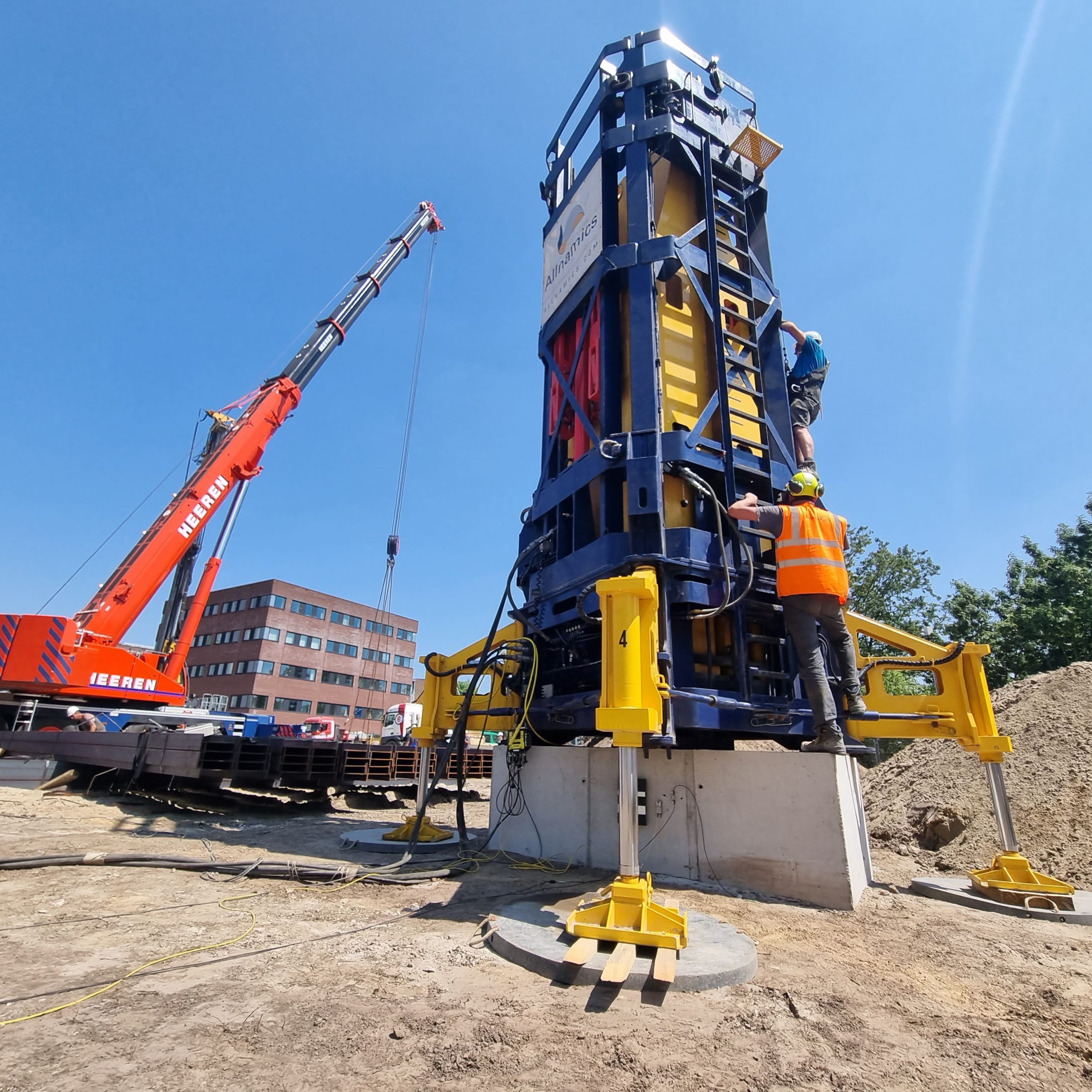
For piles that pass integrity screening, a load test confirms whether residual bearing capacity meets the demands of the new structure. Static Load Testing applies a sustained load and measures displacement directly, producing a load-settlement curve that is straightforward to interpret and accepted by all regulatory frameworks. Rapid Load Testing, including the StatRapid method, applies a controlled impulse load over a longer duration than a dynamic blow, eliminating stress wave effects and delivering high accuracy with a simpler setup than a full static test. Both methods generate the direct, unambiguous performance data that a sustainability-driven reuse assessment requires.
Dynamic Load Testing can also contribute, particularly where a large number of piles need to be assessed efficiently. However, for reuse decisions involving complex load transfer or bored piles, static or rapid methods provide more reliable results and a clearer evidentiary record.
What are the carbon savings when foundations are reused rather than replaced?
The carbon savings from foundation reuse depend on the scale of the project and the type of foundation being avoided, but the principle is consistent: every pile that does not need to be manufactured and installed removes its full embodied carbon from the project’s footprint. For a steel tubular pile, this includes the carbon embedded in steel production, fabrication, transport, and driving. For a concrete bored pile, it includes cement production, aggregate, reinforcement, and the plant required for installation.
Beyond the material carbon, reuse also eliminates the emissions associated with demolition and disposal of the existing foundation, which would otherwise need to be broken out, removed, and processed. In dense urban environments, this can involve significant plant, haulage, and waste management activity, all of which carry their own carbon costs.
The carbon benefit is not automatic. If the existing piles cannot carry the new loads and require reinforcement or supplementary new piles, the savings are partial. This is why accurate testing matters: it defines exactly how much of the existing foundation can be relied upon, allowing engineers to optimise the balance between reuse and new installation rather than defaulting to a full replacement out of caution.
When should pile testing be commissioned as part of a sustainability strategy?
Pile testing should be commissioned as part of a sustainability strategy at the earliest feasible stage of a redevelopment or refurbishment project, ideally during the feasibility or pre-design phase. Testing at this stage gives the design team verified data before structural decisions are locked in, maximising the opportunity to design around reuse rather than retrofitting a reuse strategy onto an already fixed design.
Commissioning testing too late is a common missed opportunity. If a new foundation design is already specified and procurement is underway, the window to substitute reused piles for new ones has largely closed. Early testing, by contrast, can shift the entire design approach and unlock carbon savings that would otherwise be unavailable.
There are also specific project triggers that should prompt a testing commission:
- A site with known previous construction where pile records are incomplete or absent
- A change of use that increases structural loads on an existing foundation
- A sustainability target or net-zero commitment that requires embodied carbon reduction
- A regulatory or planning requirement to demonstrate carbon performance
- An owner or developer seeking to maximise the residual value of an existing asset
In each of these situations, the cost of testing is small relative to the value of the decision it informs. A test that confirms reuse potential can eliminate the need for a new foundation system worth many times the testing fee, while simultaneously reducing the project’s carbon footprint.
How does pile monitoring during installation support low-carbon construction?
Pile monitoring during installation supports low-carbon construction by providing real-time data that allows the installation team to optimise driving energy, reduce the risk of pile damage, and confirm capacity as piles are driven. When monitoring shows that piles are consistently achieving higher capacity than predicted, the team can adjust installation criteria, potentially reducing pile lengths across the programme and cutting material use and associated carbon emissions.
Pile Driving Analysis (PDA) and Vibratory Driving Analysis (VDA) both serve this function. PDA monitors stress waves during impact driving, tracking hammer performance, pile stresses, and soil resistance in real time. VDA performs a comparable role for piles installed with vibratory hammers, monitoring penetration speed, hammer frequency, and pile fatigue. Both methods generate data that supports informed decisions during installation rather than after the fact.
The carbon relevance of this monitoring is direct. Piles that are driven too hard risk damage, requiring replacement and the full carbon cost of a new pile. Piles that are driven further than necessary consume more material than the design requires. Real-time monitoring keeps installation within the optimal range, reducing waste at both ends of the spectrum.
Monitoring data also builds a verified record of installation performance across the full pile programme. This record supports post-installation analysis, informs future projects on similar ground conditions, and provides the evidence base for any reuse assessment that may be conducted years later when the structure is eventually redeveloped.
How We Support Decarbonisation Through Pile Testing
We work with developers, structural engineers, and sustainability teams to generate the verified foundation data that makes low-carbon design decisions possible. Our approach to decarbonisation through pile testing covers the full assessment and monitoring workflow:
- Foundation reuse assessments: We combine Pile Integrity Testing with Static Load Testing or Rapid Load Testing to determine whether existing piles can carry new structural loads, giving your team the evidence needed to justify reuse to clients and regulators.
- StatRapid Load Testing: Our in-house developed StatRapid method delivers high-accuracy capacity data with a simpler setup than a conventional static test, making it practical for sites with access constraints or tight programme schedules.
- PDA and VDA monitoring during installation: We monitor driving stresses, hammer performance, and soil resistance in real time, allowing your installation team to optimise pile lengths and avoid damage, reducing material use and carbon output across the programme.
- Independent technical review: Where your team needs an independent assessment of existing foundation records or test data to support a sustainability case, we provide expert analysis and reporting.
- Offshore and onshore coverage: We deliver pile testing and monitoring services across both onshore and offshore environments, supporting renewable energy, infrastructure, and urban redevelopment projects globally.
If your project involves an existing foundation that may be suitable for reuse, or if you want to reduce the carbon footprint of a new installation through better monitoring, contact our team to discuss what testing approach fits your project stage and objectives.