


Pile load testing reduces foundation risk on complex projects by providing verified, site-specific data on how piles actually perform under load — rather than relying solely on design assumptions. This matters most on projects where soil conditions are variable, loads are high, or the consequences of foundation failure are significant. The sections below address the most common questions about how pile load testing works and what methods are available, and when to use them.
What types of foundation risks does pile testing address?
Pile testing addresses risks related to insufficient bearing capacity, unexpected settlement, and hidden defects in installed piles. These are the three failure modes that most frequently cause foundation problems on complex projects. Testing provides direct evidence of how piles behave under realistic load conditions, reducing reliance on conservative design assumptions that can either compromise safety or inflate costs.
Design models carry inherent uncertainties on any site, especially on projects with variable or poorly characterized ground conditions. Soil layers may behave differently from what soil investigation reports (based on CPT’s, SPTs, borehole data, etc.) suggests, and pile installation can alter the surrounding ground in ways that affect the load transfer. Without testing, these uncertainties accumulate and force engineers to apply larger safety margins or accept unquantified risk.
Pile load testing also addresses construction-related risks. Driving or boring piles can introduce defects such as cracks, necking, or soil inclusions that are not visible from the surface. Identifying these issues early prevents them from becoming structural problems after construction is complete.
How does pile load testing work on a complex project?
Pile load testing works by applying a controlled force to an installed pile and measuring its response in terms of displacement, strain, and load distribution. The data collected is then analyzed to determine the pile’s actual bearing capacity, stiffness, and integrity. On complex projects, this process is typically integrated into the construction program at defined verification stages.
The process begins with selecting representative test piles based on ground conditions, pile type, and load requirements. Instrumentation is installed to capture the pile’s response during the test. Depending on the method used, loads are applied statically over time, dynamically through impact, or rapidly through a controlled impulse device.
After testing, engineers analyze the data using signal matching software for DLT or direct interpretation methods for SLT and RLT. The results are compared against design predictions. Where discrepancies appear, the foundation design can be adjusted before full-scale installation proceeds. This feedback loop is what makes pile load testing a practical risk management tool rather than just a compliance exercise.
What’s the difference between static, dynamic, and rapid load testing?
Static load testing applies load slowly and directly to the pile head; dynamic load testing uses high-strain impact measurements; rapid load testing applies a short-duration impulse force. The methods differ in how load is applied, how long the test takes, and what information they produce.
Static load testing
Static load testing (SLT) is the most direct method. A load is applied incrementally using hydraulic jacks and a reaction system, and the pile’s settlement is measured at each load increment. This gives a clear load-settlement curve and is widely accepted as the reference standard for pile capacity verification. It is time-intensive and requires significant on-site setup, but it produces highly reliable results for critical or heavily loaded foundations.
Rapid load testing
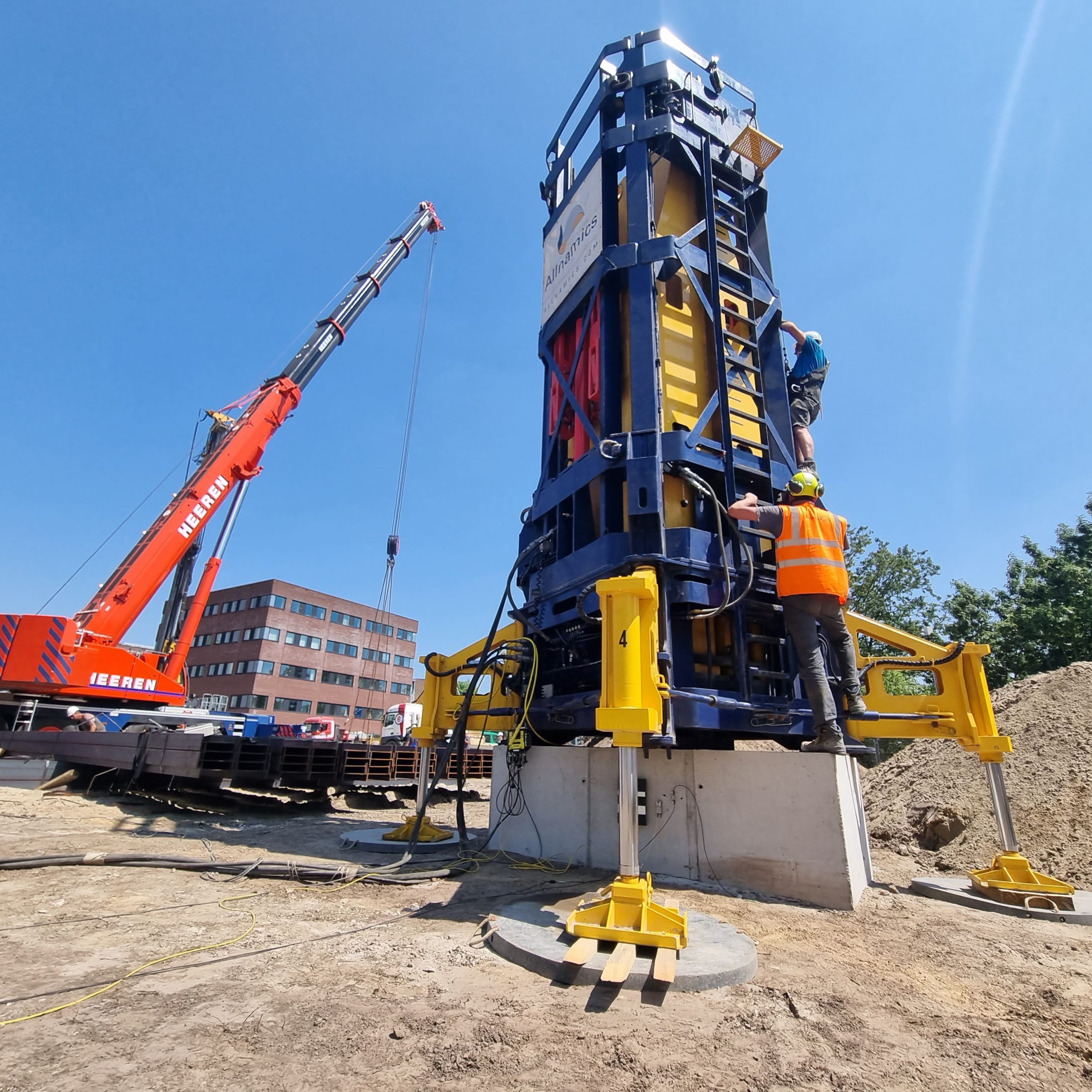
Rapid load testing (RLT) applies a force pulse lasting between 50 and 200 milliseconds, typically using a device such as the Statnamic or StatRapid system. The test duration is significantly longer than a dynamic impact but shorter than a static test. It requires a standardized method to account for inertia forces (see ASTM and Eurocode). RLT is well suited to replace SLTs (i.e.to sites where static testing is logistically difficult) and where a higher level of accuracy than dynamic load testing is needed.
Dynamic load testing
Dynamic load Testing (DLT) uses sensors attached to the pile to capture strain and acceleration data during a hammer impact. This data is analyzed using stress wave equation methods to derive a soil model. This soil model is used to estimate bearing capacity and soil resistance distribution. DLT is faster and less expensive than static testing, making it practical for testing larger numbers of piles across a site. It is particularly useful during pile installation, where it can be combined with Pile Driving Analysis (PDA) to monitor driving performance in real time.
When should pile load testing be carried out during a project?
Pile load testing should be carried out at three points: during the design phase as a preliminary test, at the start of production piling to verify installation, and during or after construction for Quality Assurance or if concerns arise. The timing depends on the project stage, the level of uncertainty in the soil behavior, and the consequences of underperformance.
Preliminary or trial pile testing before main installation begins allows the design to be confirmed or refined before large numbers of piles are installed. This is particularly valuable on projects where ground conditions are complex or where the pile type has not been used on similar ground before. The results of the load tests provide information to optimize foundation design, reduce costs, and lower material use, carbon emissions, and project time.
Production testing during installation provides ongoing quality assurance. Dynamic load testing and integrity testing can be carried out on a percentage of installed piles to confirm that performance meets design requirements. If anomalies appear, they can be investigated before the structure above is built.
Post-construction testing is sometimes needed when settlement observations, structural changes, or concerns about the quality of the original installation require investigation. In these cases, testing supports decisions about remediation, load redistribution, or continued safe use of the foundation.
How does pile integrity testing detect hidden defects?
Pile integrity testing (PIT) detects hidden defects by sending a stress wave down the pile and analyzing the reflected signal. Changes in pile cross-section, material quality, or continuity cause reflections that appear as anomalies in the signal trace. This allows engineers to identify cracks, necking, soil inclusions, or breaks without excavating or loading the pile.
The most widely used method is Sonic Integrity Testing (SIT), also called low-strain integrity testing. A small impact (hammer blow) is applied to the pile head, and a sensor records the resulting reflected waves. The wave travels down the pile at a speed determined by the pile material. Where the pile cross-section changes or a defect is present, part of the wave reflects back. The timing and amplitude of that reflection indicate the depth and severity of the anomaly.
Integrity testing is fast and non-destructive, making it practical for testing all piles, or at least a large number of piles, on a single project. It is most effective on slender piles with a high length-to-diameter ratio. For shorter or larger-diameter piles, or where defects are suspected near the pile toe, additional methods such as cross-hole sonic logging may be used to provide more detailed information.
Can pile load testing data support long-term foundation decisions?
Yes. Pile load testing data supports long-term decisions by establishing a verified performance baseline that can be referenced throughout the structure’s life. This baseline is useful for assessing changes in foundation behavior, evaluating reuse potential, and supporting decisions about structural modifications or load increases.
When a building or infrastructure asset changes use, is extended, or carries additional loads, the original design assumptions may no longer apply. Archived testing data allows engineers to assess whether the existing foundation can accommodate new demands without full retesting or conservative over-design.
Foundation reuse is an area where testing data has growing importance. Reusing existing piles rather than installing new ones reduces construction waste, lowers carbon emissions, and shortens project timelines. However, reuse decisions require confidence in the condition and capacity of existing piles. Testing data from original construction, combined with current integrity assessments, provides the evidence base needed to make that judgment responsibly.
For assets subject to ongoing monitoring, such as bridges, port structures, or offshore foundations, periodic load testing can be integrated into a broader structural health monitoring program. This allows gradual changes in foundation behavior to be detected early, before they become safety concerns.
How Allnamics Supports Pile Load Testing on Complex Projects
We provide the full range of pile load testing services, from initial test planning through to data analysis and design recommendations. Our team works with you at every stage of the project to make sure testing is integrated effectively into your construction program and delivers results you can act on.
Here is what we offer:
- Static Load Testing (SLT) for high-confidence capacity verification on critical foundations
- Dynamic Load Testing (DLT) and Pile Driving Analysis (PDA) for efficient production testing and real-time installation monitoring
- Rapid Load Testing (RLT) using our proprietary StatRapid device, suited to sites where static testing is not practical
- Pile Integrity Testing (PIT) and Sonic Integrity Testing (SIT) to identify defects in installed piles without excavation
- Foundation reuse assessments that combine testing data with engineering analysis to support sustainable project decisions
- Offshore pile testing and installation monitoring for wind energy, oil and gas, and marine infrastructure projects
- Developing and implementing a testing program to enhance foundation pile performance, lower risks, cut costs, minimize raw material consumption, decrease carbon emissions, and shorten installation time.
- Optimizing foundation design based on testing program results
We bring over 50 years of experience in foundation engineering, and our founders played a direct role in developing several of the testing methods now used as industry standards. Whether your project is onshore or offshore, in early design or already under construction, we can help you reduce foundation risk with testing that is fit for purpose.
Contact us to discuss your project and find out which pile testing approach fits your situation.